

Spyker Is Back With The 800-HP, Gold-Plated, Manual-Only C8 Preliator XXV Coupe

One of the most fascinating and visually stimulating automakers of the 21st century is Spyker, the Dutch supercar manufacturer that was founded in 1999 using the name of an innovative aircraft and automobile manufacturer that was around from 1880 to 1926. The reborn Spyker is most well-known for the C8, which used Audi power and had incredible design details like a propellor-shaped steering wheel and tons of polished aluminum.
Spyker came out with a bunch of different models, all of which were mid-engine showstoppers in a similar vein to the original C8 (sadly the planned SUV never got built), but the company had a tumultuous time to say the least. It went bankrupt twice, first in 2014 and then again in 2021. The last model it made was the 2016 C8 Preliator, of which only a couple of the planned 50-unit production run were built. Over the course of its modern history, only 255 Spykers were produced.
Now Spyker Cars has returned once again, with original founder Victor Muller back at the helm. During The Quail at Monterey Car Week, the automaker has revealed the new C8 Preliator XXV Coupe, an Audi-powered mid-engine supercar with a manual transmission, thoroughly modern chassis technology, gold brightwork, and all of the styling details that have made us love Spyker for the past 27 years.
Full disclosure: A couple days before its debut, Spyker invited me to drive to a studio in Long Beach so I could see the C8 Preliator XXV in person and chat with CEO Victor Muller for half an hour.
You don't have to get polished rose gold
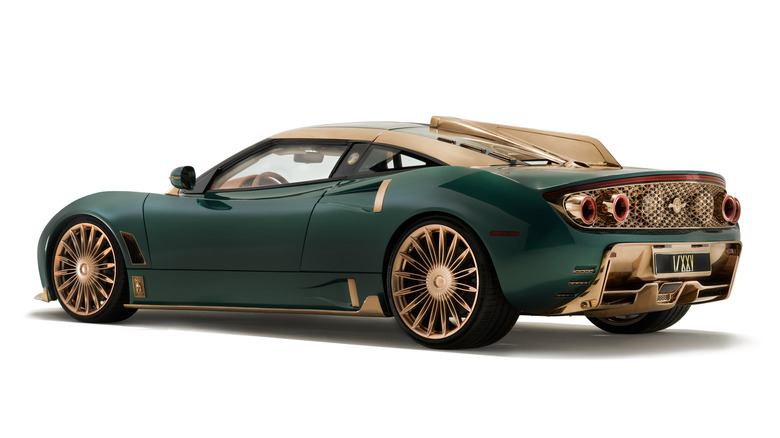
Before you dismiss this as another promised model that will probably never happen, the car you see here is production car number one, commissioned by Spyker's new co-owner, Ukrainian entrepreneur Volodymyr Nosov (who I also had the opportunity to talk to). Spyker will be hand-building 25 of these — thus the XXV in the name — with the next couple units set to be built later this year. On the outside it may look similar to the C8 Preliator we saw a decade ago, but under the skin everything is new and developed just for this car, and the skin is all new as well.
The aluminum spaceframe was engineered in-house in partnership with Coventry Prototype Panels, and the body is made from aluminum as well. One big change from prior Spykers is that the fuel tank is now in a trapezoidal space in the firewall between the engine and the seats, instead of there being two separate tanks in each door sill. This was done for U.S. crash regulations, and also because it's just better this way. There's still a fuel filler on each side of the car, though.
 Spyker
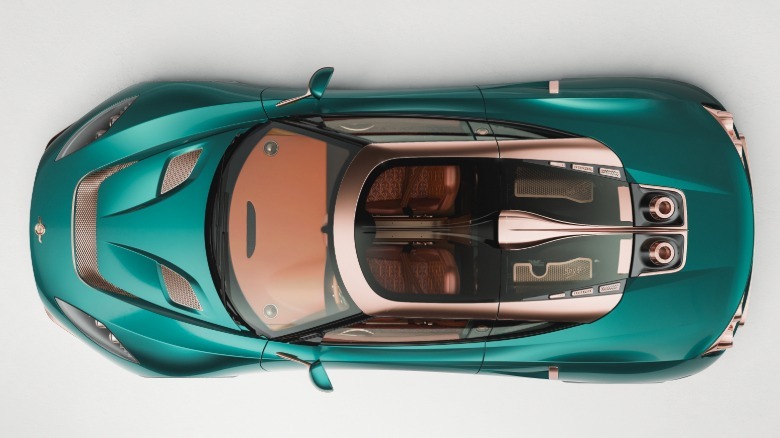
Sitting behind the occupants is Audi's twin-turbocharged 4.0-liter V8 found in cars like the RS6, but it has been modified by Audi tuner Abt to produce 800 horsepower and 738 pound-feet of torque, quite a bit more than it makes from the factory. Spyker says the car will be able to hit a top speed of more than 217 mph. Standard carbon-ceramic brakes will help bring the car down from such speeds. It should sound freakin' awesome too, thanks to the large top-exit exhaust tips poking out of the rear deck, a Spyker first.
It's a real manual
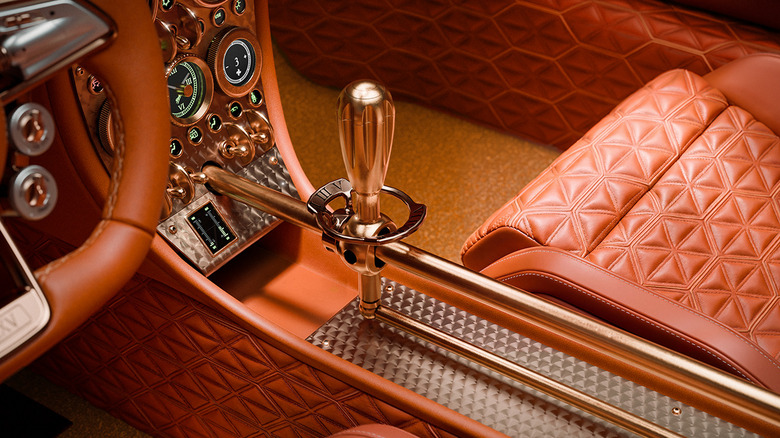
Though earlier Spyker models were offered with a 6-speed ZF automatic in addition to a manual, an option that Muller says was introduced because of demand in the U.S., times are changin'. The only transmission for the Preliator XXV is a six-speed manual. Muller threw some shade at the Ferrari 12Cilindri Manuale, telling me that Spyker's manual is the real deal, not an imitation. "If you make a mistake, you pay the price," he said, "this is how a real sports car should be."
And don't worry, you still get Spyker's iconic shifter linkage that runs down the center of the cabin. "We will never get rid of the exposed linkage as long as I'm alive, and also as long as he's alive," Muller said as he gestured at Nosov.
The car features an advanced tractive suspension with six different modes and a lift function; Muller says there's no stabilizer bars needed because the suspension is constantly keeping the car level. The pumps for the suspension also power the "butterfly mode" feature that opens the scissor doors and front and rear clamshells at the press of a button. The cargo space has been entirely moved to the frunk, and Spyker says because of the open sesame feature the engine bay "had to be designed to the same standard as the rest of the car" akin to "the movement of a fine Swiss watch."
Lots of aviation inspiration
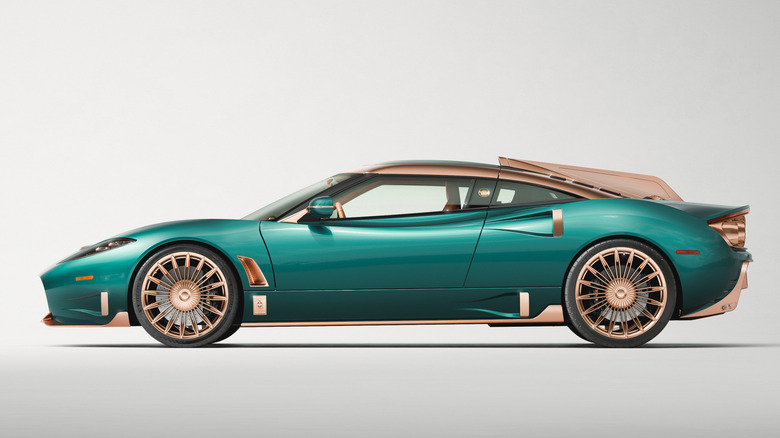
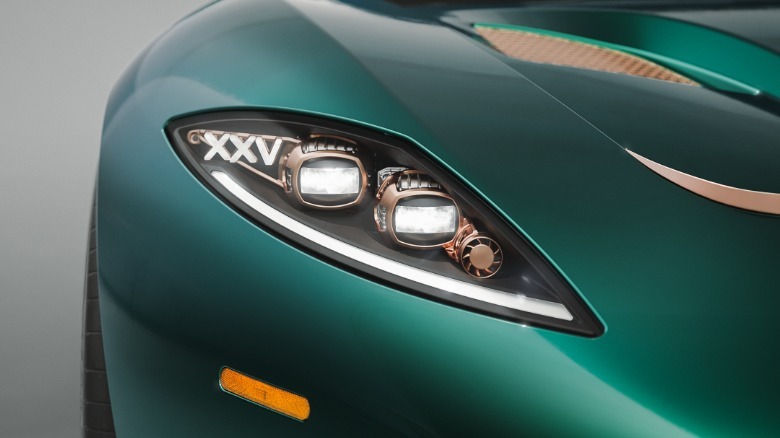
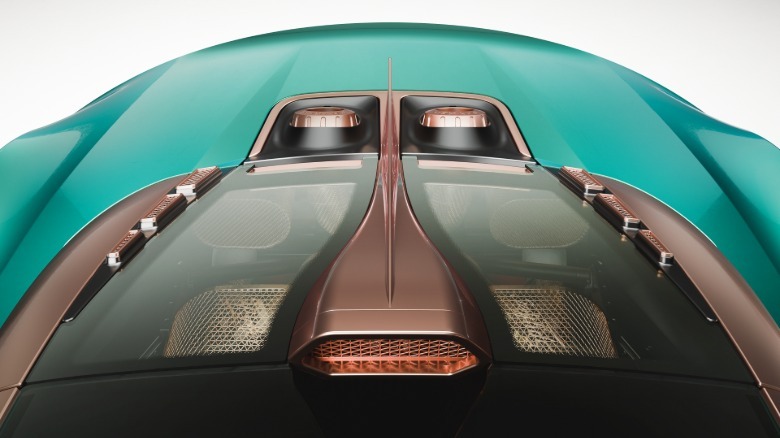
The Quail Green paint and polished rose gold color scheme of car number one (which is chassis number 270) won't be to everyone's tastes, but I thought it looked really awesome under studio lights, so surely it'll be even better when the actual sun hits it, especially given the rose gold flakes in the paint. Compared to the Preliator that was revealed a decade ago, the XXV has some new details like a reworked hood, headlights with illuminated 'XXV' lights in them, a redesigned diffuser that no longer houses exhaust tips, and some additional vents.
 Spyker
Complementing the top-exit exhaust is my favorite new design element: the tail fin, which has an integrated roof scoop at the front of it. It's a callback to the 1919 Spyker C1 Aerocoque's rear end that looked like that of a biplane. The sick afterburner-shaped taillights are another aviation-inspired styling element, and of course it's got propellor-style wheels. Perhaps the silliest design element is the plaque on the front fenders that features a Spartan helmet — Preliator means "warrior" in Latin — the car's name and its production number.
All of the grille mesh is made from 3D-printed stainless steel with an isogrid lattice pattern that's both super strong and light, also derived from the aircraft industry. The panel in the rear end, for instance, is made from nine different pieces welded together, which was then polished and gold-plated. (Muller says the process used to make it shiny gold adds a minuscule amount of weight.)
Everything is tactile
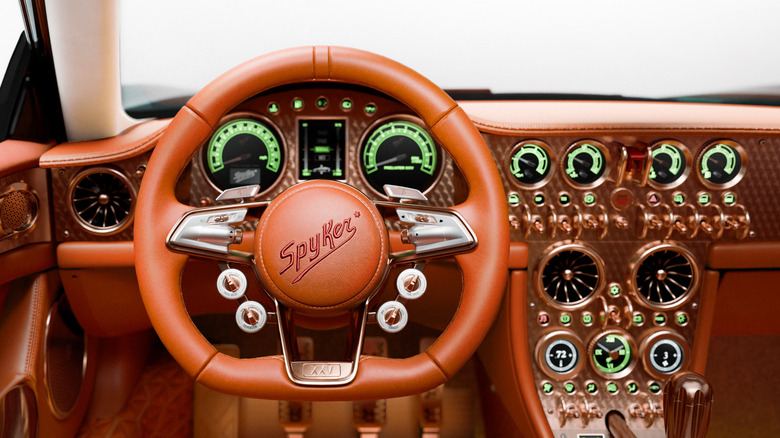
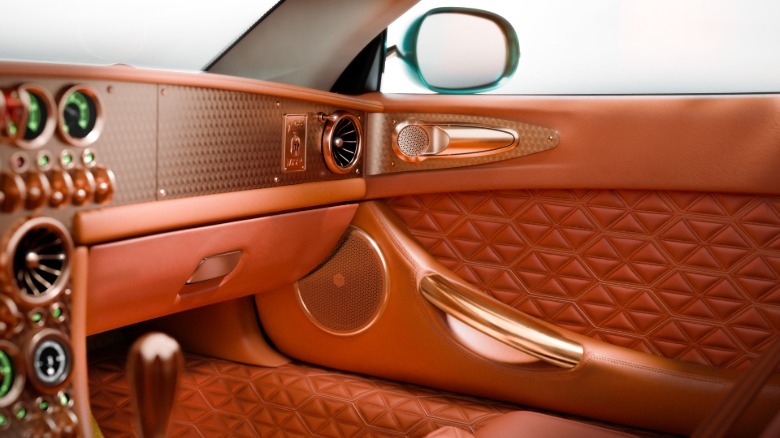
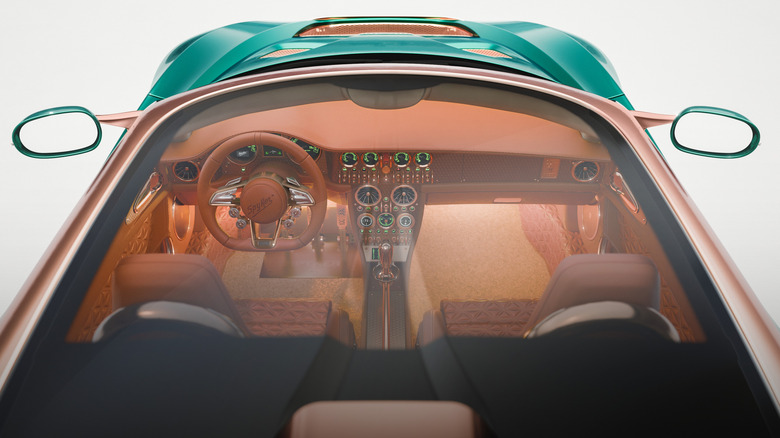
The C8 Preliator XXV's is as extravagant as you'd expect from Spyker, with this one being covered in Tuscan Saddle leather. The upholstery's stitching pattern matches the lattice mesh, and that technique is also used on the pedals and speaker grilles. There's not a single screen to be found in the turned aluminum dashboard, with the backup camera view being presented in the rear-view mirror. You get a bunch of gorgeous analog gauges and dials, tons of toggle switches that feel wonderful to click up and down, and turbine-like air vents. It's got a very low seating position, but the view out is actually pretty great, and the glass roof and engine cover stop it from feeling too cramped.
 Spyker
One of the most radical (for Spyker) bits is the steering wheel. Sadly, because airbags save lives the Preliator doesn't have the metal propellor design of early C8s, instead having a leather airbag cover with a vintage Spyker script stitched into it. Spyker got rid of the stalks, moving all the wiper and light controls to the steering wheel, incorporating Lamborghini-style turn signal buttons. There are two lovely metal vertical scroll wheels for volume and media controls, and then four knobs that adjust the drive mode, suspension, fan speed and exhaust loudness. It all looks and feels very cool.
It apparently takes 800 hours to hand-build a Spyker, 40 of which are just on creating the interior, and there are some really nerdy details:
The steering wheel is stitched with two needles at once, by one craftsman, over four hours. The dashboard, in turned aluminum, is a nod to the pre-1925 Spykers, milled by a workshop that has finished automotive parts since the same decade Spyker was founded in 1880. Even the screw heads inside the cabin are aligned by hand to face the same direction, a detail no owner will likely ever notice, which is precisely the point.
The best is yet to come
As of Tuesday, Muller said that 19 of the 25 Preliators had been spoken for, but by the time you're reading this they're surely all claimed. The first few cars will serve as a bit of a test bed for the rest of them, thus why the co-owner is getting this first one. There's currently 252 parts in the chassis, but Muller says that could be reduced by around 50 parts as development continues. This car weighs 3,362 pounds, but the goal is to hit 3,285 pounds. Car number five will be the first "real" production car, Muller says.
Speaking with Muller in the photo studio, he seemed really excited about the new car and the hopefully positive direction the company is taking. (He said he loves Jalopnik, too.) It does look really awesome, and could be awesome to drive. We won't have to wait long to find out, as this C8 Preliator XXV number one is ready to hit the road. I hope noted Spyker owner Missy Elliott is one of the 25 people who are buying one.
 Spyker
But want to know what's even more exciting than the Preliator launching? In the press release, Muller said, "The partnership with Volodymyr Nosov underlines the long-term ambitions of the brand and its shareholders, which extend from re-entering the endurance race arena to the development of the Spyker D8 Peking-to-Paris SSUV in the very near future." The D8 Peking-to-Paris is perhaps the most outrageous and perfect SUV ever conceived, and it was always such a shame that it never got made. If it really does happen now, that will fulfill so many peoples' childhood fantasies.