

The Vegas To Reno Legends Rally Is A Baptism By Dust For Novice Desert Racers
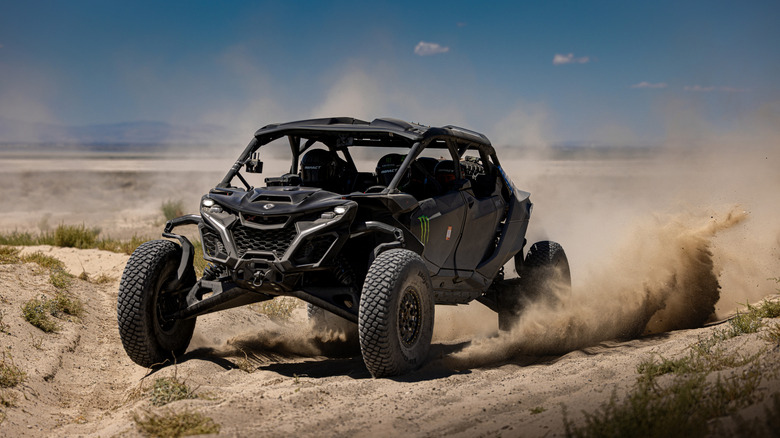
Could you imagine stepping up to the plate for batting practice in the Bronx with the New York Yankees, or pushing in a tackle sled alongside the Green Bay Packers at Lambeau Field? Very few sports would even consider giving fans the opportunity to practice alongside their stars. Despite featuring a far more inhospitable playing field, it's a different story for Vegas to Reno, the country's longest off-road race. Desert racing isn't like other sports, or even other forms of racing. It's one part cutthroat competition and one part communal adventure.
Three weeks ahead of this year's Vegas to Reno, the Best In The Desert Racing Association organized the inaugural Vegas To Reno Legends Rally. The event served two purposes: An official pre-running event for crews to scout the route before the main event and a non-competitive environment for amateurs to rub shoulders with the sport's stars. Despite the relatively fixed route, there was plenty to scout for the crew preparing for the marquee event. This year's race is being run "the other way," southward from Reno to Vegas, to commemorate the event's 30th anniversary.
Full disclosure: Bombardier Recreational Products paid for my flight out to Reno, put me up in a hotel for two nights and provided a 2026 Can-Am Maverick R MAX X RS so I could get part-way to Vegas.
Learning on the job is harder than it looks
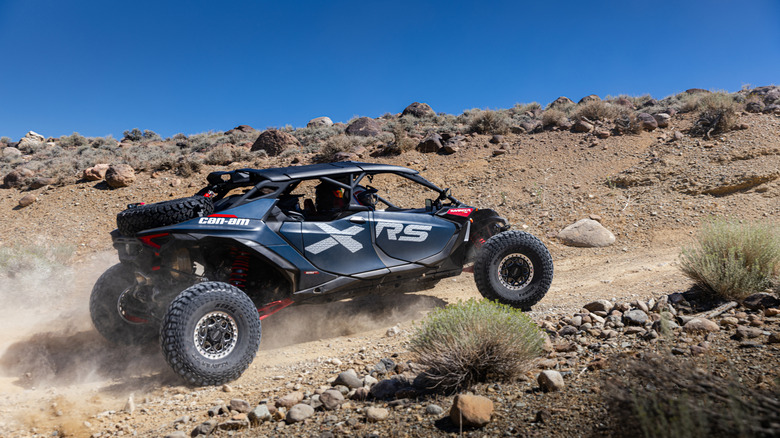
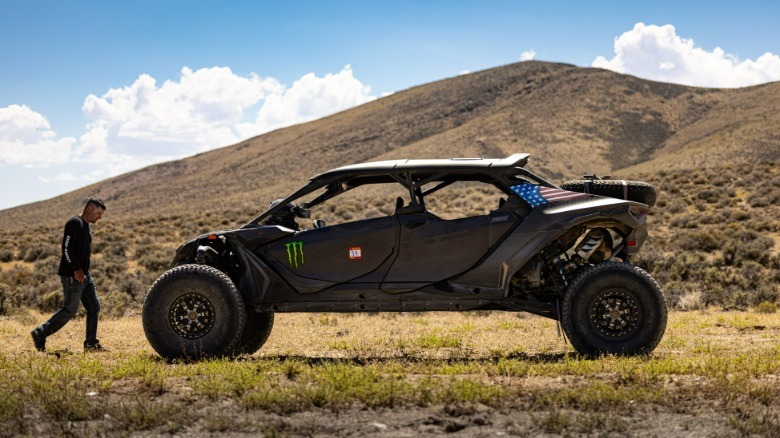
Admittedly, I was being thrown into the deep end of a completely foreign experience. All of my high-performance driving experience has come during track days on paved circuits. After riding shotgun for the rough and rocky opening miles, I climbed behind the wheel of a 2026 Can-Am Maverick R MAX X RS at a stop in Fallon, Nevada. The 2,658-pound side-by-side was enjoyably agile for its size, similar to a paved open-wheel car. It was a thrill to blast across the desert, slaloming between transmission towers.
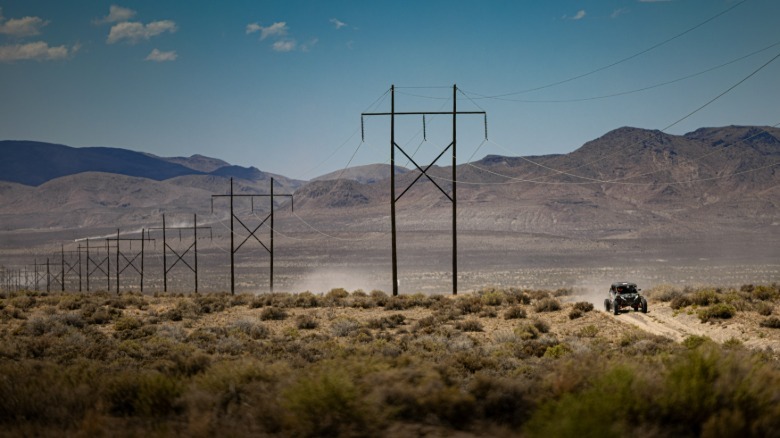 BRP / Justin W. Coffey
Sandy ruts carved through the ocean of brush were extremely useful for staying on the race route. However, it was tricky trying to hold the Maverick straight through the loose terrain. Little did I know that my cautiousness was causing my lack of control. Once I picked up my pace from 30 miles per hour to 40 mph, it felt like I was guiding a dart. My faster pace also meant I started to pass other drivers out on track, and that was much easier said than done. With the dust, a driver's visibility dips down to almost nothing once you pull up behind someone else. While I felt proficient, I soon learned what being dominant looked like on the Vegas to Reno course.
Practice makes perfect, even for champions
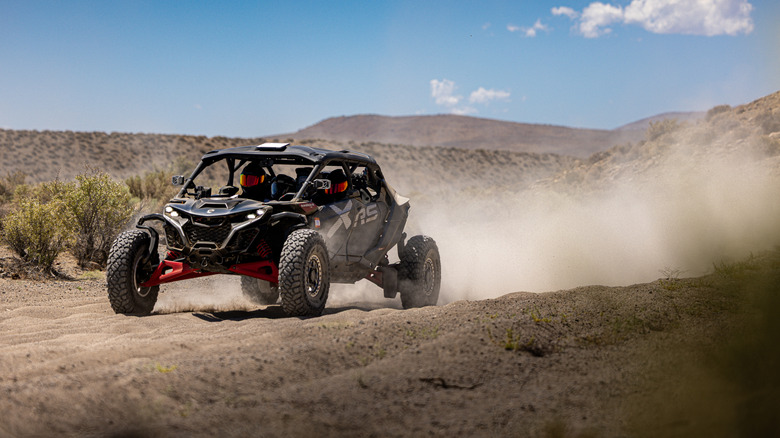
When my time driving was done, I climbed into the back seat of four-time Vegas to Reno winner Phil Blurton and his co-driver Jeff Gallegos. The multi-time UTV World Champion was essentially driving the same Maverick R MAX X RS I was, with a few modifications. They rigged an intercom and air conditioning system into the 240-horsepower side-by-side for their pre-run. Pulling on a full-face helmet with an orange-tinted visor, it felt like sitting in the back seat of a fighter jet. As Burton drove, Gallegos noted any hazards they should be aware of during the race. The professional duo used a color-coded system on a tablet-displayed digital map. Dangers were marked green, yellow or red, based on their severity.
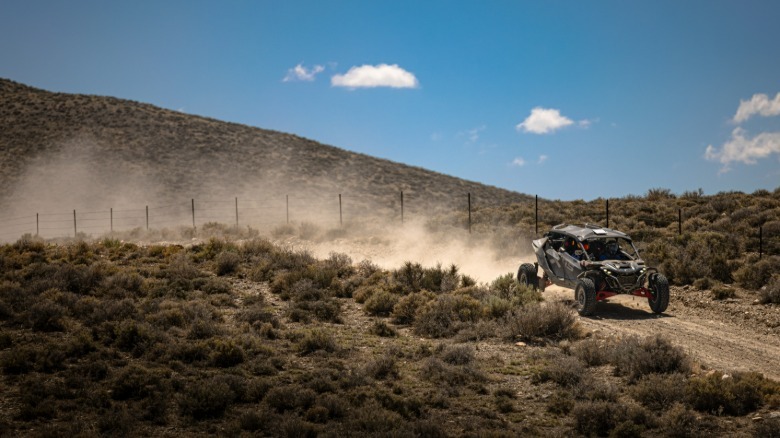
Blurton wasn't out of a Sunday drive either as he reached speeds over 90 mph. He called the segments after Fallon his favorite on the route. From a distance, the straight blasts across desert valleys were accented by hilltop turns. However, the expansive landscape with dust devils twirling in the distance is deceiving. The course isn't flat out. Managing your speed is a vital skill to quickly traverse the dips and rises, and it's safe to say that it's second nature to Phil at this point.
The only vehicles faster than us in the area were a pair of F/A-18 Hornets, with one soaring right by the Maverick. It wasn't completely unexpected with the route passing Naval Air Station Fallon, the home of the U.S. Navy Fighter Weapons School a.k.a. Top Gun. Blurton mentioned that it can be startling to be buzzed by a jet because you can't hear them until they fly past.
Passing can be a problem when almost any vehicle is allowed to enter
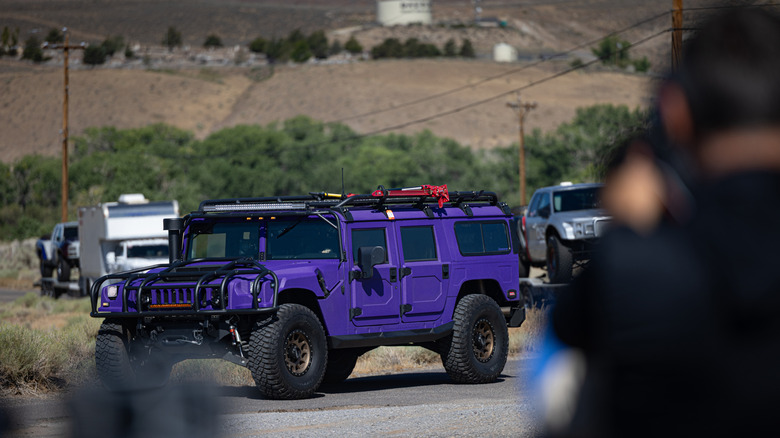
Circling back to passing, it can be especially difficult to get around someone else where the route is only two-car-widths wide at best. This is only complicated for the Legends Rally, which allows stock road vehicles out on the course. I knew it was rough terrain when we passed a purple Hummer H1 stopped with a wheel issue. There are rules in place to prevent slower racers from purposely holding up faster rivals.
Vegas to Reno proper and the Vegas to Reno Legends Rally utilize RacingTraX, a satellite transponder system. Every entry is required to run with a transponder, and the units can also broadcast messages. Crews can signal to the competitor ahead that they want to pass. While there isn't an obligation to move over, racers always keep a mental rolodex of who makes things more difficult than they need to be. Blurton's key to passing is simply intimidating the competitor ahead. He'll signal to pass, blare his horn and flash his lights all at the same time. If that fails, then the chrome horn is the last resort.
 BRP / Justin W. Coffey
I know I'm not ready for the main event, but Blurton is hoping that preparations will pay dividends in the form of a fifth victory. The 30th Anniversary Casey Folks Vegas to Reno will be run on August 14. If you're unable to make your way to Nevada for the race, you can follow the action online. The livestreamed broadcast will begin at 12:30 p.m. EST on YouTube, Facebook and Instagram.