

How Mazda Was Allowed To Race At Le Mans With A Banned Rotary Engine In 1991
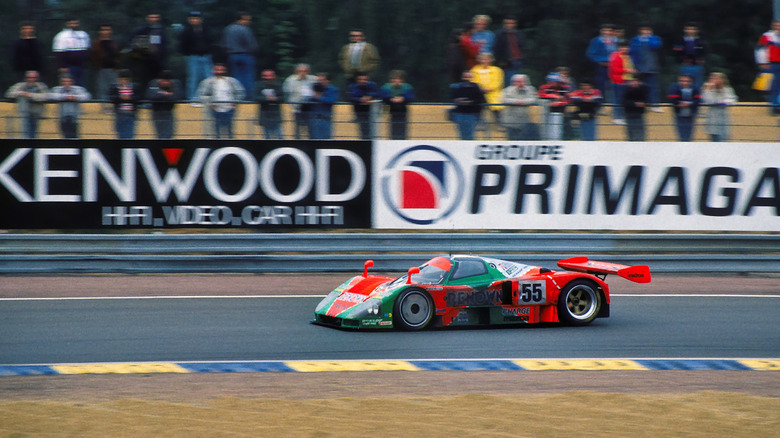
When Johnny Herbert crossed the finish line at Le Mans on June 23, 1991, he was driving one of the best race engines of all time — an engine that had essentially already been banned. The Mazda 787B's four-rotor R26B was the last rotary-powered car to race at Le Mans, and the team knew beforehand that the 1992 regulations would make the engine ineligible. What made Mazda's 1991 miraculous win possible was a combination of regulatory timing, a grandfathering clause, and a small but critical amendment that Mazdaspeed's team principal managed to extract from the governing body.
Rotary engines were not explicitly welcomed under the regulations that governed the era. They fell into a category of unconventional powerplants that the rulebook treated with increasing skepticism through the late 1980s. By the time the 1992 season approached, the Fédération Internationale du Sport Automobile (FISA) had made clear that rotary engines would no longer be permitted at Le Mans.
Mazda's 787B was grandfathered into the 1991 race under existing regulations before the ban took formal effect the following year. The team knew this was their final window. Mazdaspeed had been campaigning rotary-powered cars at Le Mans since the 1970s, with the factory effort beginning in earnest in 1983. By 1991, it had accumulated nearly two decades of hard-won development, and the regulatory clock was running out.
The amendment that mattered
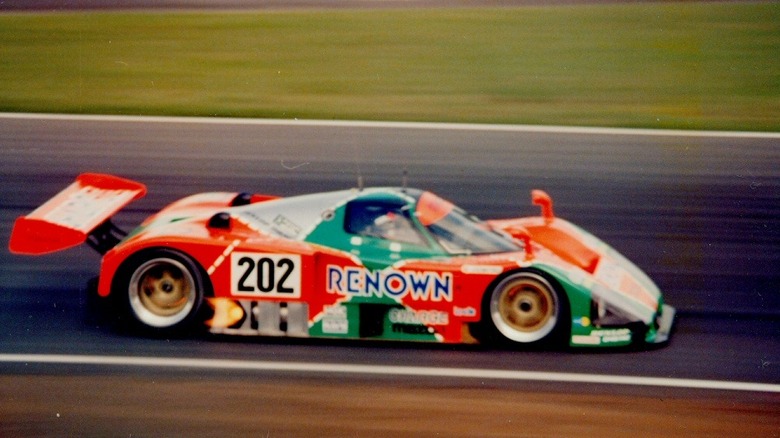
Racing at Le Mans in 1991 wasn't simply a matter of being allowed to show up. A new regulation required competitors to add ballast to their cars, a change that would have meaningfully impacted the 787B's performance. Mazdaspeed's team principal Takayoshi Ohashi successfully secured an amendment from FISA, allowing the 787B to run in its standard configuration while rivals were required to add the extra weight. It was a small regulatory victory, but in endurance racing, small advantages accumulate.
The 787B started from 23rd on the grid. Volker Weidler moved the car into the top ten by 6 p.m. on the first evening. By the race's midpoint, it was running third, and with three hours remaining it was in second place when the leading Mercedes-Benz suffered engine failure and retired. Mazda needed only to hold position.
The number 55 car completed 362 laps over the 24 hours, requiring just one oil top-up, a change of brake discs and pads, and one nose replacement across its 28 pit stops. The 700-horsepower four-rotor rotary — an engine that technically had no future at Le Mans — proved itself the most reliable machine at the race.
Despite being powered by an engine that would never race again, the 787B's victory marked the first overall Le Mans victory for a Japanese manufacturer and cemented the rotary machine's place among endurance royalty. It also set the stage for future Asian competition at Le Mans, including Genesis Magma Racing, whose successful Le Mans debut was thrilling to witness.