

This 18,000-RPM Marvel Is The Smallest Inline-6 A Manufacturer Ever Put In A Motorcycle
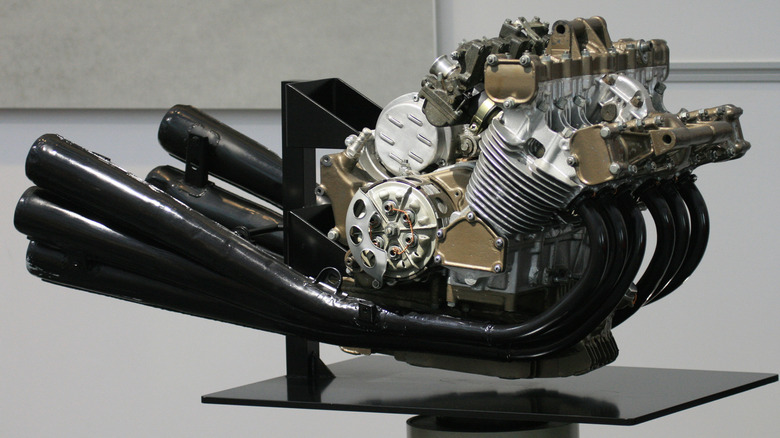
In the 1960s, Grand Prix motorcycle racing underwent a massive paradigm shift. Two-stroke motorcycles were dominating the circuit because every single rotation of a two-stroke engine crankshaft delivers a power stroke. Four strokes, by contrast, only generate power on every other crankshaft rotation, making them less mechanically efficient. Soichiro Honda, however, had made a firm, company-wide commitment to the quieter and cleaner-burning four-stroke engines, but to defeat the light and punchy two-stroke twins fielded by rivals such as Yamaha, Honda's engineers faced a complex task. To match the power output of a two-stroke, their four-stroke engine had to spin ridiculously fast without blowing up, and the radical answer came in the form of extreme miniaturization.
Designed under the leadership of a brilliant 24-year-old engineer Soichiro Irimajiri, Honda created the RC165 and its championship-winning evolution, the RC166. Displacing a tiny 245cc ( just under 15 cubic inches) across six compact cylinders, it was far smaller than the smallest displacement six-cylinder car engines, and remains the smallest inline-six engine ever produced by a major manufacturer. Good luck finding one that's smaller.
Inside Honda's 18,000-RPM jewel
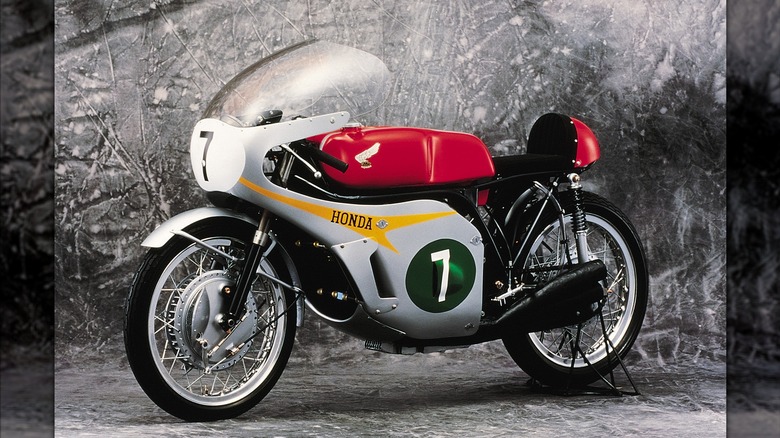
Each of the RC166's cylinders displaced just under 41cc, featuring a tiny 41.0mm (1.614-inch) bore and an ultra-short 31.0mm (1.22-inch) stroke. Despite (or thanks to) its size, this tiny engine screamed all the way up to an unheard-of at the time 18,000 rpm. It delivered 62 horsepower, which translated to an unbelievable specific output of 248 horsepower per liter. To achieve that insane 18,000-rpm redline, Honda had to push metallurgy, precision machining, and micro engineering to limits never previously seen in motorcycling.
The RC166 engine was an intricate jewel. The block was aluminum, but it used a magnesium lower crankcase to save weight. Meanwhile, its complex crankshaft was pressed together from 13 individual pieces using specialized jigs. The piston itself was no larger than a Kodak film roll. The DOHC cylinder head squeezed four tiny valves into each combustion chamber, totaling 24 valves across all six cylinders. Smaller valves meant lighter valvetrain components, drastically reducing valve spring stress and float at screaming revs. Fuel delivery was handled by six Keihin 22mm round slide carburetors fed by five tiny fuel and air jets instead of a conventional main jet. To aid in cooling the tightly packed engine block, the inner carburetors were tuned to run slightly richer.
Despite packing six cylinders, double overhead cams, 24 valves, and six carburetors, the entire assembled engine was a packaging masterpiece. Measuring just 14 inches wide, the six-cylinder power unit was quite compact. In fact, the overall bike was narrower than the two-stroke parallel twin Yamaha racers it challenged.
Mike Hailwood drives Honda RC166 to victory
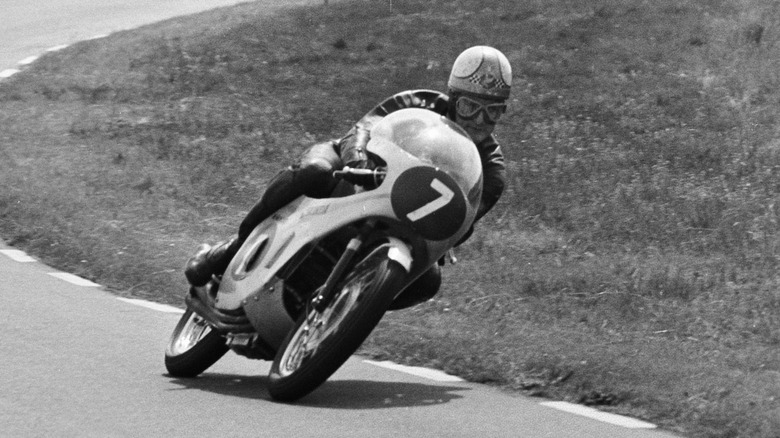
Feeding all that power to the rear wheel was a 7-speed manual transmission, which kept the engine operating strictly within its razor-thin power band. Power was nothing without chassis development, however. When the six-cylinder bike debuted, it suffered from notorious handling issues. So, Honda brought in the legendary racer Mike Hailwood to tame the wild machine. After inspecting the factory suspension setup, Hailwood famously removed the stock Honda rear shocks, threw them into a nearby pond, and demanded stiffer Girling units. Under Hailwood's direction, the tubular steel duplex frame was completely redesigned with thickened tubing, and the wheelbase was lengthened by 3.5 inches to stabilize the bike at speed. The structural revisions transformed the RC166 into an unstoppable track weapon. Rolling on 18-inch Dunlop race tires and relying on 9-inch four-leading-shoe front drum brakes, the 247-pound bike could top 150 mph while screaming through six megaphone exhaust pipes.
During the 1966 Grand Prix season, Hailwood rode the RC166 to pure perfection, winning all 10 races he entered and securing the 250cc World Championship for Honda. He repeated the world championship victory in 1967 before Honda withdrew from Grand Prix motorcycle racing to divert its engineering genius towards Formula 1. There was another reason as well. To ensure uniformity, the Fédération Internationale de Motocyclisme stepped in. For the 1970 racing season, regulatory bodies imposed strict technical limits capping the 250cc class to a maximum of two cylinders and 6-speed gearboxes. This regulatory shift effectively outlawed motorcycles like the RC166 and preserved its status as a technological marvel of racing engineering. It remains one of Honda's rarest motorcycles that is worth a ton of money.