

Why The Differences Between PSI And CFM Matter
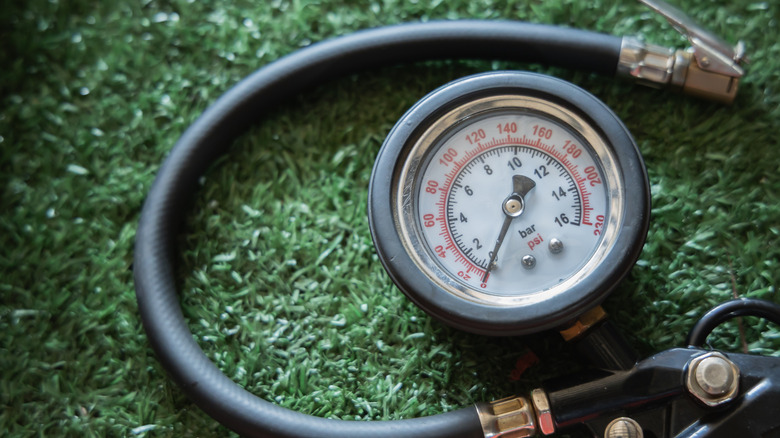
Air is utilized to power a myriad of everyday tools. Because of this, it must be measured in various ways so that these aptly-named air tools, powered by an air compressor, run properly and perform the task they're designed to do. One is cubic feet per minute (CFM), whereas the other is pounds per square inch (PSI), and they're neither interchangeable nor convertible. So why do people get these two units of measurement mixed up?
Perhaps because they both pertain to compressed air in some way. Not only that, but other measurements of air may cloud one's understanding as well, such as air density, which is the mass of air divided by the volume it occupies — we'll save that one for a future piece. The differences between CFM and PSI matter because the former is a measurement of flow, whereas the latter is a measurement of pressure, such as the one that keeps your tires inflated — although you never want to inflate your tires to the PSI number displayed on their sidewalls. Let's dig into their exact definitions and discuss why both CFM and PSI are so important to know.
Both PSI and CFM are important

While PSI denotes the pressure of air inside an object in pounds per one square inch, CFM measures the volume of air in cubic feet that is delivered per minute. It's important to point out that the former is related to the latter; PSI decides whether the air has enough force to power the tool, and CFM indicates whether there's enough volume to keep it powered. Slightly confusing, we agree. A common comparison that's easy to visualize is a garden hose; the water flowing through the hose represents CFM, and restricting its flow at the end with your thumb to make it spray further represents an increase in PSI. If you cut off the flow of water at the spigot, the pressure decreases because less water is trying to get out.
Now, in an air compressor, the pump fills up the tank in CFM to a certain PSI. Once a tool is hooked up and used, like an impact wrench – one of the tools Jalopnik's readers absolutely hate to use – air leaves at a certain CFM and requires pumping in more, also measured in CFM, to refill it to maintain that pressure. If enough air isn't pumped in time, pressure drops, and it will cause the tool to operate below its rating. The higher the CFM, the more air leaves the compressor every minute to power tools that require a high volume of air. The differences between PSI and CFM matter because they not only tell you if a compressor can perform the job at hand, but also how long the job — such as buzzing off wheel bolts or spraying paint — can last before the compressor needs to be refilled with air.