

Here's Why This Is The Top EV Brand In The World In 2026
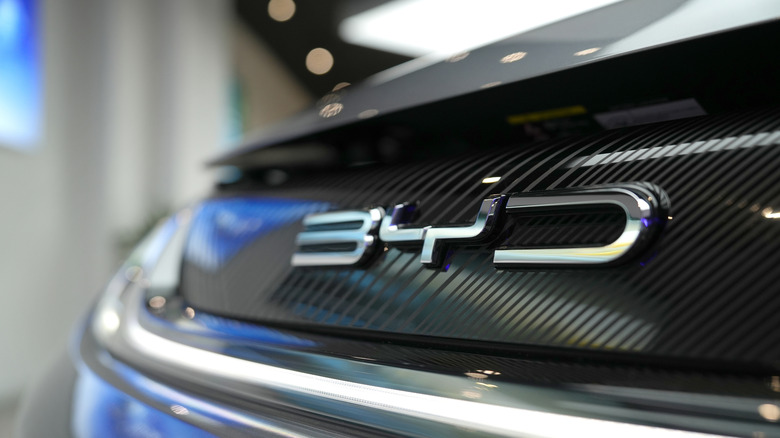
The EV market looks nothing like it did a decade ago. Tesla's Model S prototype debuted in Detroit in 2009, years before EVs became a mainstream buying decision, and it helped convince the public that an electric car didn't have to be a compromise. Since then, virtually every major automaker has poured billions into electrification, and global EV sales have grown from a niche segment into a mainstream force.
Tesla held the title of the world's top-selling EV brand through 2024 — then lost it in 2025. BYD closed out the year having delivered about 2.26 million battery-electric vehicles — roughly a 28% jump from the year before, well ahead of the 1.64 million vehicles Tesla delivered over the same twelve months. That's a gap of more than 600,000 cars.
BYD pulled this off while its EVs still weren't sold in the United States — despite Tesla depending on China, its second-largest market, for a big chunk of its own sales. BYD's roots trace back to Shenzhen, where the company was founded in February 1995 as a rechargeable battery maker. It didn't enter the auto industry until 2003, having spent its first years making batteries for phones and laptops.
Today, the brand's lineup spans everything from the entry-level Dolphin Surf city car to the three-row Sealion 8 SUV — and it's still expanding. Whether you've heard of BYD before or not, it's the most important EV brand in the world right now, and its chairman has said the company aims to become the world's largest automaker within five years. Here's why it's earned that position.
Competitive pricing
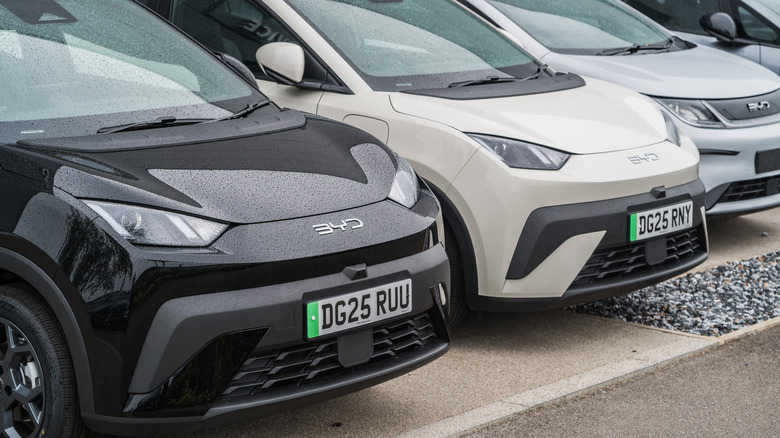
One of the most important reasons why BYD is so successful has to do with the pricing. The brand has a wide range of models, and the cheapest ones are usually a lot cheaper than most rivals. For example, for the BYD Dolphin Surf in the U.K. market starts at around £18,650 (~$24,800). In terms of monthly installments, the Dolphin Surf could be had for as little as £175 (~$233) per month.
EVs like the Renault 5 compare directly with the Dolphin Surf, and a 2025 Renault 5 starting price in the U.K. is £21,495 (~$28,600) or approximately £229 (~$305) per month. At the other end of the range, the Sealion 7 starts at £44,990 (~$59,800), putting a large electric SUV with up to 312 miles of range comfortably below comparable rivals.
That kind of pricing breadth — from an accessible city car to a performance SUV — gives BYD a foothold in segments that most EV brands can only pick one or two from. The absurdly cheap BYD Seagull is basically the Dolphin Surf, but for the Chinese market, and in China, you could buy one for as little as $8,000, several times cheaper than Tesla's least expensive cars.
In Australia, the BYD Atto 1 comes in well below almost everything else on sale, with a starting price below $24,000 before on-road costs, while the cheapest Tesla Model Y starts at over $60,000. Prices are constantly changing and are subjected to politics as much as they are to the will of the free market, but overall, few brands can get you into an EV as cheaply as BYD.
BYD controls the supply chain
The modern car industry works thanks to a vast network of long-lasting supply chains. If you want to start a car company, chances are that you will source many of the components for your car from a dedicated company. You could call Brembo for your brakes, Bosch for your electronics, Rimac for your battery, and Osram for your headlights.
However, every link in that chain adds cost, creates delay risk, and hands margin to someone other than the carmaker. This is where BYD is different from most automakers out there because it makes many of the necessary components itself. EV Magazine notes that "BYD manufactures about 75% of its vehicle components internally, including its Blade Batteries, electric motors and power electronics."
This gives it a cost control level that few Western automakers can match at scale. That's the structural reason its cars can be priced so aggressively without sacrificing profitability. The foundation of this strategy is batteries, with the battery pack alone eating up roughly 40 cents of every dollar spent building an EV — and BYD even invests in lithium mining operations to extract raw materials directly.
China in general is becoming a global EV battery building behemoth, and part of that boom is fueled by initiatives such as BYD's vertical integration that gives them levels of freedom that is difficult to come by. The result is a company that competes not just as a carmaker, but as a fully integrated system spanning raw materials, components, manufacturing, and logistics.
The BYD Blade battery
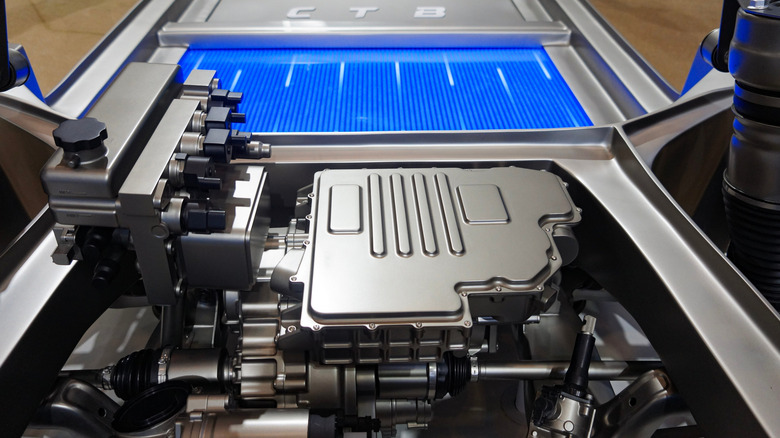
Battery technology is one of the most important factors in an electric car. It determines range, safety, longevity, charging speed, and a significant chunk of the vehicle's cost. Most EV makers source their batteries from external suppliers — usually Chinese firms like CATL or BYD — or rely on conventional lithium-ion chemistry. BYD took a different path entirely, developing its own proprietary battery technology that would eventually become the Blade Battery.
Though Apple's secret car project played a role in its early development, BYD holds complete property rights and patent rights over it. The Blade Battery is cheaper compared to conventional battery packs. By ditching the module-based layout most LFP packs use, BYD fits over 50% more cells into the same footprint — outperforming the block-style LFP packs most other automakers still use.
BYD calls it "a quantum leap in electric vehicle battery technology, offering superior safety, greater longevity, and better performance over time than traditional solutions." Safety is where the Blade Battery sets itself apart from the competition. The nail penetration test is one of the harshest evaluations a battery can undergo.
According to BYD, when subjected to this test, the pack stayed cool — 30 to 60°C at the surface, no flames, no smoke — in a test that pushes a typical ternary lithium battery past 500°C when the same test is run on it. The second-generation Blade Battery 2.0 pushed things even further: BYD ran the same nail test mid-charge on the second-generation pack, repeating it 500 times without a single fire, smoke trace, or runaway event.
A model for almost every buyer
At the time of writing this article, the only new Tesla cars you can buy in Europe are the Tesla Model Y and the Tesla Model 3, because the last Tesla Model S and Model X rolled off the production line in May 2026. Compare that to what BYD offers, and you'll find 15 to 20 different mainstream models or submodels on sale in Europe. There's simply more choice from BYD than from most EV makers out there. Plus, you have Yangwang, Denza, and Fangchengbao as the brand's subbrands.
You can buy a BYD pickup truck, a small and cheap city runabout, a family SUV, a sporty sedan, or even an EV hypercar with 3,000 horsepower. That range matters more than it might seem. A buyer cross-shopping a compact hatchback isn't looking at the same options as someone who wants a three-row SUV or a performance-oriented saloon, and most EV brands still only have one or two answers for each of those buyers, if any at all.
BYD instead treats nearly every segment as one worth competing in, from the cheapest city cars all the way up to six-figure performance models. This isn't an accident. It's a direct result of the vertical integration and cost control discussed earlier in this piece — when you build your own batteries, motors, and electronics in-house, launching a new model line becomes far less risky.
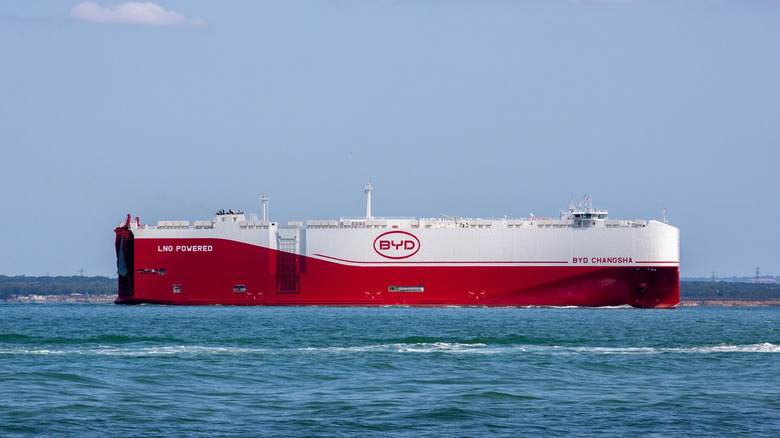
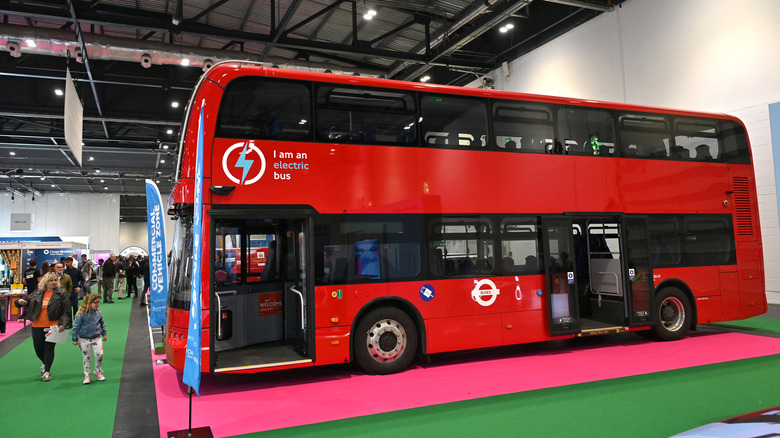
It also becomes far less expensive than it would be for a manufacturer sourcing everything from outside suppliers. Fewer models isn't necessarily a weakness for a company like Tesla, but it does mean BYD can meet almost any buyer where they already are. Besides just cars, BYD also makes London buses, trucks, and even operates its own fleet of car-carrier ships to export vehicles worldwide.