

How And Why The Vanguard CitiCar Failed To Revolutionize City Driving
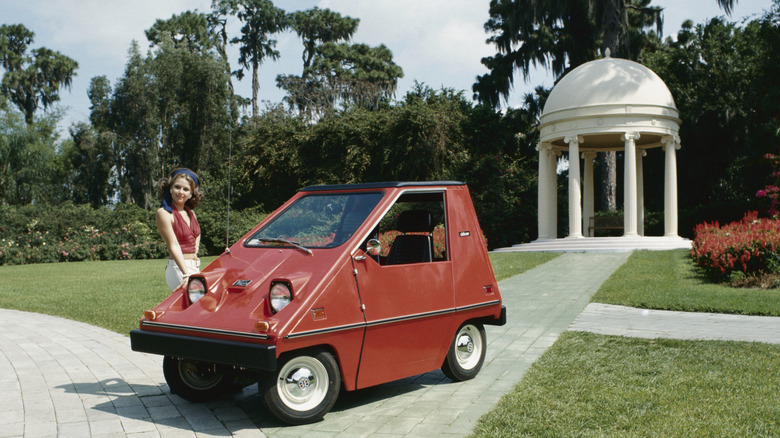
An electric vehicle (EV) with an aluminum tubular chassis and minimalist interior that makes use of lightweight materials to favor range-effectiveness sounds exactly like the kind of car the world needs right now. However, the Sebring-Vanguard CitiCar is not some up-and-coming sector savior ready to take city centers by storm — in fact, it looks dire even in comparison to the worst EVs offered for sale today. Instead, it launched in the 1970s as a real-world alternative to gas-guzzling domestics, arriving right in the thick of the EV's crap era.
Saying the CitiCar "failed to revolutionize city driving" makes it sound like a complete failure, but it really wasn't, as we'll explain in this article. It was developed as a solution to the ever-rising costs of motoring following the 1973 Oil Crisis, featuring a lead-acid battery powertrain which boasted between 2.5 and 12 horsepower, and it was built upon that aforementioned tubular aluminum frame. To keep the weight down, plastic was the material of choice for the body panels, while flat glass panels were chosen for the windows, presumably to also keep costs to a minimum. However, despite the excellence of the idea and intent behind the CitiCar, pricing structures, market conditions, and battery technology did ultimately stop it from becoming the new face of city driving. In total, roughly 6,500 were made, counting both CitiCar and Commuta-Car units, and it notably became the best-selling American EV since the end of World War II, right up until Tesla launched its Model S.
Here's what stopped the CitiCar from succeeding further
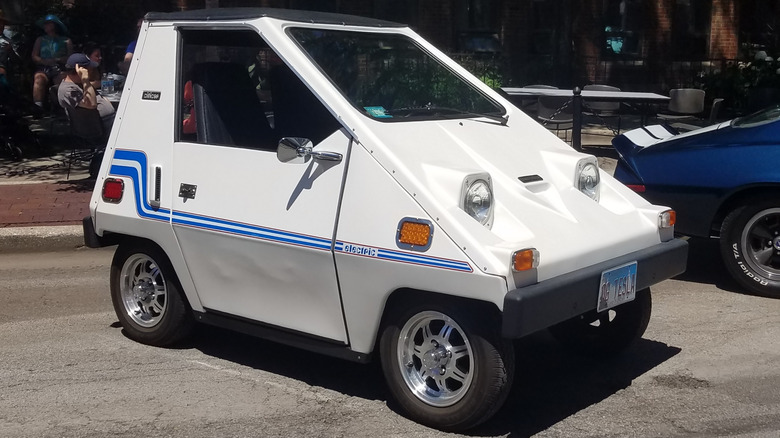
The Vanguard CitiCar clearly enjoyed its day in the sun, but it could never have become more of a success than it was — not at that particular time, at least. While the Oil Crisis and the associated high gas prices presented an opportunity for the CitiCar to launch and find the success that it did, other more compelling solutions came along at the same time, too – solutions like Honda's CVCC-powered Accord and Civic. Japanese imports like these gave American motorists a real alternative to the inefficient V8 domestic options, and in truth, they made the CitiCar look like dreadful value by comparison. Case in point, the 1973 Honda Civic debuted with a price tag of $2,150, while the CitiCar commanded roughly $2,988 in 1975, with some sources citing its MSRP as high as $4,500.
Those early Civics were a little basic, with a 50-horsepower 1.2-liter engine ticking away up front, but that was still plenty of power in comparison to CitiCars and its Commuta-Car successors. The former debuted with paltry 2.5-hp powertrains, which were soon upped to 3.5 hp, while the latter produced 6 hp. Better. But then again, the Commuta-Car demanded even more money at the tail-end of the 1970s – starting at $3,995 in 1980, with some sources claiming the average price was about $6,500. Clearly, the battery technology just wasn't developed enough in the 1970s for a compelling EV to take on even the simplest of ICE-powered cars. The CitiCar also boasted just 40 miles of range — way less than the range required by most motorists – and it sported a similarly dismal 38-mph top speed, too. It never really stood a chance of revolutionizing city driving.