

The Right Prep For A Rooftop Tent (Because Here's How Much It Can Go Wrong Otherwise)
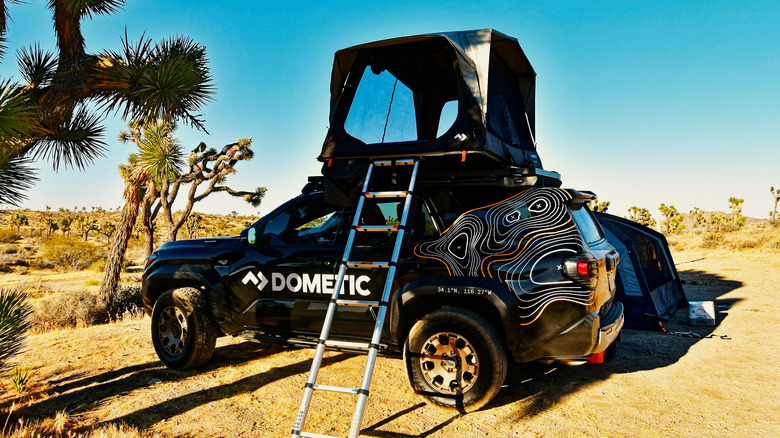
We think rooftop tents are cool. They look great and they're handy for off-road adventures, but using them is a bit more complex and counterintuitive than you'd wager.
Here's what we mean by counterintuitive. The 2026 Subaru Outback has a very high, 800-pound static load capacity. Static load means what it sounds like: When the Outback's not moving, you can put 800 pounds on top. And that Subaru's dynamic load capacity is 220 pounds. The latter factors forces like those caused by braking to a stop from 50 mph and the physics of barreling through a turn — or rock crawling off-camber at merely 4 mph.
Now let's take a brawnier brute of an off-roader. You're probably guessing the mighty Ford Bronco wouldn't be wimpier than the Outback when it comes to roof toting. And you'd be wrong. The dynamic rating is merely 110 pounds, the static one, a more modest 450 pounds.
So how come? Massively reductively, a rooftop tent, like any load mounted on top of your rig, changes the way the thing handles. Meaning, take a tall vehicle and make it taller, and bad things can happen. Or, put simply, the vehicle can roll more easily. And so factoring in these load ratings is word to the wise numero uno. But there are other factors to consider beyond vehicle choice — and they very much have to do with properly securing whatever you put on top of your rig.
Take the weight limits seriously
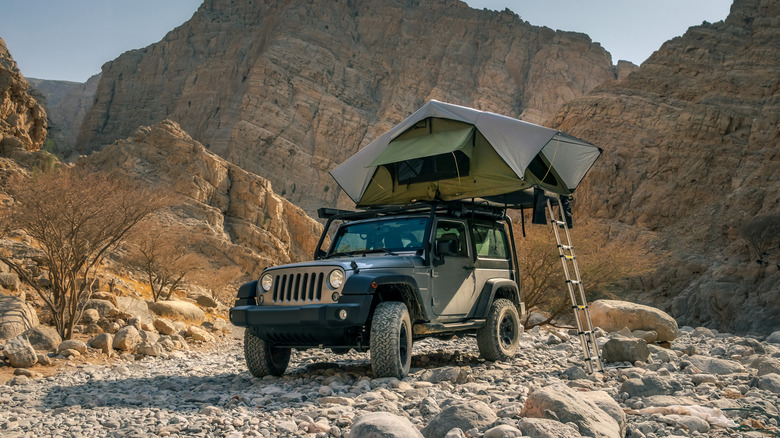
The idea of having your rooftop tent fly off into the wind might seem funny, because you're maybe picturing Dorothy smashing the Wicked Witch of the East with her house. But in real life, the driver of a Chevy pickup was killed in Michigan in 2022 when the roof rack and its attached kayak detached from a Honda and flew through the windshield of the Chevy.
According to AAA, between 2011 and 2014, "road debris was a factor in a total of more than 200,000 police-reported crashes," resulting in roughly 39,000 injuries and 500 deaths. The motor club says about two-thirds of those were caused by improperly secured loads on vehicles. So, beyond having a rack and system that can be supported by your vehicle — which we'll detail further — securing the load properly is extra important.
Ratcheting won't come until you know what you can carry. Consult the owner's manual for both the static and dynamic weight limits. If it's not there, ask your dealer, many of which list that on their own websites. They, and rack makers, also caution that exceeding those load ratings can risk damaging your vehicle or making it unstable. And, further, know that these ratings include the weight of the rack, not only the tent. The latter might weigh under 100 pounds, but it depends on the configuration, and more elaborate models get heavier pretty quickly. You also have to figure out the static limit, because that includes you, anyone joining you in that tent, and camping gear like sleeping bags, which is pretty quickly going to hit 400 pounds or more.
No matter what, a rooftop tent impacts handling and stability
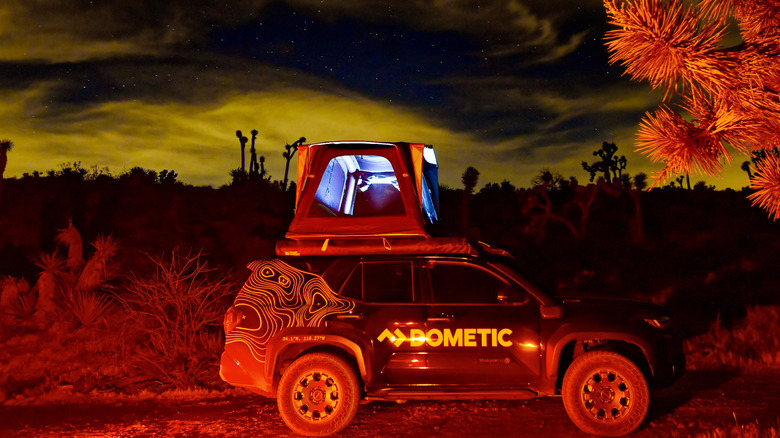
Beyond the static limits, there are the dynamic ones. And, again, the more butch your ride, the more likely those limits will feel less macho. For instance, there's a 165-pound dynamic load rating for a Toyota 4Runner TRD Pro and Trailhunter, and just a 135-pound dynamic load for all other 4Runners. They, and aftermarket suppliers, abide by and test to the International Standards Organization (ISO), which sets static and dynamic tests for racks and rack systems. And those ratings are all about physics.
Speaking of immutable laws, there's another figure that the National Highway Traffic Safety Administration (NHTSA) uses called Static Stability Factor (SSF), which the agency cites as a strong predictor of rollovers. Yep, SUVs are not necessarily safer than sedans, partly because of the higher risk of rollovers.
As for SSF, while it's a pretty complex formula to calculate, an important rule of thumb is that especially taller or lifted rigs already have a higher center of gravity and a greater potential to roll, which means they generally have lower capability to carry weight on top. When you pile more junk to the rooftop you exacerbate that chance, and you weaken both highway handling and off-roading capability. Lastly, regarding physics, always check the fitment guide for the tent you're installing. Typically they tell you the strongest placement of the crossbars to support maximum weight.
None of these cautions are to imply that we don't want to go overlanding often and spend all our money on rooftop tents. A few of these shots were taken by the author of this piece while camping in the California desert. But doing this right requires, well, doing it right. So your s'mores and your snores are both delightful.