

This 'MythBusters' Test Visualizes The Carnage Of A Moose Collision Without The Gore
From experiments like turning a Ford Taurus into a golf ball to using a semi to smash through all their props in the show's grand finale, "MythBusters" had quite the entertaining 14-year run. In the show's "Alaska Special," featuring hosts Kari, Tory, and Grant, the team set out to test the myth that if you can't avoid crashing into a moose, the best course of action is to speed up instead of slowing down so that the animal flips over while you walk away without injuries. Spoiler alert: it's not. "MythBusters" reveals that, no matter what you do, damage is inevitable.
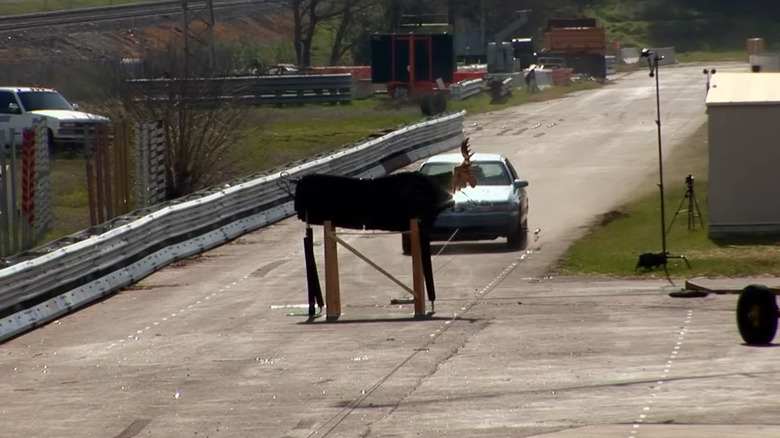
The video, available on the official "MythBusters" YouTube channel, explained how the team planned to execute the stunt. For obvious reasons, the presenters decided not to send an actual moose into the fourth dimension. So in typical "MythBusters" fashion, the team built a makeshift moose out of rubber sheets and cables, but not without first seeing a live one up close and personal.
Stumbling across a Swedish man's thesis on how to build a rubber moose did make things a lot easier for them. But it's not like they knew beforehand the moose replica would be made of rubber, nor did they have any measurements to begin with. Instead of taking measurements off a wild bull (which would've been a bad idea), the team approached a captive moose, measuring 9 feet from nose to tail and 6 feet to the hump. They also did a "feel test" and decided rubber would be a better fit, as opposed to using ballistics gel. With hip joints made out of steel and weighing close to 620 pounds, the dummy moose looked more than ready for the test.
Busting the myth
While Kari explained why the dummy did not feature antlers, that detail was not all that significant once you actually watch the test unfold. Within E-TECH's test facility were two tracks, where a truck pulled a test car toward the dummy moose at a speed of 45 mph. It was set up with a 2:1 ratio, meaning the truck (traveling in the opposite direction) only had to do half the speed of the test car, which had a guide bar fitted to one of its front hubs so that it tracks straight.
Run number one went about as well as you'd expect — both test subjects had damage to report, with the midsize sedan now boasting nearly flat A-pillars. Next, the team fitted the car with a remote-controlled braking system to see if stopping makes any difference. For the last experiment, they accelerated another test car 30 feet before hitting the moose, finally putting the myth to rest. As it turned out, braking actually makes a difference, with the second test car looking less damaged than the first one, which struck the moose at 45 mph. Test number three, however, resulted in the car clocking in at 51 mph before hitting the moose. And no, it did not survive, much like the fourth car (a two-door coupe) that took the hit at 75 mph.
While the team managed to keep the experiment gore-free (thanks to their moose replica), the experiment revealed that there's no way of avoiding damage, with Grant explaining toward the end of the video that this myth would only hold true if you were driving an F1 car at over 97 mph.