

Why Goodyear Made The Switch To Zeppelins From Blimps
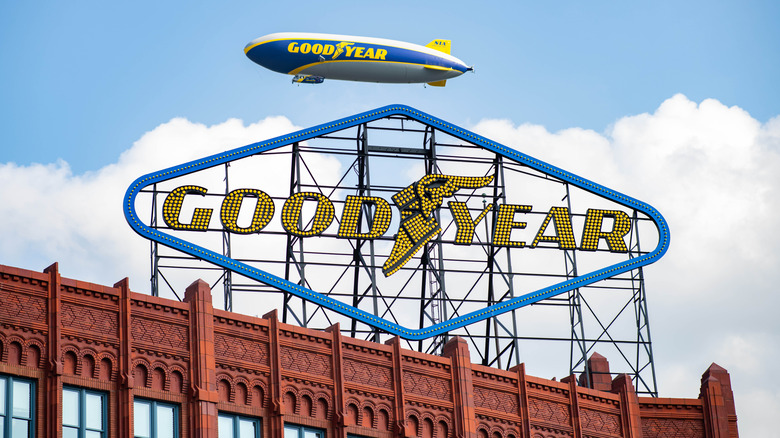
In 2011, faced with having to replace its fleet of aging airships, Goodyear made a monumental decision. Instead of building a new model on its own, Goodyear partnered with Germany's ZLT Zeppelin Luftschifftechnik for the new craft, switching from blimps to zeppelins in the process. As explained by Nancy Jandrokovic, director of Goodyear's Global Airship Operations at the time: "Our current airships are approaching the end of their lifecycle, and we saw this as an opportunity to take the next evolutionary step in our airship program."
Opting for zeppelins is a distinction with a difference, too. Blimps technically rely on a non-rigid "envelope" to hold their lighter-than-air gas, with the pressure of the gas ultimately supporting the skin of the envelope. The zeppelins, in contrast, feature a semi-rigid setup with aluminum and carbon-fiber trusses. This helps the resulting airship maintain a more aerodynamic shape and provides the foundation for building larger craft with longer ranges, increased cargo-carrying capacities, and nicer bathrooms than some apartments.
Goodyear picked the right partner for its project as well, since ZLT Zeppelin traces its roots back to Count Ferdinand Adolf Heinrich August Graf von Zeppelin, the German inventor from whom the airships got their name. Moreover, Goodyear and the Zeppelin company have a prior history of working together. The two formed the Goodyear-Zeppelin Corporation in 1923 and remained partners until the end of 1940. The corporation even built a pair of fully rigid airships, the U.S.S. Akron and U.S.S. Macon, for the U.S. Navy in the early 1930s. Unfortunately, both would experience (unrelated) catastrophic accidents and crash into the sea.
How big is the Goodyear Blimp?
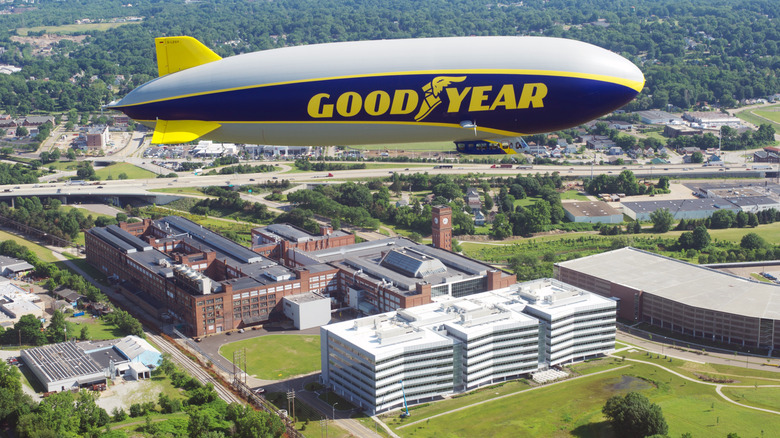
We've previously described the surreal experience of riding on the Goodyear Blimp over the Indianapolis Motor Speedway, so let's now look at some facts and figures. First off, though, keep in mind that the word "zeppelin" has sort of become Kleenexed over the years: Both words represent brand names that have gone on to have a second life as generic terms. In this case, then, it's accurate to say Goodyear partnered with the ZLT Zeppelin company to develop its new zeppelin-type airships
There are now four, to be exact, including three based in the U.S. — Wingfoot One, Two, and Three — and one in Germany that seems to simply be called the Europe Blimp. Each is 246 feet long, making them more than 50 feet longer than their predecessors. The added length unlocks the space for a larger gondola that launched with room for 12 passengers –- doubling the passenger capacity of past Goodyear Blimps. Yet, despite these increased dimensions, engineers managed to reduce the gondola's weight by 800 pounds by building it from carbon-fiber composite.
Now, the new airship's overall curb weight did climb, from 12,840 pounds to 19,789 pounds. But with a helium-filled weight of just 150 pounds, and a trio of 5.9-liter flat-four Lycoming engines kicking out 200 horsepower each, Wingfoot Two took to the air in 2019 with Car and Driver projecting an estimated 0-to-60 time of 90 seconds and a top speed of 80 mph — which makes it some 20 mph faster than the previous-gen Spirit of Goodyear.
How did the Goodyear Blimp become a sports icon?
Charles Goodyear was a pioneering American chemist who, in 1839, came up with the first practical way of hardening rubber for industrial use — a process he called "vulcanization" when he patented it in 1844. The same process is behind those tiny rubber hairs on new tires. To be clear, though, Goodyear would die in 1860, and that was about four decades before the Goodyear Tire & Rubber Company debuted in 1898. However, his innovations were what inspired the company's founders, Frank and Charley Seiberling, to use the Goodyear name.
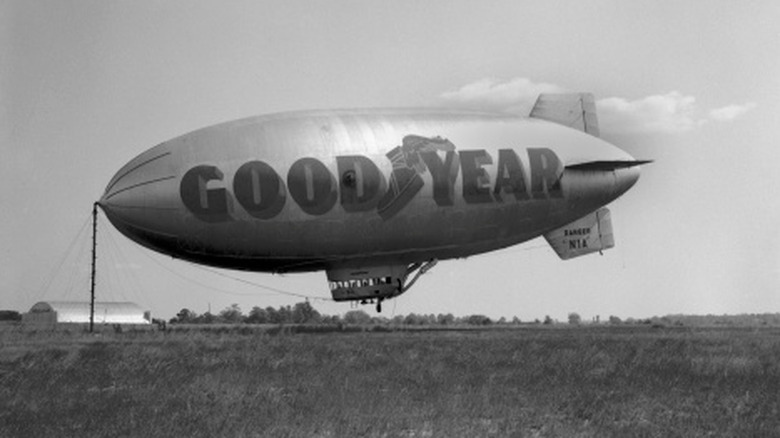
The Goodyear Company would go on to open an Aeronautics Department in 1910 with a goal of expanding its business into the fledgling U.S. aviation industry. The focus was originally on rubberized fabrics and coatings, and it must have made sense for Goodyear to start constructing its own balloons in 1912. Much of its early work was for the U.S. Navy, but the company began using its craft for lighter-than-air advertising by 1925.
Those marketing efforts would really take off in 1955. That was after someone at NBC, which had the rights to broadcast college football's Rose Bowl game that year, contacted Goodyear for a flyover. Equipped with a camera and microwave transmitter, Goodyear's Enterprise V broadcast the Rose Bowl Parade on January 1, marking the first time that nationally televised programming was shown live on TV. It would be the start of an ongoing relationship with major sporting events that carries on to this day.