

Why You'll See Two Different Speed Limit Signs On The Same Road
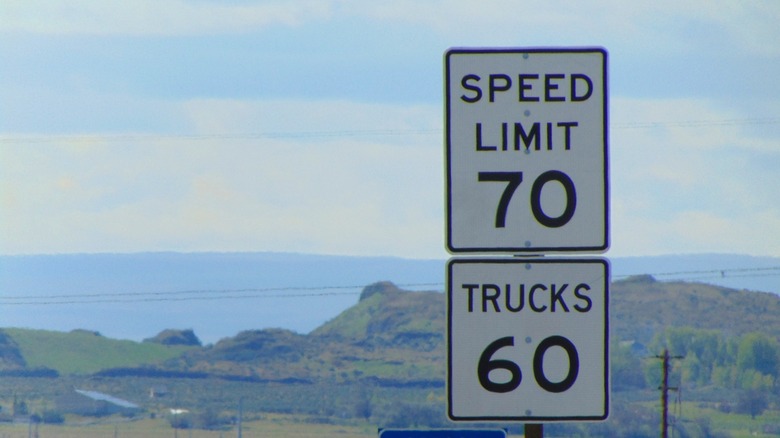
Those who have traversed one of the many interstate highways connecting the 48 contiguous states have likely come across a highway or two with two different speed limits posted on the same sign. These are known as differential speed limit (DSL) signs, where some vehicles follow one speed limit and others have to adhere to the other one. For example, one sign can be limited to cars and passenger vehicles (usually on the top), and the other is specified for trucks, which is aimed at your commercial vehicles or semis – usually 5-15 mph slower and placed on the bottom.
Differential speed limits appeared not long after the '70s fuel crisis faded into the history books, and states were able to raise their speed limits from 55 mph (established to save fuel during the crisis) to 65 mph in spring 1987. Many states at the time had raised the speed limit to 65 for cars and passenger vehicles, but kept the lower speed limit for trucks. The idea behind the difference would be that passenger cars tend to be smaller, can maneuver better, and brake in shorter distances than a commercial-sized vehicle, and thus help prevent potential accidents.
Are differential speed limits safer?
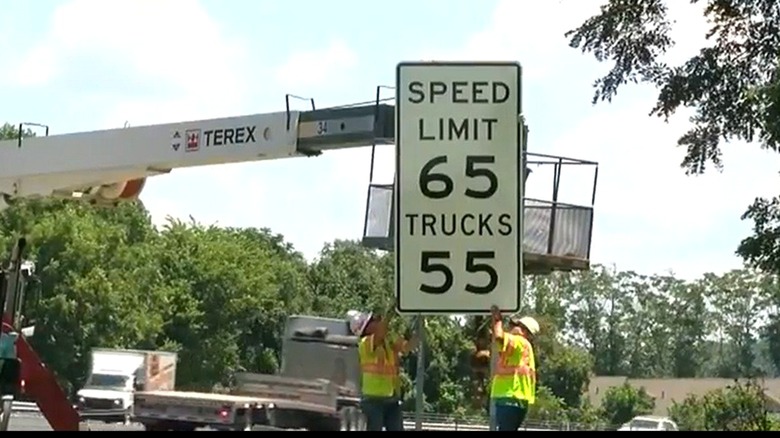
Studies, albeit limited in their samplings, came up split on that theory. For example, a report (PDF) published by the Bureau of Public Roads – the predecessor to the Federal Highway Administration in the 1960s — found that "vehicles traveling 10-15 mph less than the average speed of all traffic had a much greater chance of being involved in a crash." Another study published by the Virginia Transportation Research Council concluded that vehicles staying closer in speed would create safer highways. This is backed by another study from 2016, which found that uniform speed limits were more ideal in creating a safer highway environment. It found that it was more likely for a crash to occur if a vehicle were to "interact" or pass more vehicles, such as in higher volume traffic areas and cases when trucks are moving at lower speeds.
Then again, some studies found no real difference between the use of uniform speed limits (USLs), which require everyone to follow the same speed limit, and DSLs. A 2004 Federal Highway Administration study compared collisions on highways across three different speed limit policies: USL, DSL, and those that changed from one to the other. The study found that almost every highway experienced an increase in crashes over time, regardless of whether speed limits had changed or remained the same. Notable exceptions were North Carolina, where total crashes involving a truck on highways with uniform speed limits experienced no change, and the state of Washington, which maintained differential signs. Still, despite mixed findings in studies over time, both uniform and differential speed limits remain in use today. And according to the IIHS's maximum posted speed limits, only seven states use differential speed limits anyway.