

The 4 Top Causes Of Fatal Semi-Truck Crashes

A tractor-trailer barreling down the highway is a rolling wall of steel and rubber that isn't able to stop as quickly as a standard passenger car. When things go wrong with a machine of this scale, the results are catastrophic. While heavy commercial vehicles constitute about 5% of all vehicles on American roadways in recent years, they have been involved in nearly 10% of total fatal traffic accidents — and that was just in 2023.
For decades, public perception around semi-truck accidents has leaned heavily towards the drivers screwing up. However, crash reconstruction experts and federal oversight agencies have found that fatal collisions are the result of more than a single, isolated variable. A catastrophic highway accident occurs when multiple dangerous factors converge simultaneously. It could be a tight delivery schedule, a hidden mechanical defect, a distracted truck driver, or an aggressive maneuver by a passenger vehicle. These factors can all come together to cause an accident in a matter of seconds.
To understand why these massive machines are prone to crashes, we need to dive into the research provided by the Federal Motor Carrier Safety Administration (FMCSA) and, surprisingly, the Centers for Disease Control and Prevention (CDC). When you strip away the chaos, the data consistently points to a distinct recurring group of mechanical failures, driver recognition errors, and systemic operational pressures. Here are the top four causes of fatal semi-truck crashes on American highways (and, no, freight trains destroying semi trucks that ignored closing barriers isn't one of them).
Failure of critical braking systems
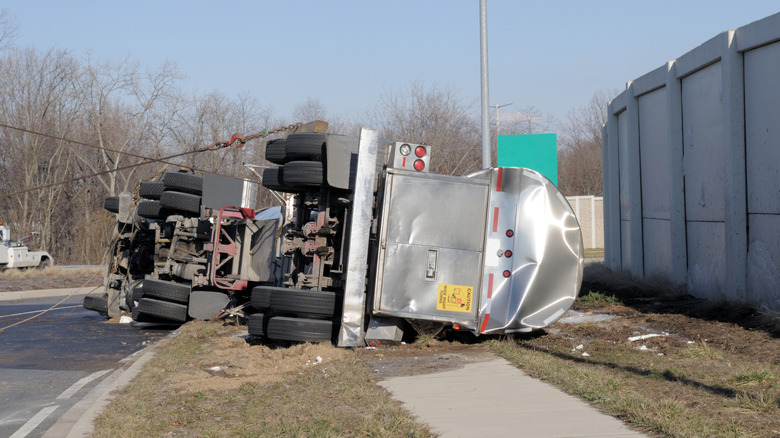
When it comes to stopping a fully-loaded 18-wheeler rig, the mechanical stakes are much higher than they would be on a commuter hatchback. A deadly crash sentenced a truck driver to 110 years in prison – and it happened because his brakes were failing. To bring themselves to a halt, commercial semi-trucks rely on complex pneumatic systems driven by compressed air to clamp down on massive drums or discs. (For more information, check out our coverage on how semi-truck air brakes work.) According to the Large Truck Crash Causation Study published by the FMCSA, brake problems were the single most prevalent vehicle-related factor in serious truck accidents. This one factor accounted for about 29% of the commercial vehicles investigated.
A truck's brakesgenerate enormous amounts of heat. This leads to a phenomenon is known as brake fade, and it occurs when the brake linings break down under high temperatures. When this happens, despite maximum air pressure being delivered to the brakes, the truck completely loses its braking ability. Despite how common this problem is, post-crash investigations reveal a grim picture of systemic neglect across the transportation industry. A shocking example is the April 2026 semi-truck crash in New York. As reported by CDLLife, post-accident investigations revealed that 8.5 out of 10 brakes on the single tractor-trailer were unfit for use. Despite this, the trailer was kept on the road, bypassing safety inspections for years.
High-speed tire blowouts
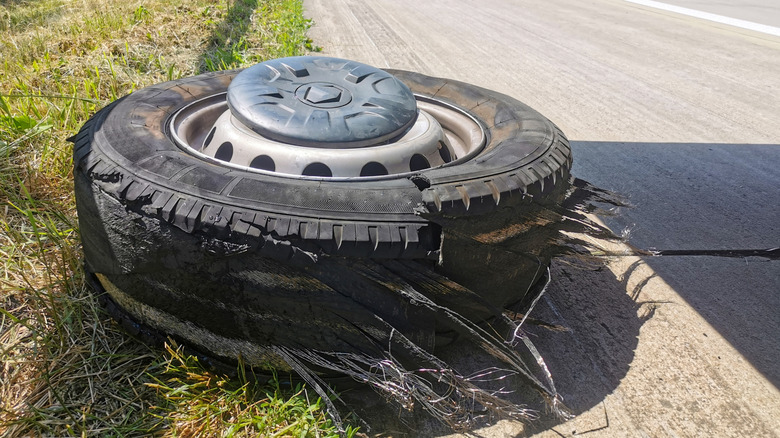
When it comes to stopping a semi truck, the tires are just as critical as the brakes. A typical tractor-trailer distributes its immense cargo weight across 18 wheels, which means even a single tire failure can destabilize the entire vehicle. Truckers have found that this situation caused their ride to immediately start shaking, so it should come as no surprise that truck tire failures constitute another major cause of serious road accidents.
Heavy commercial tire damage doesn't just come from sharp road debris; underinflation is another major factor. Trucks need far more air pressure than your everyday passenger cars. Without it, the highway driving speeds and heavy loads will stress out its physical structure. If the tire is pushed past its structural limits, the entire tread layer can peel away. These large, heavy strips of rubber can become deadly projectiles for passenger cars trailing behind, and a trailer can end up jackknifing across multiple lanes due to the sudden loss in traction.
Inadequate driver attentiveness

While semi-truck crashes happen due to mechanical failures, human performance remains a critical crash variable in highway safety data. The FMCSA's research revealed that driver error or inactivity was the reason behind roughly 87% of all investigated large truck crashes. A commercial truck driver's life consists of grueling schedules, irregular sleep shifts, and long stretches of monotonous highway driving — a perfect environment to bring out human fatigue. Epidemiological safety data compiled by the CDC and the National Center for Biotechnology point to a persistent link between sleep deprivation and severe traffic accidents. Long-haul truck drivers frequently experience disrupted circadian rhythms, and a significant portion of single-vehicle truck crashes occur during the early morning hours.
Federal Hours of Service regulations are in place to combat this exact issue, limiting commercial drivers to a maximum of 11 hours of driving time after 10 consecutive hours off duty. However, the economics of the logistics industry frequently overlook this safety code. Many truck drivers are compensated strictly by how many miles they drive rather than how many hours they work, creating a powerful financial incentive to maximize driving distance at the expense of physical rest. When carrier companies apply intense work pressure by setting unrealistic delivery windows, drivers are often pushed to drive through heavy exhaustion.
Similarly to chemical impairment, fatigue destroys human performance by severely slowing reaction times, diminishing situational awareness, and ruining dynamic judgment. In a worst-case scenario, the driver gives into microsleep, which can last from a fraction of a second to several seconds. At highway speeds, a truck traveling during a five-second micro sleep can cover the length of a football field without an awake driver at the helm. That's enough time and space for a catastrophic event to occur.
Driving too fast for the road conditions

Speeding is a universal hazard, but the danger increases exponentially when it comes to a commercial semi-truck. Traveling too fast for the road and weather conditions has been identified by the Department of Transportation as one of the leading causes of truck crashes, especially in cases where the rig ends up running off the road or rolling over. When an 18-wheeler enters a highway curve or an exit ramp with too much speed, the high center of gravity associated with a loaded trailer creates a rollover hazard that no amount of steering input can correct.
Going too fast for road conditions does not exclusively mean breaking the posted speed limit. It could be that the drivers aren't slowing down enough when dealing with adverse weather, low visibility, or congested traffic. On a wet or icy road, the truck's tires have low grip. If a driver maintains standard highway speeds during a heavy downpour, the tires can easily hydroplane, causing complete loss of steering and braking control.
Driving too fast also drastically reduces the driver's margin for error. Because a heavy commercial vehicle requires a lot of distance to come to a halt, driving at excessive speeds means the truck can cover more distance braking than its headlamp can light up. In other words, if your lights suddenly catch an obstacle in your lane, excessive speed means it can be literally impossible to get the truck to a complete stop before crashing into it.