

How Camber, Caster, And Toe Adjustments Affect Handling
There's an awful lot of things that determine how a car handles. Whether it's designed for a sporty, enthusiastic ride with fast steering response, or simply meant to roll down the road in an assuring and comfortable manner, dampers and springs are only one part of the equation.
The rest concerns the car's alignment. Specifically, what the vehicle's camber, caster, and toe settings are. These three work together to determine how a car drives down the road. Depending on how they're set, the difference in handling and steering can be quite significant, and even utilized to maximize a vehicle's intention. A 2023 Lotus Emira will turn-in and handle far differently than a Rolls-Royce Spectre, and part of that is due to their respective alignments.
But how exactly do camber, caster, and toe adjustments affect handling? Let's dig into what each does, and how the car's behavior changes by adjusting them one way or another.
Camber and toe
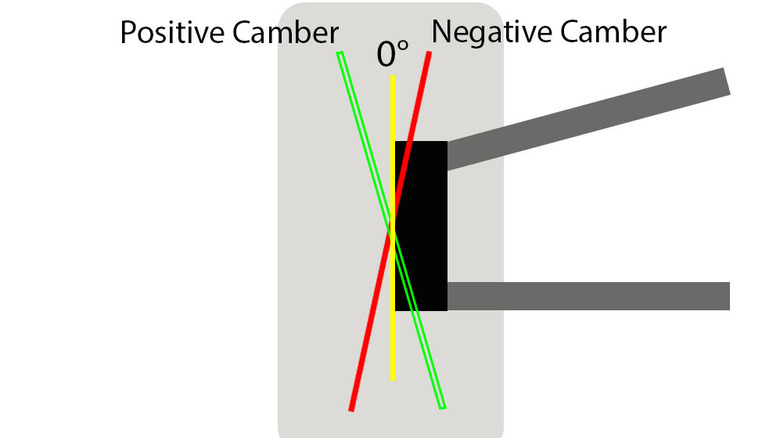
Camber and toe are the two most significant alignment adjustments due to how they position and point the tire on the road. Let's start with the former.
Camber is essentially the tilting of the wheel inwards or outwards from the center of the vehicle. Negative camber means the top of the tire is more leaned in, whereas positive camber indicates its pushed out. Generally speaking, it's more common for factory alignment settings to have a faint bit of negative camber. That's because it helps maximize the tire's contact patch under cornering, and load in general.
It's common for cars set up for track driving to have a lot of negative camber, usually by way of installing aftermarket components like adjustable or longer lower control arms and damper top hats. The more negative camber, the bigger the footprint the tire makes with the road during cornering, thus, more cornering grip. The inside tire will, too, as it's more flattened-out rather than the outside shoulder bearing more of the brunt.
Toe is easier to visualize: look down at your feet and either point them outwards or inwards. Now, imagine looking down at a wheel and tire from up above. If it's pointed outwards: it has toe-out. Inwards: toe-in. Factory alignments typically have a smidge of toe-in as it aids acceleration and keeps the steering nice and straight. Like adding negative camber, adding more toe-out behooves performance driving as it aids turn-in and steering response.
There's also such a thing as zero toe, meaning they're not pointed one way or the other.
Caster and how these settings affect handling (and tire life)
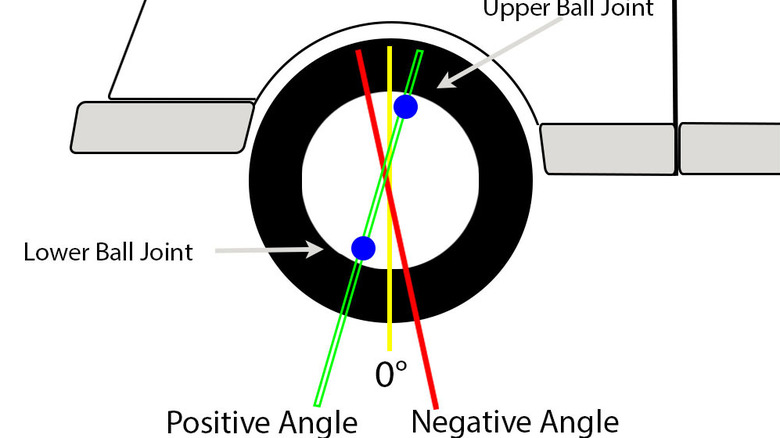
According to Suspension Secrets, caster angle is "measured by drawing a line between the top and bottom pivot points of the front upright. The angle between the drawn line and vertical is the caster angle." Front upright, meaning, the top and bottom pivot points. Meaning, what's the top and bottom of the whole wheel, damper, tie rod, and control arm(s) assembly.
Positive caster is when the top point is further back than the bottom, neutral is when they're straight up and down, negative is when the bottom point is further back. Generally speaking, any degree of positive caster is ideal as it improves turn-in and feedback. It does increase steering effort, but this isn't really an issue with power steering.
It's important to point out that each alignment setting affects one other, and the ideal order of operations is to adjust camber, caster, then toe. They help each other out, too — more positive caster means the outside wheel will gain more camber under cornering, improving grip.
We briefly touched on tire wear above — it's also a thing with increased negative camber. This brings up an important point when determining the best alignment: there are considerations to understand when changing it, with tire wear patterns being the number one, followed by how the car rolls down the road. More negative camber and toe-out can cause tramlining. Additionally, under braking, rear tires with more toe-in will increase rear-end stability, which can be a positive or negative depending on one's needs.
Considering how camber, caster, and toe adjustments affect handling to make the most of a vehicle's suspension and chassis, it's worth digging into if either performance or maximizing tire life is one's goal.