

Why Those Fuzzy-Dice Hanging From The Review Mirror Have Nearly Disappeared
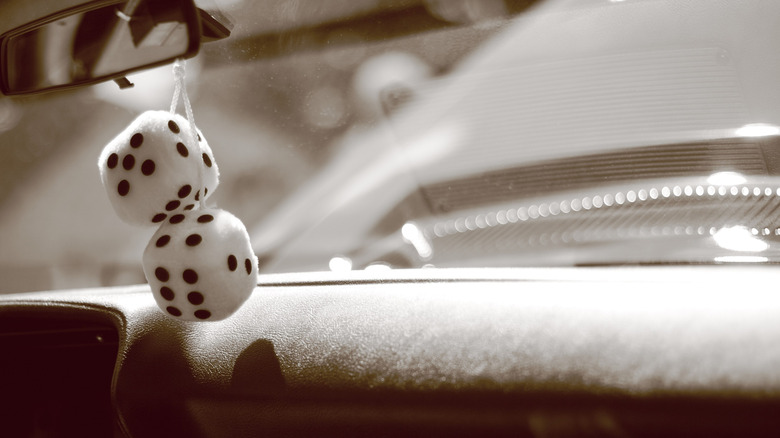
Far beyond just a colorful way to customize a car, fuzzy dice once represented risk and rebellion in car culture. By the time they fell out of fashion, they had become so tame that a 1993 study found drivers with them were no more likely to take risks than those without them. Let's take a look at that trajectory.
A commonly told story traces the history of fuzzy dice back to WWII pilots who placed dice on their instrument panels before missions — often with seven pips showing for luck, or as a darker acknowledgment that every flight was a gamble. When those pilots came home, they brought the same superstitions with them, adorning their cars the same way they'd decorated their aircraft cockpits. The habit migrated to the illegal street-racing subculture of postwar America, where displaying dice meant you were willing to risk your life to race.
The original dice were plastic, which created a practical problem: they melted in direct sunlight. Stuffed, fuzzy versions replaced plastic, and from there, the trend spread through hot rod culture in the 1950s. The fuzzy dice movement was bolstered by placement in car magazines that featured them in photo spreads, tempting readers to purchase their own set.
How fuzzy dice peaked — and faded

Through the 1950s and into the 1980s, fuzzy dice were a staple of car personalization — drivers matched the colors to their custom paint jobs and the meaning shifted from rebellion to individual expression. Fuzzy dice were eventually crowded out by newer novelties. Psychologists studying car interiors in the 1980s noted that drivers treated their cabins as extensions of their homes, filling them with Garfield window toys, hula dancers, bobbleheads, and other accessories.
Legal regulations didn't help. California laws declared rearview ornaments, such as the fuzzy dice, illegal way back in the '50s, and by the end of the 1980s, multiple states had passed laws prohibiting items that could obstruct the driver's field of vision through the front windshield. Most states have some version of this law on the books today — a reality that modern ADAS cameras mounted near or behind the mirror have only reinforced, as anything hanging nearby risks interfering with sensors that keep those systems calibrated.
Fuzzy dice made a brief comeback in the 1990s on a wave of nostalgia for golden-era car culture — and that's essentially the role they've occupied ever since. They show up at car shows, on collector vehicles, and occasionally in the window of a dream retro project car. The risk and defiance they once signaled are long gone. What's left is the accessory itself, which has outlasted everything it originally stood for.