

Slate Says Every Truck Will Be Profitable, Probably Because It Makes You Pay For Things Every Other Car Already Has
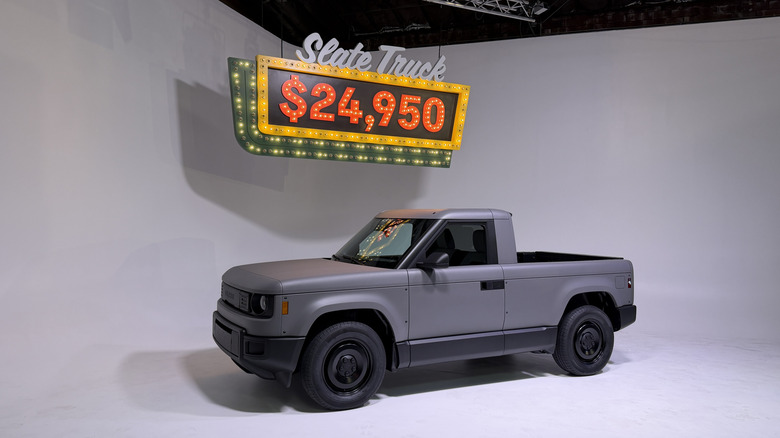
According to Slate CEO Peter Faricy, each and every one of its option-devoid electric pickups will be profitable. Faricy told CNBC that each truck will be gross margin positive, even at its new starting price. And it's probably because the truck isn't as cheap for customers as it was originally going to be, and Slate makes you pay for things every other car company throws in gratis.
Earlier this week Slate finally revealed official pricing for its budget electric pickup, and it's a bit more than customers were initially hoping for. When the Bezos-backed EV startup first showed off its two-door pickup, the $7,500 federal EV tax rebate was still in place in the U.S., which would have dropped its then-advertised price of $27,500 down to a smooth $20,000. Such a price led to 180,000 would-be customers flocking to drop $50 for a reservation. Now, since the federal rebate is dead, Slate had to readjust its pricing to $24,950, before destination.
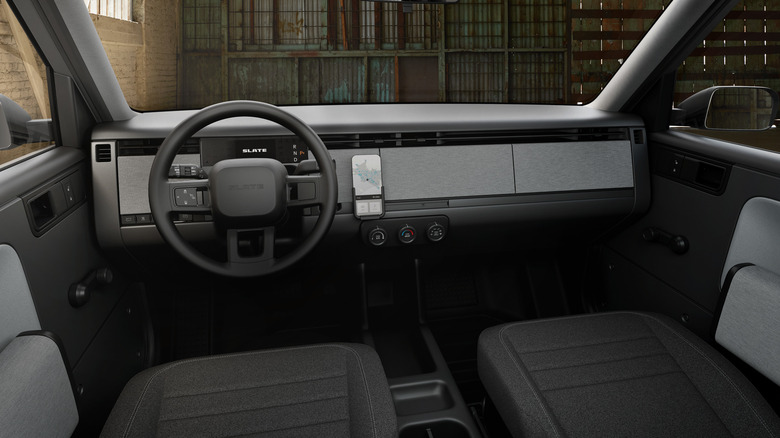
That's more expensive than the Honda Civic, Kia K4, Toyota Corolla, and Volkswagen Jetta. But those are all sedans, and the Slate is a pickup — with the option to turn it into an SUV — so it's more practical than anything at its price point, right? Well, also cheaper than the Slate to start are the Buick Envista, Kia Seltos, Chevy Trax, and Nissan Kicks, all of which are crossovers with decent trunks and hatchbacks. And all of those cars and crossovers come with speakers, power windows, door pocket, and freakin' center consoles. If you want any of those things in your Slate, you'll have to pay extra and even install them yourself. Except for power windows, as Slate isn't even offering them anymore. They might come back to the options list, but nothing is official yet.
I get that Slate's whole thing is being charmingly barebones, as a modern take on old-school, no-frills pickups. But there's a difference between no-frills and lacking any sort of basic creature comforts at all. If Slate made sneakers, the shoelaces would be optional extras. But apparently customers are intrigued by this, so it isn't entirely surprising that Slate can turn a profit on each truck when you're paying for everything inside a la carte.
Slate should be profitable before 2027, something few other EV startups have ever been able to claim
Slate's profitable trucks should make the entire company profitable before taxes, depreciation, and amortization by 2027. It's something few other EV startups have been able to do, as brands like Rivian and Lucid are still seeing multi-billion dollar losses.
"It's an ambitious goal," Faricy told CNBC. "No other automotive company has been able to do that before. So it's ambitious. It's going to take a lot of work. Nothing's guaranteed in life, but you have to have ambitious goals if you want to achieve big things. That's the big goal we're shooting for."
According to Faricy, Slate's breakeven point is 80,000 vehicles, which is less than half of the reservations the company already has. And it's far less than the planned 150,000 vehicle production capacity at its Warsaw, Indiana plant. If it can truly produce as many vehicles as it's shooting for, and even half of its reservation holders actually take delivery, Slate will easily reach that breakeven point.
It might even be able to surpass its goals, as the majority of its customers are getting more than just the base truck. Slate's President of Vehicles Chris Barman says the company expects around 60% of customers will turn their Slate into the squareback SUV. That bumps the price to $29,950. If they want to make it a fastback SUV — which looks like the squareback, just kinda notched at the rear — the price jumps to $31,950. So it isn't entirely surprising to think that Slate might be profitable quicker than every other EV startup. And that's before customers even add speakers and door pockets.