

How Michelin Used Le Mans Races To Refine Its Tire Designs For A Century
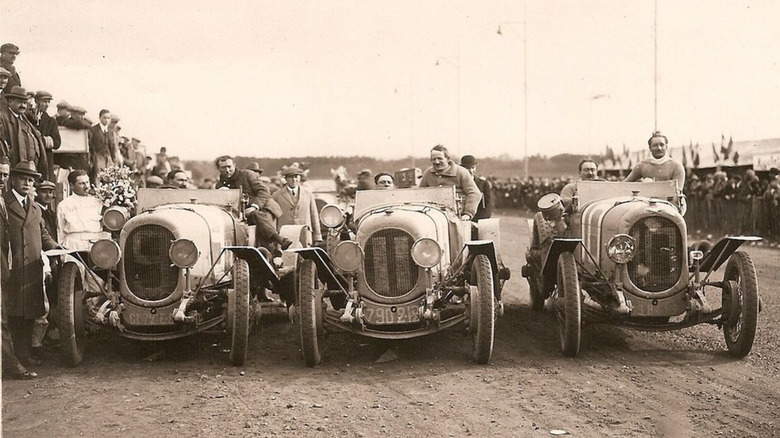
Michelin has used racing as a proving ground for its tires since the 1890s. It's known for being undefeated in Le Mans since 1998 (the tire maker claimed its 35th overall Le Mans victory and 28th consecutive win in June 2026, making it the winningest tire manufacturer in the race's history), and won bicycle races before its first Le Mans victory in 1923. Michelin equipped the world's first removable tire on Charles Terront's bicycle in 1891 and won the Paris-Brest-Paris race eight hours ahead of the second-place finisher. Talk about domination.
Michelin introduced the world's first radial tire in 1951. It was called the Michelin X, and it proved to the world that radial technology was the future of tires by going racing. Michelin fitted a Lancia Aurelia GT with Michelin X radials and entered the 1951 Le Mans race. The car finished 12th overall and topped its racing class. On the street, Michelin radials were comfier, more robust, and fuel-efficient than bias-ply tires, showing the automotive world that radial tires were the way forward.
Winning races is nice, but Michelin isn't just aiming for podium finishes and record-breaking wins. It goes racing to learn and gather data that it eventually applies to its street tires. Le Mans is one of the most grueling events in the racing calendar. The temperature changes, demanding track conditions, and the 3.7-mile Mulsanne Straight make Le Mans the ideal testbed for Michelin's evolving tire technologies.
Radial tires are instrumental to Michelin's racing dominance
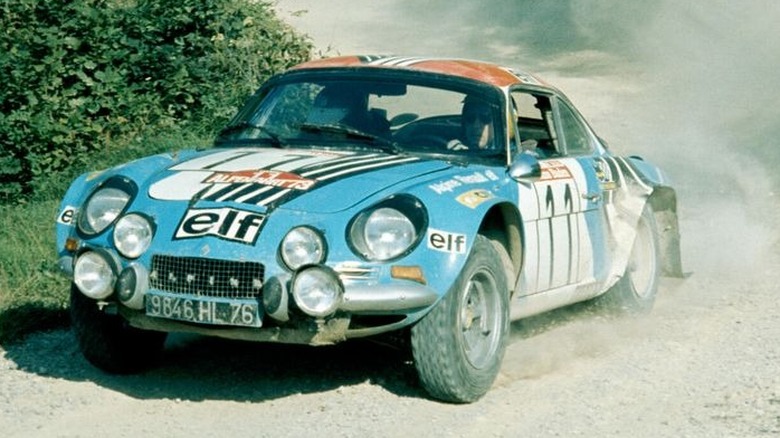
Michelin radial tires' unexpected success at the 1951 24 Hours of Le Mans established the brand as the go-to tiremaker in motorsports. The brand had patented radial tire technology in 1946, but it's better known for relentlessly improving on the design Savage Tire Company of San Diego patented in 1915. However, Michelin was the first to debut slick tires in 1967. That radial slick design claimed the inaugural World Rally Championship title in 1973 for the Alpine-Renault team.
Michelin eventually made waves in Formula 1 and MotoGP, winning their World Championship titles in 1979 and 1984, respectively. The company has since racked up 102 Formula 1 wins from 1977 to 1984 and 2001 to 2006, 347 FIA World Rally Championship wins (1973 to 2020), and 35 MotoGP motorcycle championship titles. It has also remained unbeaten at Le Mans since 1998.
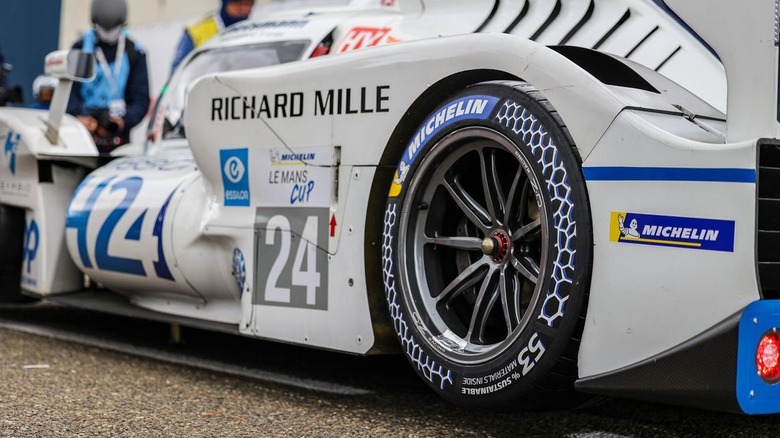
Michelin's latest-generation Pilot Sport Endurance slick tires for the 2026 Le Mans race were engineered to deliver consistent performance and longevity using 50% recycled or renewable materials (including rice husks, pine resin, orange peel, and scrap tires, in some applications). The tires lasted up to 372 miles per set on soft, medium, and hard compounds.
Technology is at the heart of Michelin tires
Decades of experience at Le Mans and Formula 1 led Michelin to develop Tame Tire, an advanced modeling tool for tires. Its simulation software has evolved to predict tire and vehicle performance based on driving conditions, rubber compounds, and tire temperatures. For automakers, Tame Tire can predict performance by analyzing the suspension, chassis, and electronic settings, helping improve handling, comfort, or both. The technology applies to Michelin passenger car tires and has been instrumental for the brand's reputation as the most satisfying tire brand.
Michelin expanded its learning on simulation technology by acquiring Canopy Simulations in 2023. The purchase was designed to take Tame Tire to new heights by combining it with Canopy's virtual driver software while solidifying the tiremaker's pledge of sustainable innovation. Simulation and virtual modeling significantly reduce the development time of a new tire while saving on raw materials and carbon dioxide emissions. Racing improves the breed of any car, and Michelin has led the way with its century of experience in Le Mans and motorsports.