

School Buses Still Mostly Run On Diesel, And That Might Not Be Great For Kids' Health

As you might guess, folks in the school bus industry can go pretty far when it comes time to support these transportation behemoths. Some companies say taking the bus to school can help kids learn to manage their time, or that it gives them a chance to hang out with old friends and make new ones. Certain organizations, like the National Transportation Safety Board, also claim that school buses are "the safest vehicles on the road." Indeed, one of the reasons school buses haven't changed much since 1939 is that they've proven to be so good at keeping kids safe from typical road hazards. Yet many kids still face a different kind of danger on their commutes: exposure to toxic diesel fumes.
One study from the Natural Resources Defense Council, albeit from 2001, indicated that a school-bus passenger can be exposed to so much diesel exhaust that it's 23 to 46 times more likely they'll get cancer. Diesel fumes are also linked to asthma and a variety of other health issues that make it harder for kids to learn, such as headaches and nausea. Despite the potential dangers, over 85% of national school buses remain powered by diesel fuel. But with the help of modern technology, this might not be the case for much longer.
Some school buses are ditching diesel to help kids and the environment
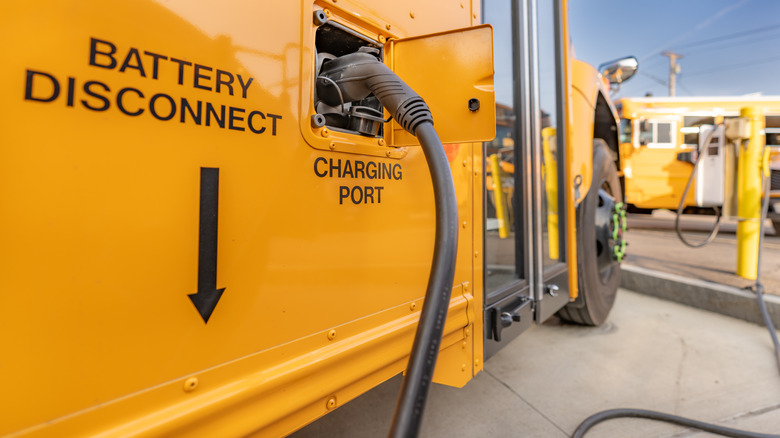
The good news is that school buses are well-positioned to opt out of diesel motivation. For instance, electric vehicles are known for being more efficient during stop-and-go driving. They have the opportunity to recapture electricity through regenerative braking — and school buses, of course, make a lot of stops. They also generally travel on relatively short, predictable routes that take them on the road just a few times a day. That gives them plenty of time for charging back at the bus barn.
There's plenty of support the concept of electric school buses, with people like Jeff Bezos and organizations like the World Resources Institute. The Environmental Protection Agency even has a dedicated Clean School Bus Program that had been focused on providing funding for electric school buses. The latest administration has nixed that focus, though, putting an end to rebates for battery-powered vehicles like those.
The results weren't entirely negative, however, as half of the program's funding — about $2.3 billion — is still reserved for zero-emissions vehicles. Additionally, the key change expands the types of fuel that eligible buses can use. In other words, school districts will be able to use program funds for buses running on cleaner and cheaper propane, as well as hydrogen and other environmentally-friendly alternatives to gasoline. It's further worth mentioning that Cummins has introduced a gas engine well-suited for use in school buses. And while it's not a zero-emissions power plant, that mill at least has the benefit of not burning diesel.