

These 5 Touring Motorcycles Easily Keep Up With Sport Bikes
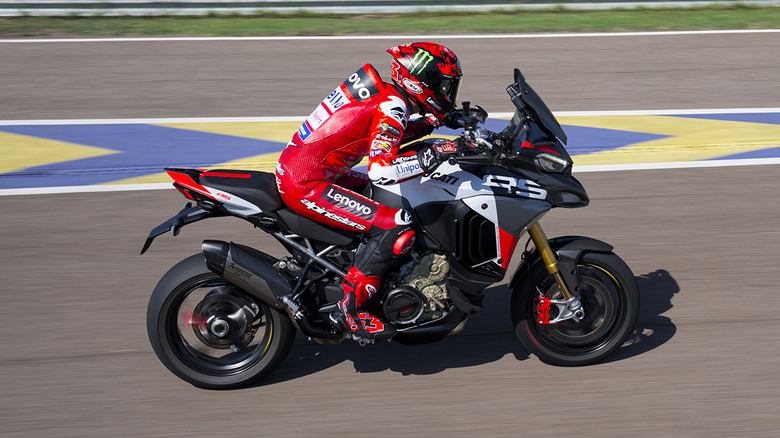
There are few things in life as exhilarating as a competent sport bike on a twisty road. For those of us in our middle age, however, the ergonomics of hardcore sport bikes can be a bit harsh. And most of us are willing to give up some race track performance in exchange for a little comfort. These days you don't have to sacrifice much, though, as advanced electronics, suspension, and tire technology have improved to the point that touring bikes can be hustled basically as fast as their sport bike counterparts can. There's a racing series for bagger bikes, after all.
It isn't absurd to see a Yamaha Tracer 9 or a Gold Wing at a track day anymore either. Touring bikes have gotten pretty good at just about every facet of riding, becoming both faster and more comfortable over the last twenty years. There is still a weight disadvantage, of course, and sport bikes have moved forward aerodynamically, but technology has advanced in such a way that can help compensate for some of that speed.
It's true, you aren't going to get the 845-pound Gold Wing Tour to run similar lap times to a CBR1000RR, but the Gold Wing's 1.8-liter engine pulls out of corners like a champ with 125 lb-ft of torque. The Gold Wing's main performance limitation is found in its lean angle clearance, though, as an aggressively ridden bike, it will certainly end up with beveled foot pegs and scuffed engine covers. So what if you want something in the middle, that's excellent on a twisty road without sacrificing long-distance comfort? Here are five of my favorite answers to that question.
Kawasaki Ninja H2 SX SE
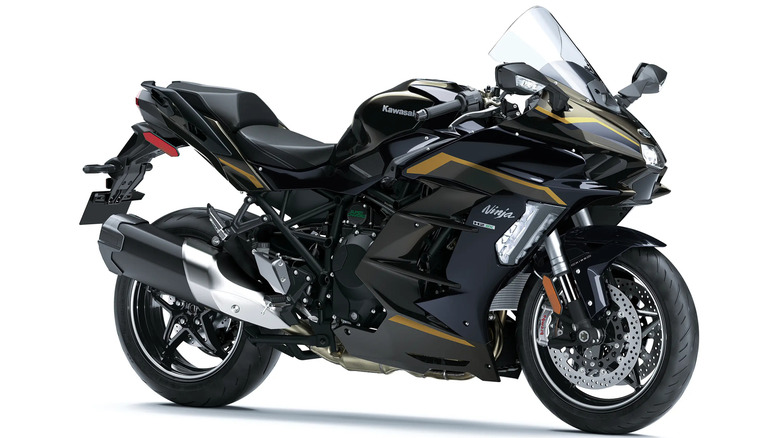
Kawasaki's supercharged 998cc inline four-cylinder monster of an engine powers one of the most exciting sport touring bikes in history. Built to power their H2R superbike, and used in other wild creations like their Teryx side-by-side, Team Green also plopped the boosted engine in a more upright and easy-to-ride version of the Ninja — the SX SE. The result is a machine that can out-power just about any bike on the road while possessing the grip and fancy rider aids needed for a fast lap time, while still offering ultra-premium levels of comfort.
This bike does almost everything incredibly well. It's getting a bit long in the tooth these days, and doesn't have the advanced infotainment stuff like some of its competitors might. It lacks Apple CarPlay, for instance, but it still has high-tech features like adaptive cruise control to go along with all that speed. It is a 200+ horsepower motorcycle that will cost you over $30,000 to bring home, after all, so it should be competent at that price.
What kind of performance can you expect from the H2 SX SE? It is electronically limited, naturally, to 186 miles per hour, but could certainly top 200 if it were allowed to. With the right rider and perfect conditions, the H2 SX SE will run a blisteringly quick 10.04-second quarter-mile at 144 mph. It'll run from zero to 60 mph in just 3 seconds flat, as well. You're carrying around 600 pounds of bike, so you might lose out to a very competent sport bike through some corners, but you'll make it up on the straights without a doubt.
Harley-Davidson CVO Road Glide ST
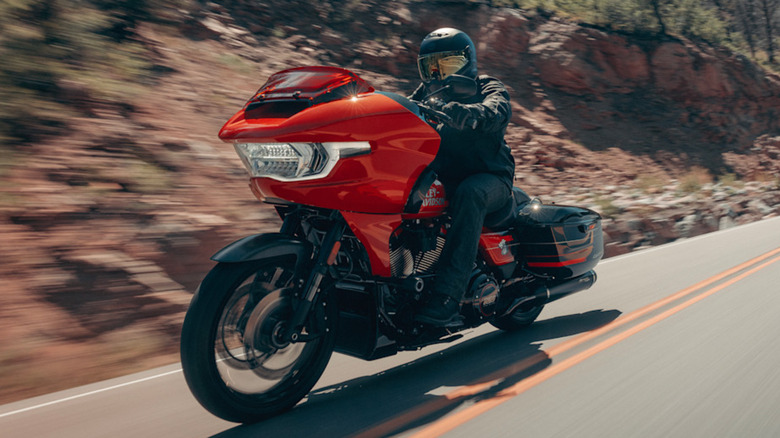
Everything on this list is going to be a compromise, and you have to decide if you're looking for more comfort or quicker lap times. Harley-Davidson's CVO Road Glide ST is a large 838-pound bike, so it's going to wear its weight when the corners get tight. But if you're looking for a style-heavy American V-twin, nothing handles as well as this. Harley has learned a lot from the King of the Baggers series in the last few years, and brought some of that track speed to its halo bike.
With an incredible 145 lb-ft of torque, this bike is built for jumping up out of corners and ripping away from stop lights. It's got just 31 degrees of lean angle, so you won't be dragging a knee, but with sticky Dunlop tires, lots of carbon fiber, and fully-adjustable, remote-reservoir suspension, it's going to rip up the track with the right rider onboard.
Depending on the rider, this bike will run a quarter mile in the mid-11s, which is maybe not as quick as the H2, but still pretty impressive. The top speed is limited to just 120 miles per hour, but I reckon it would go quite a bit faster if you tuned out the limiter and weren't worried about the warranty on your $45,000 bagger.
Triumph Rocket 3 Storm GT
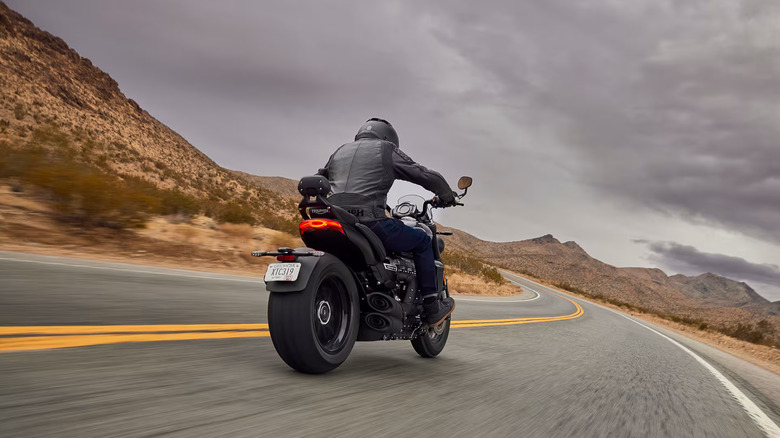
Triumph's hulking 2.5-liter three-cylinder muscle bike is probably not most people's choice for touring, but by selecting the Rocket 3 GT model with a windshield and better ergonomics, it becomes a much more competent touring bike. Make sure you option the mid-controls and the comfort seat, and you could easily ride this bike all day. It's got a cushy fat seat, a passenger backrest, and enough reach on the handlebars that most riders you can sit upright. If you need to carry stuff, Triumph will sell you panniers, and you could probably get a bigger aftermarket windscreen if you're really worried about getting beaten up by the elements.
This massive engine powering the Rocket 3 produces 179.5 hp and 166 lb-ft to work with, but isn't a lightweight at 705 pounds. It'll take some getting used to in order to turn a quick lap time with this behemoth, but it has plenty of go-fast to match its looks. And the added benefit of a bike with a big fat rear tire is that you have plenty of grip to back up your power.
Like the Kawasaki H2 SX SE, the Triumph is happiest in a straight line. This ripper will clock in a low-10-second quarter-mile pass if you get the launch right and bang the gears. It'll also pull a zero-to-60 time in the 2.7-second range. Do you really need a bike to be any quicker than this?
BMW M 1000 XR
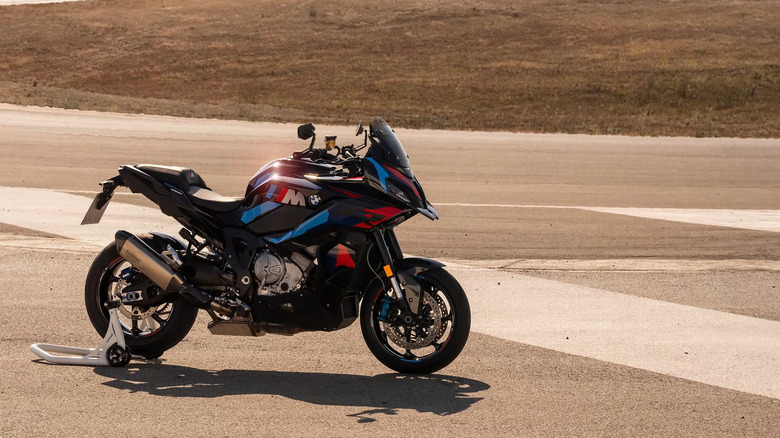
BMW's M 1000 XR is sometimes referred to as the brand's superbike on stilts, as it's effectively the same engine, chassis, and controls as the brand's race replica M 1000 RR machine, just sitting up taller with a more upright ergonomic layout. Motorcycle Magazine called the bike "Pretty f***ing great," and referred to the bike's 201-hp and 83 lb-ft engine as a spicy schnitzel. This is perhaps the best riding machine BMW Motorrad has ever built.
Despite being over two-hundred pounds lighter and carrying a 20 horsepower advantage, the Bimmer's no match for the Triumph Rocket 3 in a run to 60 mph, with the German turning in a still-impressive 3.2-ish second time. Keep the throttle pinned, however, and the BMW's advantage starts to appear pretty quickly, netting a claimed 10-second-flat quarter mile run at 121 miles per hour across the line. BMW calls it "the lightest and most powerful production crossover bike in the world." It's a bike that is marketed as "maximizing everything" while allowing you to relax across great distances.
Like everything else on this list, it's expensive, with a starting price of $25,595, but you're definitely getting the performance you're paying for. On the same track at the same time, the XR would trail its RR sibling, but not by much. Certainly not enough that a non-professional could really eke out the extra lap time anyway. If you're buying a bike primarily to ride it on the street, the XR is going to be more forgiving and comfortable without giving up much speed.
Ducati Multistrada V4 RS
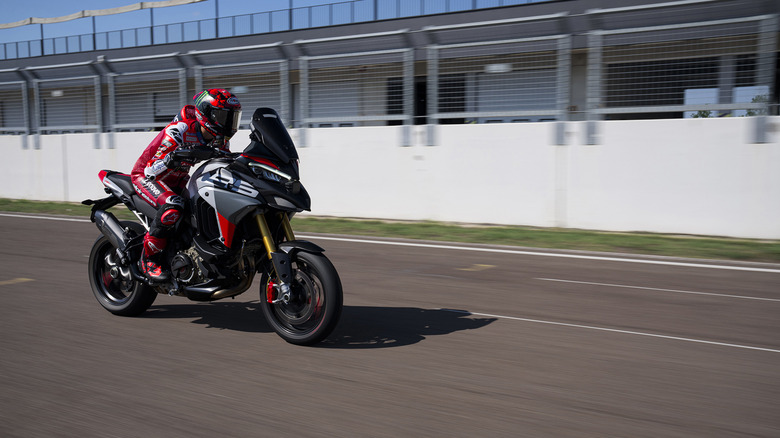
There's no motorcycle manufacturer on the planet willing to stretch things as far as Ducati. The Multistrada was originally envisioned as the Italian answer to BMW's long-legged off-roady GS. While BMW errs more on the Gelände side with its big boxer twin motorcycle, Ducati has always had a decidedly more Strasse (er, Strada) flair to its Multistrada. Ducati calls the Multistrada an adventure touring bike, but with sticky Pirelli tires and lightweight Marchesini wheels, I wouldn't advise taking the V4 RS version on any surface that is remotely loose.
The heart of the V4 RS is Ducati's 1103cc Desmosedici Stradale race-derived four-cylinder engine that revs to 13,500 and makes 180 horses on the trot. Ducati says this engine will "amplify every riding sensation," which is something Ducati is decidedly quite good at. While the BMW is a bit more powerful and might have a slight edge on some tracks, the Ducati feels more soulful in my experience, and the difference in speed between them is tough to tell without riding them back to back.
Ducati claims the V4 RS will run from zero to 60 in just 2.52 seconds, which is the quickest of the bikes on this list, and beats several pure sport motorcycles. That explosive off-the-line speed is due to the Multistrada's short (15/43 sprocket setup) final drive, but this contributes to a slightly slower quarter mile time for the Ducati as compared to the Bimmer, ending up somewhere in the low 10s with trap speeds over 130 mph. The Multistrada also has a blistering top speed of 177 mph. That's a whole lot of speed for this machine, but then it had better be with a ridiculous $39,995 MSRP.