

This Semi Truck's 10 MPG Might Sound Terrible, But Here's Why That's Incredibly Efficient
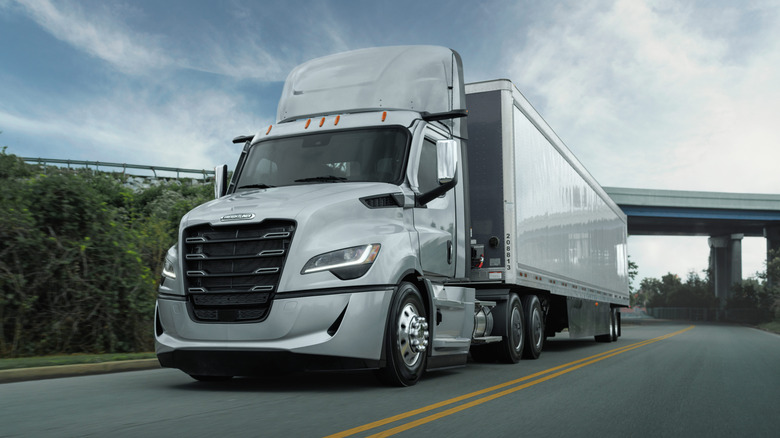
What kind of fuel mileage does your daily driver get while cruising on the highway? The average new vehicle in the U.S. achieves around 27 miles per gallon according to the Environmental Protection Agency, which is better than it ever has been in the history of the passenger car. But the average car weighs in at just under 4,500 pounds, and most of the time you're driving around alone without so much as a passenger or a load to haul. It may be surprising, then, that the most efficient semi truck on the highway, the fifth-generation Freightliner Cascadia, is capable of up to 10 mpg while hauling over 40,000 pounds just in payload.
Launched in 2024, the fifth-generation Cascadia is among the most advanced long-haul trucks on the market. While most trucks on the road still struggle to return 7 mpg, Freightliner pushed that into the double digits. Competition from Kenworth, Volvo, and Peterbilt are catching up, with their most up-to-date models getting into the 9s, but still not quite as efficient as this. There are all-electric trucks of course, including the Freightliner eCascadia, that are more efficient than diesel, but much more difficult to run long distances (except for the Tesla Semi).
So how did Freightliner build the most efficient diesel tractor on the market? It wasn't with one big change, but hundreds of tiny ones. This truck was a holistic approach toward efficiency without removing its usefulness for its operators. Some of that increased efficiency was found in simple aerodynamic shaping, while other factors are baked in deeper. That's important when the economics of driving a truck are getting more tenuous with every increase in the price of a gallon of diesel.
What did Freightliner do?
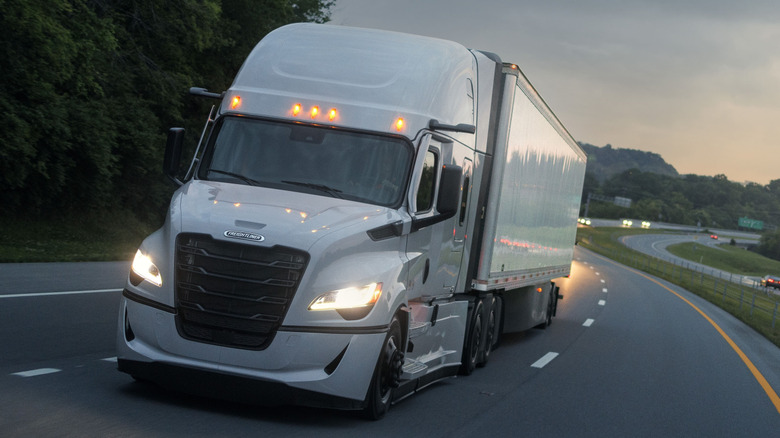
Since the Cascadia line of trucks was introduced in 2014, Freightliner has been pushing for more efficient trucks. The company says it has found a cumulative 35% improvement in economy across the last 12 years, and the current fifth generation saw a 1.9% improvement over the model it replaced.
It all starts with the Detroit DD15 Gen 6 engine under the hood. The DD15 is a 14.8-liter inline-6 engine delivering up to 1,850 pound-feet of torque, built for over-the-road and heavy freight. With compound turbos the DD15 can spool quickly enough to accelerate in town, but has the low-boost efficiency needed for long steady highway miles at speed.
Freightliner spent a whole lot of time shaping this truck to defy the wind. The deep flexible front air dam prevents air from getting under the truck where it would tumble and cause drag. The deep cuts in the "Max Aero Bumper" push air out through the front wheel wells as an air curtain. This prevents air from getting turbulent along the side of the truck. Freightliner also calls out the wheel covers, chassis fairings, side extenders, roof fairing, and an improved hood-to-bumper seal as contributing to its mileage numbers. These aero tweaks help contribute to a 50% reduction in cab noise, reducing stress and fatigue for the driver, and improving road safety.
It is, of course, possible to achieve over 10 miles per gallon with older trucks, but that's going to be much more driver-dependent. Just listen to 2025 Overdrive Trucker of the Year John Penn describe what he's doing with his 2019 Cascadia to get there. Penn says he drives "slow as possible, but as fast as necessary." A few of his aero upgrades, especially to his trailer, are really adding up.