

Here's How A Plane Can Land Safely With A Flat Tire
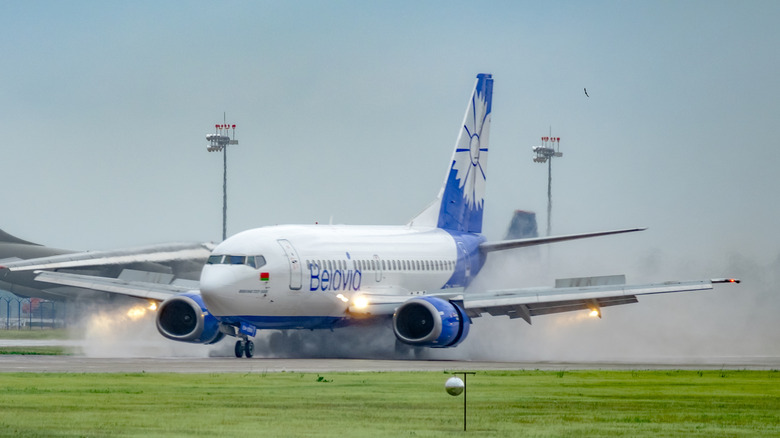
Let's assume you aren't a pilot. When you fly, it's on big passenger jets, like the one in this shot. That's a good thing. According to the National Transportation Safety Board, in 2024 you were 26.5 times as likely to be in an accident on a small aircraft as on a larger commercial flight. There were 300 fatalities that year aboard small planes, and none on commercial carriers.
Possibly this doesn't make you feel better about flying, and you're concerned that any airplane accident might be attributable to a tire going flat. After all, planes have wheels and tires just like cars, and as with the tires on your car, they can go flat. But unlike your car, commercial aircraft build in redundancy, and that's how, if a tire pops, that big jet can still land safely. Planes like the Airbus A320 have two wheels at the nose and two more each for the right and left legs of the landing gear. Each tire is often rated to handle over 50,000 pounds and inflated to incredibly high pressures. Blowouts are rare.
This means that pilots (and passengers) might not even know if there's a blown tire, thanks to that extra wheel at each corner. Maybe. Redundancy isn't quite the entire "solve" for this issue, so we'll explain what else the pilots of large or small aircraft do upon landing with a punctured hoop. Oh, and also, the real risk doesn't seem to be landing at all. It's the pilot mistakenly thinking the hazards of taking off with a busted tire are higher than they actually are.
Landing isn't nearly as big an issue as takeoff
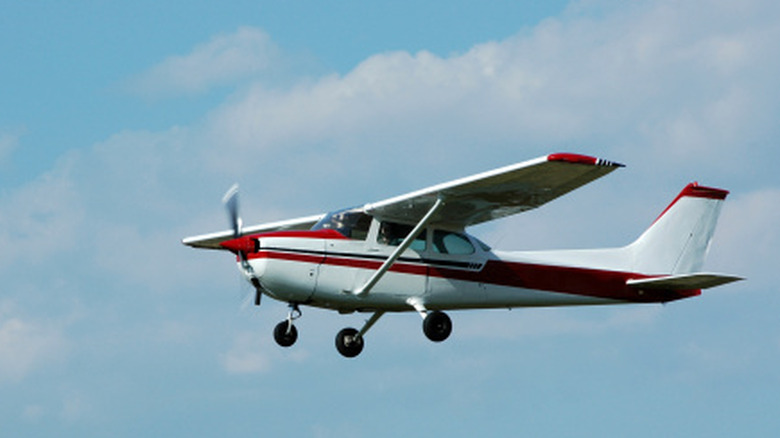
Let's tackle big planes before we look at wee ones. Commercial aircraft, like cars, have anti-lock brakes. Pilots are trained to jam them fully upon landing. Which, by the way, is what you're supposed to do during an emergency stop in your car. But you can't brake either side of your vehicle, which a pilot can do, to compensate for the plane pulling to one side if a flat tire is creating drag. Small aircraft also have separate braking control for both rear wheels, too, and pilots will use a similar technique to prevent the drag caused by a popped tire from yanking the plane to that side.
We'll dig further into other tricks pilots use in a moment, but first understand that taking off, not landing, has historically posed the greater flat-tire risk. In 1990 Boeing and the National Transportation Safety Board conducted a study of "over-runs," where the plane shoots off the end of the tarmac and crashes. Too often these "rejected takeoffs" were the result of pilot error thinking a blown tire posed a greater hazard than the last-second high-speed risk of an aborted takeoff.
Presuming any sized aircraft gets off the ground safely and there's a flat upon returning to the earth, if the flat is on either side of the landing gear, the pilot will place the aircraft's flaps fully down (those are the inboard section of the main wings that flip up or down), which cuts speed. And they'll steer the aircraft via the aileron control to touch down on the non-flat-tire side first. Once on the tarmac, they'll "opposite brake," by applying more braking on the "good" tire or tires.
Back wheels first
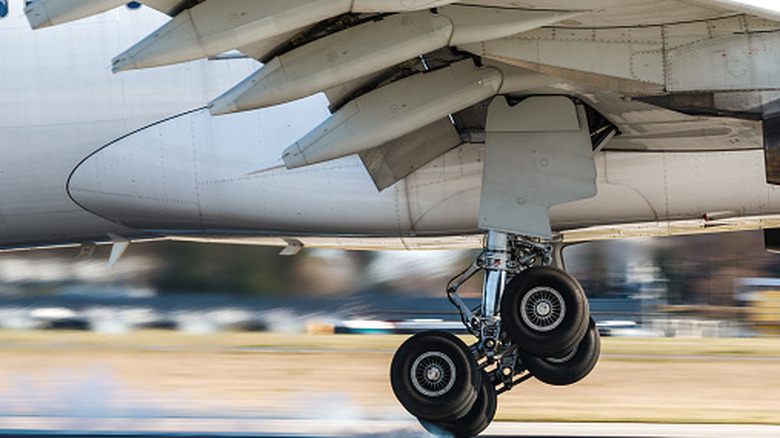
If the nose tire is blown the landing procedure is slightly different. The goal is to keep that tire from touching down until as late as possible. In that case the pilot of both a large aircraft and a smaller one will adjust the flaps to brake the plane, which ensures the aircraft first touches down on the main landing gear, and keeps the nose gear elevated. Once the plane is on the runway they'll pull up on the elevators (the flaps on the tail wing) to lift the nose and keep weight off that front tire or tires.
All things being equal, a pilot of a small aircraft or a big jet would share techniques. But they're not equal. Small aircraft like a little Cessna don't have redundant tires per side or at the nose. And unless they've been retrofitted with them, most don't have anti-lock brakes, either. More automated systems, better braking tech and the inspection regime for commercial aircraft have led to far fewer incidents of tire failures causing catastrophe for passenger aircraft. Smaller planes don't hew to the same inspection standards. And that includes fancy Gulfstreams.
A 2022 series in Aviation Week found that business jets don't have their tires checked for pressure as regularly as commercial planes. Also, their smaller tires endure much greater friction and their brakes have to withstand much higher heat.
Still, the moral of this story is that flat tires generally don't pose a huge danger either if you fly commercially or for smaller aircraft. Although flying aboard smaller airplanes is slightly riskier. See, paying way too much for that summer vacation plane ticket feels great now, right?