

Ned Jarrett's Hall Of Fame NASCAR Career Began With A Car Bought With A Bad Check
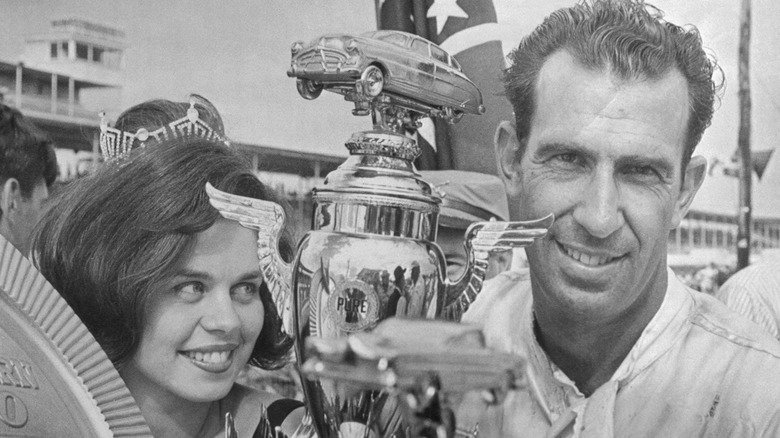
Ned Jarrett, a driver from the rough-and-tumble era of NASCAR, died at the age of 93 last week. Jarrett's calm demeanor and admirable sportsmanship garnered the nickname "Gentleman Ned," but his Hall of Fame career as a driver and a broadcaster might have never come to be if he hadn't used a bad check to buy his first competitive car in the Grand National Series.
Jarrett grew up on his family's 300-acre farm in Catawba County, North Carolina. Like many farmers in the area, his father also owned and operated a sawmill as a source of supplemental income. As a pre-teen, Ned worked as a bookkeeper at the sawmill, but his heart hoped for a future away from the family business. He developed a love for dirt track racing as a child, then leaned-in hard when construction of nearby Hickory Motor Speedway began in 1950.
A 19-year-old Jarrett entered his first race there in 1952, but had a difficult conversation with his father afterward, who believed that Jarrett would have a tough time in life as a racer — specifically earning the respect of his peers. While it's celebrated today, stock car racing's ties to bootlegging were once frowned upon. In a 2007 oral history interview with the University of North Carolina at Charlotte, he explained:
"Most of the drivers back then were either considered to be bootleggers or just a bunch of fools who didn't have any better sense than to get out there and risk their necks. And I certainly wasn't a bootlegger... That was a way of life for many people back then. But my family was never involved in that. And so I understood where he was coming from after we talked for a while. I said, "Okay, I won't drive the race car anymore."
A bad check was Jarrett's ticket to the big leagues
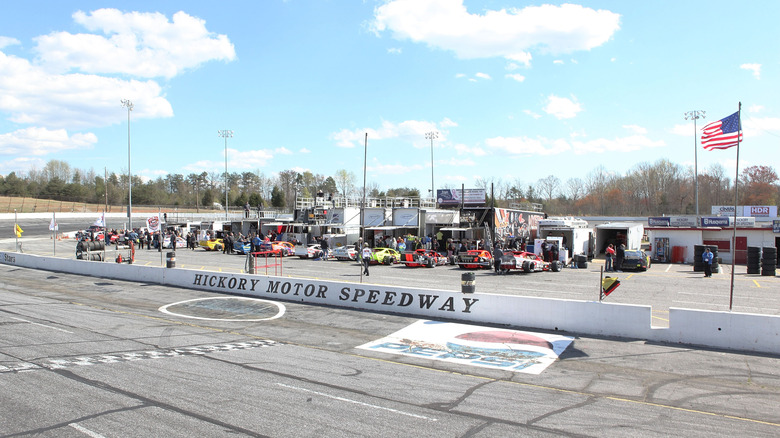
Jarrett was pulled back into racing just a few weeks later. John Lentz, his racing partner, fell ill one night and couldn't race the 1939 Ford coupe they co-owned. After switching shirts in Hickory's poorly lit infield, Jarrett raced in Lentz's place and finished second. Word spread that he was the one behind the wheel, and the story eventually reached his father, who changed his mind about his son competing in races. Jarrett became Hickory's track champion in 1955, interrupting Ralph Earnhardt's spell of five championships in seven years.
While Jarrett further proved his racing acumen by winning the 1957 and 1958 NASCAR Sportsman Division titles, he still couldn't break through in the Grand National Series, known today as the Cup Series. Jarrett believed that he needed better equipment. In 1959, he found a race-winning 1957 Ford that had been used by future Hall of Famer Junior Johnson. However, the upstart didn't have the money.
Jarrett decided to still write the $2,000 check for the car, but after the bank closed. He hoped to win two Grand National races over a single weekend: a 108-mile race in Myrtle Beach, South Carolina, and a 100-mile race at the Southern States Fairgrounds in Charlotte, North Carolina. The race victories would net him $1,900, and he would put together the remaining $100 for the car before the seller cashed the bad check. The scheme actually worked. Jarrett took the first two wins of his Grand National career and became a full-time driver in 1960.
Jarrett became a legend and built a legacy in NASCAR
Meteoric would be the best way to describe Jarrett's rise to prominence in the NASCAR Grand National Series. He won his first championship in 1961 with a single-race victory by averaging an eighth-place finish across the 52-race schedule. Jarrett would win his second championship in 1965 before abruptly retiring in the middle of the following season. He called it quits at 34 years old after a major back injury and the temporary withdrawal of Ford from stock-car racing. Jarrett remains the only Cup Series driver to retire as reigning champion.
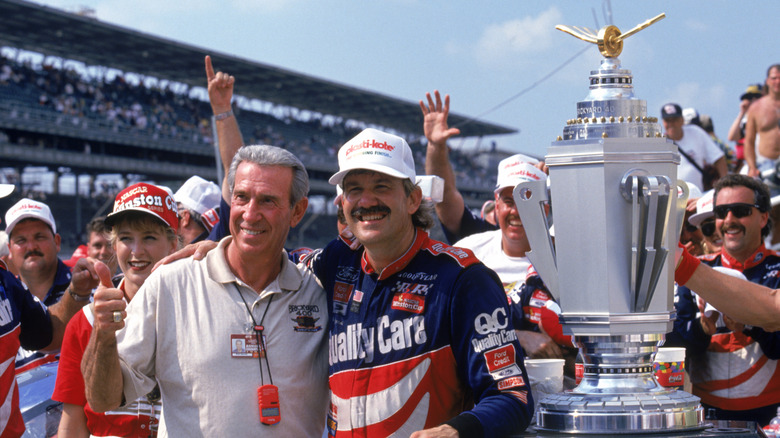
Jarrett would find his way back to racing as a radio broadcaster with MRN in 1978. Most racing fans of my generation fondly remember his television tenure with CBS during the '80s and '90s. To this day, Ken Squier and Ned Jarrett remain the iconic commentary duo for millions of viewers. From the booth, Jarrett also had the pleasure of watching his son compete. Dale Jarrett would become the Cup Series champion in 1999. Both father and son would be inducted into the NASCAR Hall of Fame in 2011 and 2014, respectively.
The corporate NASCAR of today might as well be entirely divorced from its early years, when the organization was proudly the racing home of outlaw bootleggers, but drivers like Jarrett help remind us of the outlaw spirit of racing.