

The Vector W8 Was America's Only True Independent 20th-Century Supercar
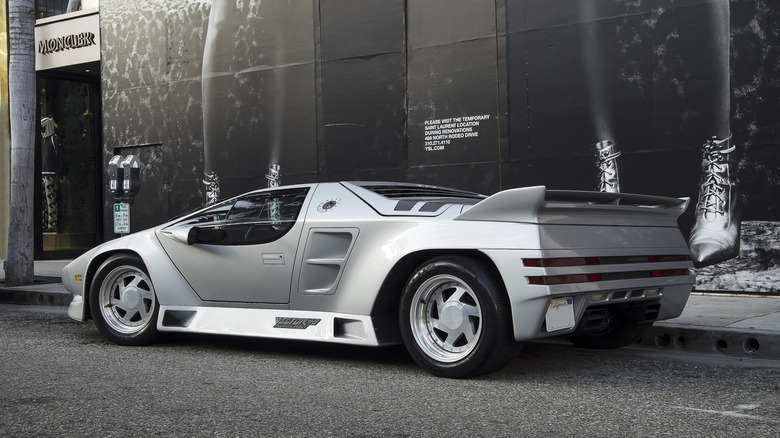
As early as the 1970s, Jerry Wiegert aspired to build the best, fastest, and most technologically advanced car on the planet, regardless of cost or time. He would spend the next two decades obsessively pursuing his aspirations, and the resulting Vector W8 would birth a Hollywood-esque story of an American supercar that was equal parts engineering achievement and cautionary tale.
Wiegert sketched the first ideas and even modeled a 1:5 scale model in 1971 for his supercar concept. With the help of Lee Brown, an autobody specialist in Hollywood, a rolling prototype would be built on a Porsche chassis. By the late 1970s, this prototype had been named the W2. This concept evolved through the 1980s before finally reaching production in 1990 as the Vector W8 — nearly 19 years after Jerry put pencil to paper.
Wiegert's fascination with aerospace technology wasn't just reflected in the company's name — the W8 was also outfitted with aircraft-certified suspension components, wiring, standard-fit fire extinguishers, and a body constructed from carbon fiber and Kevlar. At the core of the W8 sat a twin-turbo 6.0-liter V8 featuring forged aluminum pistons, a forged crankshaft, and stainless steel connecting rods that culminated in a claimed output of 625 hp and 600 lb-ft of torque. Vector declared it could reach 60 mph in 3.8 seconds and top out at 218 mph.
The arrival of the W8 was monumental, though critics may not have seen it as such at the time. America's only domestically built supercar and its creator would quickly make a name for themselves for a handful of fascinating reasons.
The rise and collapse of the Vector W8
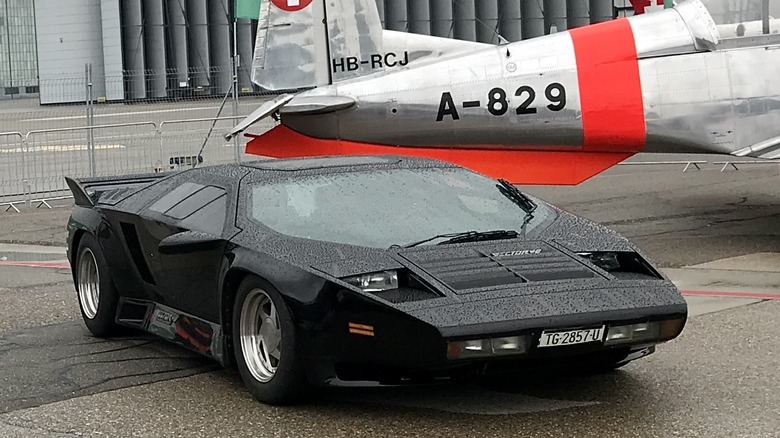
Car and Driver's early 1991 test of a pair of W8 prototypes became the stuff of legend — for a plethora of mechanical mishaps. The first prototype's transmission failed while the next overheated. Wiegert's team would work overnight to address these issues, and the magazine miraculously recorded a 0-60 time true to the company's claim, along with a 12.0-second quarter mile. Both performance figures were impressive and put the W8 squarely in the realm of the Ferrari F40. The American supercar's performance would be applauded in the following year's Road & Track review.
Then came André Agassi. The tennis star reportedly spent $400,000 on a W8, only for the carpet above the exhaust to melt during a drive near his Las Vegas home. His brother would go on to call it a death trap. Agassi returned the car and asked for his money back.
The mixed public perception, paired with ongoing financial issues led Vector to go into receivership in 1993 — the company had built just 17 roadgoing W8s. Megatech — an Indonesian conglomerate — stepped in, and Wiegert's own board of directors would vote him out. In a last-ditch attempt, he changed the factory's locks and hired armed guards to retain control of his passion project, though court would eventually rule against him. Megatech — who also owned Lamborghini at the time — quickly replaced the W8 with the Diablo-based M12.
Although Wiegert eventually reclaimed the Vector name and assets, he died in 2021 at 76 years old. The W8 never fulfilled its promise commercially, yet it captured imaginations in a way that outlasted Vector itself. Through magazine features, video game appearances, and its storied mythology, the Vector W8 was the reflection of an American independent who envisioned a stealth fighter for the streets. It's one of those cars you'd wish more people knew about.