

Why Porsche's Mezger Flat-Six Engine Is So Bulletproof
The history of the Porsche 911 is split between two distinct periods: air-cooled and water-cooled. Enthusiasts constantly debate the difference in driving quality and feel, but one German engineer's innovative breakthroughs transcended the generational divide with an engine design almost as iconic as the company it's made for.
Hans Mezger's involvement with Porsche is quite easy to sum up — the company we know today wouldn't exist without his brilliance and innovative outlook on engine design. Mezger was involved in Porsche's Formula One and endurance racing projects through the golden era of its motorsports dynasty, yet enthusiasts celebrate his roadgoing flat-six design as his greatest mark on Porsche's legacy.
The enthusiast-designated "Mezger engine" appeared across four decades of the Porsche 911 with the 996 and 997 GT3, GT3 RS, GT2, and Turbo models touted as the final versions of his original design — the last fully realized statement of everything Mezger had worked for during his career in Stuttgart before retiring in 1993. The 996 and 997 were the first water-cooled 911s, and they both share the same basic boxer layout. But when the 996 GT3 was being developed in the late 1990s, Porsche's GT department decided the Carrera's standard M96 flat-six wasn't adequate for the job. Instead, they reached back to the Mezger-powered 962 and 911 GT1 racecars, which had dominated endurance circuits for over 20 years.
Mezger's architecture was never derived from the standard Carrera engine, and Porsche decided that his design was still superior to the standard M96 and M97 found in the Carrera. One of the reasons for that was its gear-driven intermediate shaft (IMS) supported by plain bearings. Instead of a sealed bearing, the Mezger flat-six receives continuous lubrication from the engine's main oil system. That single engineering difference laid the foundation of the Mezger's "bulletproof" reputation.
The Mezger engine stems from motorsports roots
Speaking of oil, the Mezger engine runs a true dry-sump system with a separate external oil tank. Scavenge pumps remove oil from the crankcase and return it to the oil tank. As a result, oil pressure remains mostly consistent regardless of what the car is doing dynamically.
The Mezger crankcase uses thicker walls and stronger bearing surfaces than the M96. Combined with the vertically split crankcase design, it provides the structural rigidity needed for sustained high-rpm operation under boost or when approaching the 8,400-rpm redline. Because of these ingenious cues, the Mezger engine handles track use that would destroy a wet-sump engine. Many Porsches with this engine still thrive past 100,000 miles — including examples with extensive track histories. Some have even reached 200,000 miles on original internals.
Individual cylinder liners are another key differentiator. On standard M96/M97 engines, bore scoring — a known wear issue — often requires complete crankcase replacement or expensive repair. On a Mezger, each liner can be replaced independently. In other words, damage that would total an M96 engine is a maintenance item on a Mezger.
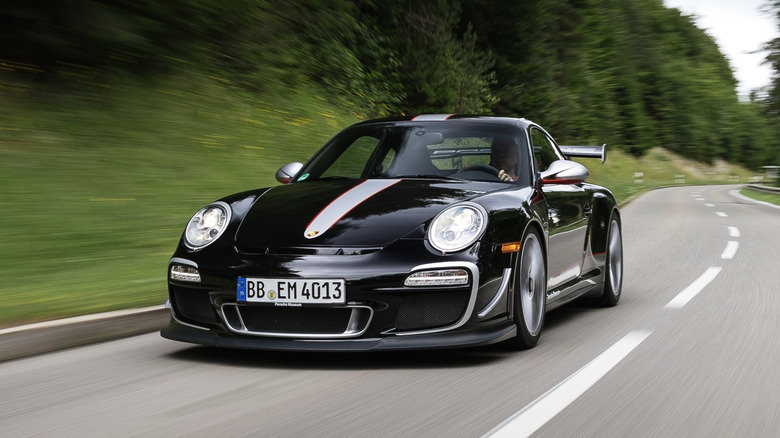
At last came the 997 GT3 RS 4.0 in 2011. The final form of the Mezger engine, this flat-six produced 500 naturally aspirated hp at 8,250 rpm on a 12.4:1 compression ratio, without direct injection. The Porsche 911 generation that followed (991) would move on to a new architecture, but not because the Mezger had been mechanically surpassed. Rather, Porsche found it too expensive and race-focused for the comfort-leaning market, and it didn't support the brand's direct fuel injection or its PDK transmissions.