

BMW Wants To Replace Factory Workers With Human-Shaped Robots
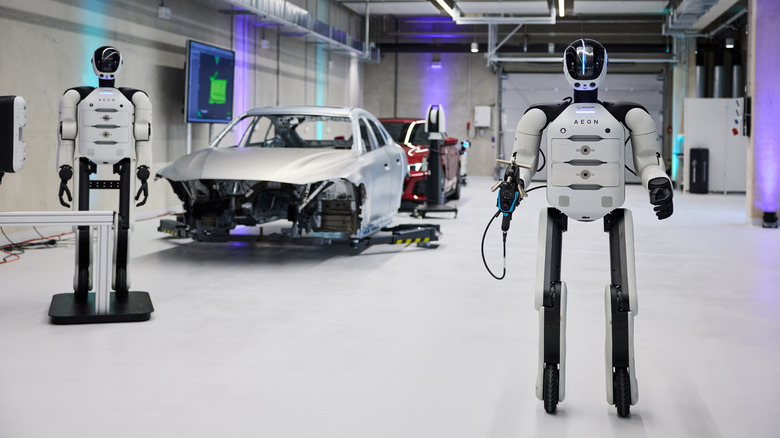
The popular image of a modern vehicle assembly plant always includes factory workers alongside huge robotic arms. But some automakers have ambitions of changing those images, making those pesky humans redundant, and putting robots next to the robots. BMW deployed its first humanoid robot worker in a pilot program at its Leipzig plant earlier this year. The German automaker stated, "The goal is to relieve employees and further improve working conditions." However, these robots aren't as autonomous as someone would presume.
The machines were produced by Hexagon, a Swedish technology company, and in true corporate buzzword fashion, BMW referred to its humanoid robot program's training process as "Physical AI." The robot, named Aeon, can be fitted with a variety of tools on its hands to mimic how we, flesh-and-blood humans, can use tools. Mimic is a term that will come up often. According to the BBC, Hexagon's robots learn by mimicking the movements of a human performing the same task, using video or motion sensors. Arnaud Robert, Hexagon's president of robotics, claims that we're only "a year or two out" from robots learning actions from literally watching humans, significantly reducing the robot's "training" time.
The robots can't work a full shift, but they'll definitely steal our jobs
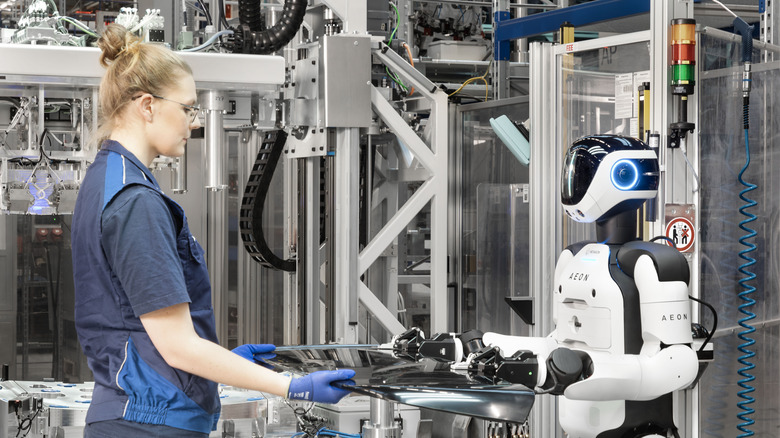
I wouldn't fear these robots successfully staffing an entire assembly line just yet, as there are some severe limitations. For starters, the Aeon robot can't complete an eight-hour shift because its battery lasts only three hours. Its manufacturer claims the robots are designed to walk to a charging station and swap their own battery. Sounds like even robots need two 15-minute breaks and a lunch hour on each shift. Michael Nikolaides, a BMW senior vice president, said:
"We know that staff will be short in a matter of years, and humanized robots help. When we automized the production of cars in the '70s, everybody said this will lead to a lot of job losses, but the opposite was the case. There were new jobs created by this new technology, and that's the way we look at [humanoid robots]."
I can't square this circle. How is it that BMW needs these robots because of a shrinking workforce, but also reiterating that these machines will create more jobs? Isn't it one or the other? If the Aeon isn't more labor-efficient, why deploy them in the first place? With a 100% employment rate being statistically impossible, it seems that BMW is actually concerned about rising wages. According to Reuters, the IG Metall union secured a 5.5% wage increase for its workers in 2024 over the following 25 months. The union is Germany's largest, representing millions of industrial workers across a wide range of companies, including Mercedes-Benz and BMW. As far as we know, the Aeon isn't a member of a union.