

The Stubby Truck You See At Warehouses Is Called A Yard Goat, Here's Why It's Special
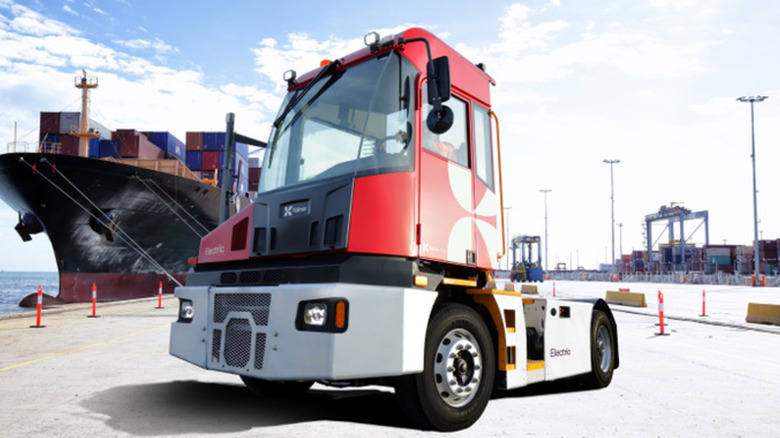
Big semi trucks are a common sight on U.S. roads, with some states even letting them pull three trailers at a time for maximum cargo-carrying capacity. Yet there's another kind of truck that may be just as vital to the transportation industry. It goes by many names, including yard goat, terminal tractor, spotter truck, yard truck, yard dog, and mule, but it has a single focus: Yard goats are designed for moving trailers around warehouses, cargo yards, and the like, where tiny distances are involved.
It takes some unique features to get the job done, of course, and their design is a great place to start. Unlike typical semis, a terminal tractor tends to have a small, stripped-down and offset cab with a rear exit door and large windows all around for visibility. And although they're still Class 8 vehicles, they have shorter wheelbases than traditional semis. This makes them much more maneuverable, which comes in handy in the tighter confines of a cargo yard.
However, the biggest benefit of a yard goat may be its hydraulic fifth-wheel lifting boom, similar to what you see on certain wreckers. With a yard goat, drivers can reverse their trucks so the boom slides under the front edge of the trailer. Then, when properly connected, the boom can raise the trailer off its landing gear without the need to crank the gear up by hand, as is usually required when hooking up to a semi. It's a pretty big deal because the repetitive cranking process can lead to serious injuries.
Putting a spotlight on yard goat technology
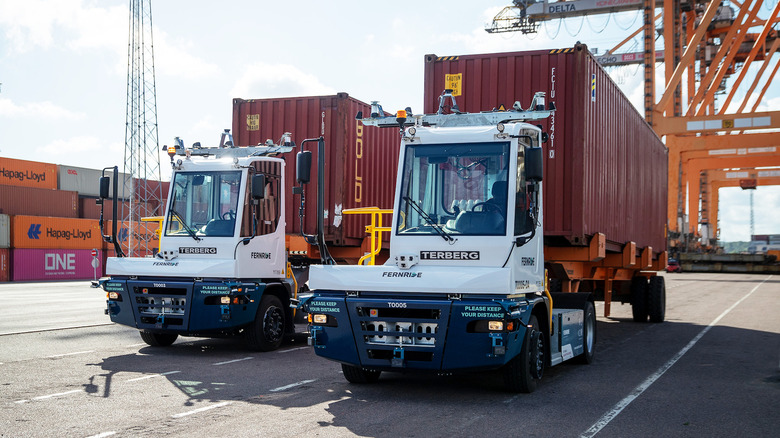
Yard goats are a fairly new invention. Daimler-Benz claims Gottleib Daimler built the first motorized truck in 1896 — despite the existence of the 1769 Cugnot Steam Drag that some say proves he didn't. But the first dedicated terminal tractor didn't come along until 1958, when it was invented by Ottawa Steel Products (now Kalmar Ottawa). And spotter trucks continue to offer some notable new technologies.
Among them is a trailer-chassis setup from a partnership between Krone — a German semi-trailer company — and Aucos, which invented an automatic coupling system that's at the core of the innovation. It allows properly equipped terminal tractors to automatically connect its electrical/air lines to the trailer by running them through a modified fifth-wheel boom. When the trailer kingpin couples with the boom, it essentially plugs the trailer into the tractor's lines. As a result, the yard-dog driver never has to leave the cab to hook up, move, and unhook trailers. Needless to say, this can be a key driver in a yard truck's ability to move trailers three to 10 times quicker than a conventional semi.
The current crop of spotter trucks is also following the tire tracks of the latest semis by developing all-electric and autonomous versions. An electric yard goat like the Kalmar Ottawa's T2 EV makes sense since they're almost always close to a cargo yard's charging station. As for the self-driving ones, Europe's Fernride already has deployed them in Estonia — albeit with remote human oversight. Let's just hope the autonomous terminal tractors do better than Tesla's Texas robotaxis, which crash four times more often than human-driven cars.