

What's The Difference Between A Fire Truck And A Fire Engine?
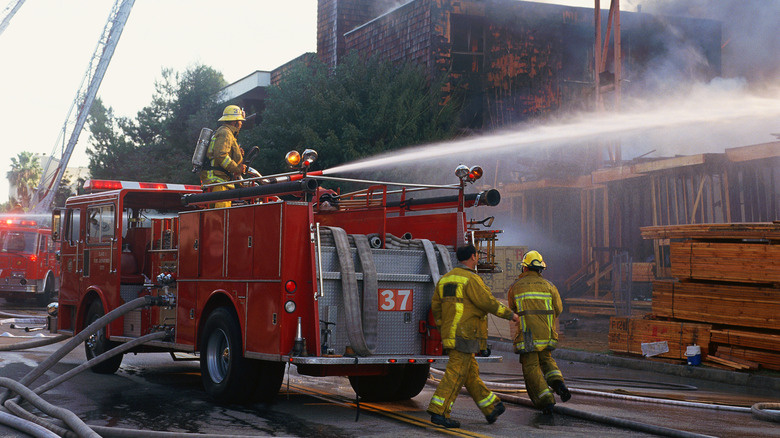
Vehicle-based firefighting equipment has come a long way since English inventor Richard Newsham patented the first fire engine in 1721. His horse-drawn machine incorporated a long-levered pump into its highly maneuverable wooden chassis, letting two firefighters, one at each end of the lever, begin pumping water through a leather hose. Yet the first fire trucks are typically dated to the beginning of the 19th century, at least in the United States. For instance, there's evidence that Rochester, New York, bought its first hook-and-ladder truck in 1824 — for $50.
How can both dates be true? Well, there's actually a technical difference between a fire engine and a fire truck. "Fire engine" refers to a vehicle designed to carry and pump water, while a "fire truck" generally brings along other pieces of equipment, like aerial ladders, to help deal with the flames.
The concept behind fire engines — using a pump to deliver a stream of pressurized water — dates all the way back to the third century B.C. That's when Ctesibius invented a hand-operated piston water pump, the principles of which would still be used fighting fires all the way up to the 1800s.
By the 1840s, steam was replacing human power for the pumps, although not the vehicles themselves, and internal-combustion engines took over for both in the 1920s. In some cases, though, they required two motors, one for the vehicle and a separate one for the pump. The two-engine setup remains in play today, too, as one of the world's biggest fire engines, the Oshkosh P-15, is engineered to take on airport fires with a pair of 495-horsepower Detroit Diesel V8s.
The history of the fire truck
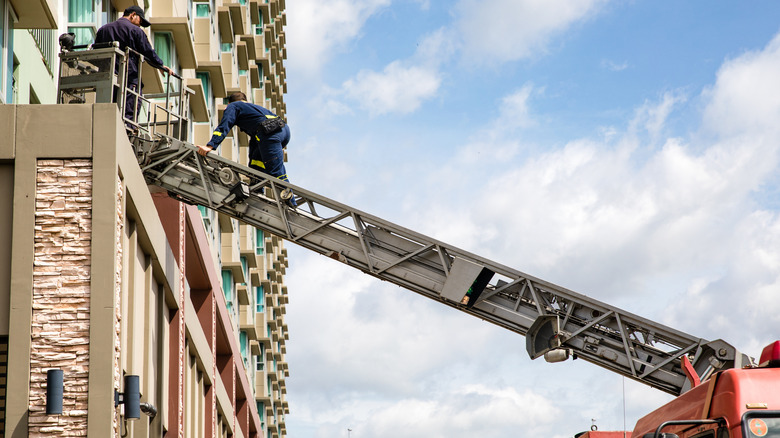
As mentioned, fire trucks with hooks and ladders were in service during the early decades of the 19th century. But a strong case can be made that the modern era for fire trucks (not fire engines) began in 1868, courtesy of Daniel Hayes. The "Hayes Extension Hook and Ladder Truck and Fire Escape" was invented to handle the firefighting needs of growing cities, where taller and taller buildings were becoming harder and harder for fire crews to safely reach.
Previous attempts at long ladders had ended in failure, and sometimes fatalities, but the Hayes system proved to be up to the task. With four to six firefighters working the crank, the telescoping Hayes ladder could be raised up to 85 feet in the air in under 40 seconds. In addition, by mounting the ladder's platform on a turntable, the crew had a much easier job of getting the ladder into an optimum position. Nowadays, the largest turntable-style fire-truck ladder in the world, found on the Magirus M68L, has a working height of 223 feet. Some folks say that huge fire trucks like these are making us all less safe on the road, though, and they clearly aren't suited for Formula Drift.
Of course, ladder trucks usually have other equipment on board as well, including special hydraulic rescue tools (among them, the Jaws of Life). And yes, there are trucks that do double duty by carrying water and ladders. In fact, the quint truck actually does quintuple duty. It can bring all five core fire-fighting tools to bear on a blaze: water, a pump, hoses, ground ladders, and an aerial ladder.