

The Legend Behind Monfort Lane – The Fastest Trucks On America's Highways
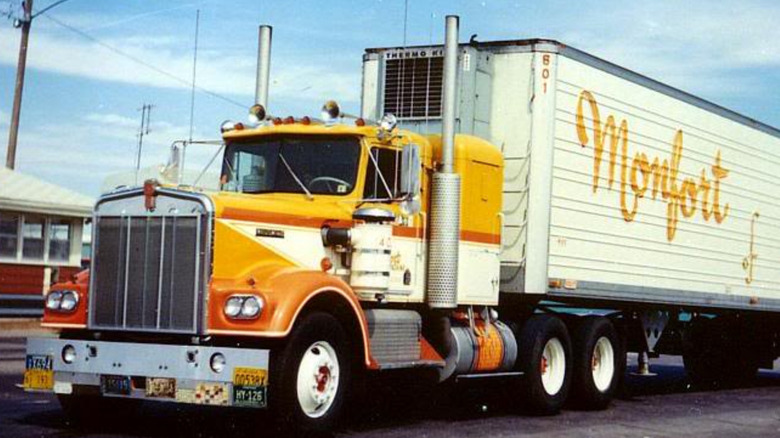
In the early 1970s, American trucking was quite different from what it is now. There were no speed limiters and no GPS trackers, and the demand for fast-moving beef was quite high. And that led the American highway — specifically, Interstate 80 — was the birthplace of the legend of Monfort trucks. They weren't just vehicles for a meat packing company; they were a logistics experiment wrapped in loud paint jobs, aptly earning them the nickname "Circus Wagons." This was primarily done for marketing, as the striking combination of bright orange, yellow, and white made them easy to spot from miles away.
Monfort was a meat-packing conglomerate based in Greeley, Colorado, that supplied tons of meat to New York, 1,700 miles away. Since beef is a perishable item, every minute on the road counts. So, on Labor Day, 1970, a fleet of 11 brightly-colored rigs aimed to make the journey with as few stops as possible — if any. Monfort cut out notorious Chicago stockyards to avoid fees and animal abuse, opting instead to process the meat in Colorado and haul it directly to the East Coast. To do this, it needed the fastest machinery and the most dedicated drivers.
These efforts led to the left-hand lane on the I-80 being known as the "Monfort Lane." It was a space unofficially reserved for the super-fast orange-and-yellow trucks that everyone saw coming — and most couldn't catch.
Big Iron and the 350 horsepower Cummins
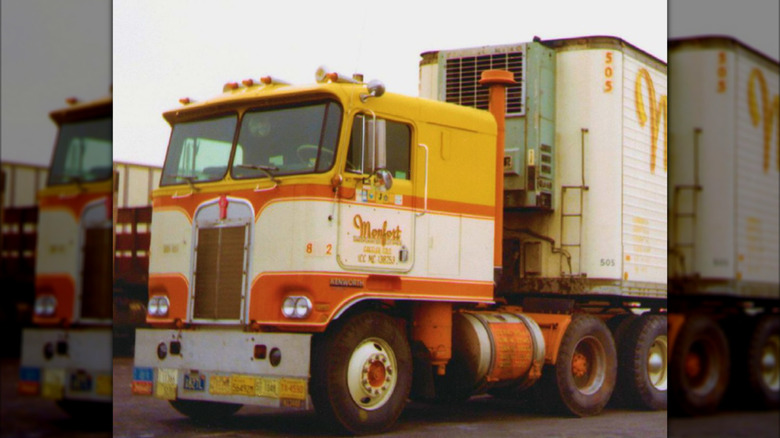
To get up to speed and stay there, you need solid mechanicals. In that context, Monfort's rigs were the Ferraris of the trucking world. The fleet primarily consisted of Kenworth W925s and later K100 cabovers. These weren't your standard tractors, either — they were specced to go for a top speed of 78 miles per hour, way before the national speed limit was 55 mph.
Under the hood of most of these rigs sat the legendary 355-horsepower Cummins NTC350 engines. By today's trucking standards, 350 horsepower isn't particularly impressive, but it was serious muscle in the early '70s. That supposedly wasn't even their limit, as some old-timers swear about seeing Monfort rigs running 8V-T1 Detroit Diesels and 600-horsepower Caterpillar V8s. These old gas guzzlers could handle such power because they didn't have to worry about running costs (something that modern EV truckers are finding hard to digest).
Of course, speed is nothing without the range to keep it up. Each Monfort truck was fitted with massive fuel tanks, allowing them to carry up to 300 gallons. This was a tactical necessity, since the goal was to make the run from Greeley to Hunts Point, New York, with just one fuel stop at the company's dedicated facility in Morris, Illinois. By minimizing stops and maximizing the mechanical output of the Cummins power plants, Monfort created a relentless logistical machine.
Logistics of insanity: the four-hour shifts
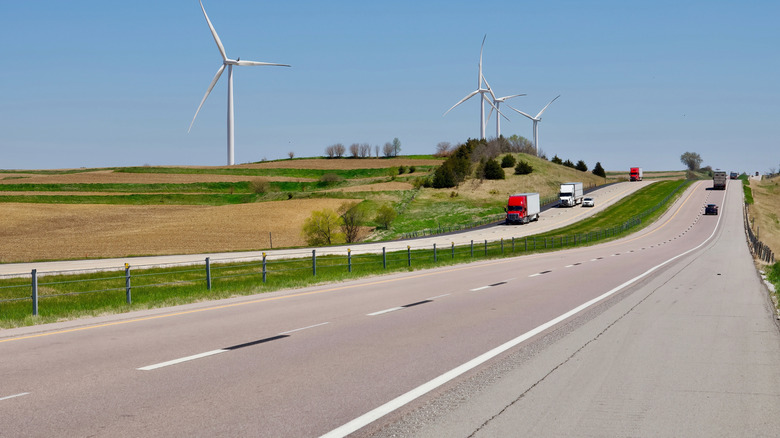
If the engines were the heart of the Monfort logistics operation, the drivers were the adrenaline coursing through its veins. Monfort hired teams willing to operate on a brutal, precision-timed four-hour shift rotation. While one man was at the helm at 78 mph, the other was in a "swinging bunk" — a mattress suspended by heavy-duty springs — designed to keep the sleeping driver from being tossed around on the rough interstate.
This rotation meant the truck never stopped moving. A team would leave Greeley and hit the I-80 corridor, and the wheels would hardly ever stop turning until they reached the loading docks in New York. It was terrifyingly efficient. A Monfort team could reliably make two round-trips across the over-1,700-mile route per week, accounting for nearly 7,000 miles of highway in seven days. To put that into perspective, the average driver today struggles to touch 500 miles daily under modern regulations (and this isn't helped by the other hardships American truck drivers face today).
Like with the bunks, these trucks were hauling beef carcasses hanging from rails in the trailer, so the driving dynamics were tricky. If you took a corner too hard or panic-braked, the beef would start swinging, creating a pendulum effect that could potentially flip a trailer. It took special skills to handle a top-heavy, high-speed load. The trucks were frequently empty on the return trip, though, and a Monfort truck running with an empty reefer was essentially a rocket ship. They were known to speed across the plains of Nebraska, leaving passenger cars in their wake.
CB radio folklore and the 100 mph myth

The 1970s were the golden age for the CB radio, and Monfort was a hot topic for highway gossip. If you got on Channel 19, you probably would end up hearing a story about a Circus Wagon. A famous story concerned the possibility fixed tickets. According to this tale, if a Monfort driver got pulled over for speeding, Monfort itself would handle the fine. Of course, the company denied it, but the rumor persisted because of how the trucks operated on the highway.
You'd probably hear tales of drivers following closely behind Monfort rigs throughout the night, allowing them to speed up while avoiding cops. Another interesting piece of lore was the "coffee handout." In this piece of gossip, a Monfort team running low on caffeine pulled alongside a slower-moving truck, and the co-driver leaned out of the door to grab a thermos from the other driver while both trucks were cruising at 50 mph.
Whether these stories were true didn't matter; Monfort's reputation was cemented in stone. Besides, the folklore was fueled by the sheer spectacle of these Circus Wagons speeding through the night in a literal wall of orange.
The downfall of the Circus Wagon
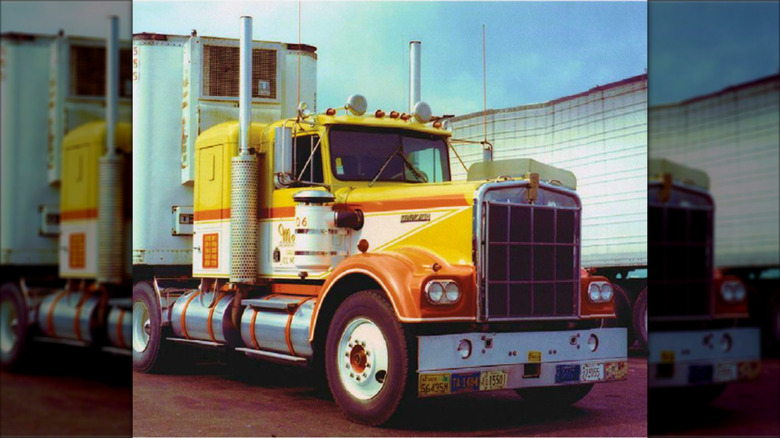
The end of this legend came due to three factors: fuel prices, deregulation, and the new management. In the mid-'80s, the Motor Carrier Act of 1980 deregulated the trucking industry, leading to increased competition with lower prices. Suddenly, traffic started to become a much bigger issue — and Monfort was having trouble with meeting profit margins.
Fuel economy became paramount. The Circus Wagons were many things, but calling them "efficient" was a stretch at best. As the price of diesel climbed, the cost of moving beef at Mach 1 speeds and returning with an empty load became unsustainable. Internal management changes also led to new overseers at the helm with little knowledge of the precision-fueled Monfort logistics operation. They brought in new trucks without bunk beds and added backhaul to maximize profits. This led to massive driver attrition, forcing Monfort to get lease operators and eventually switch over entirely to owner-operator logistics.
In 1987, the Monfort family sold the company to ConAgra. The transition marked the end of the Circus Wagon, which was replaced with more standard and subdued corporate colors. The four-hour team rotation was also phased out in favor of more rigid, legally-compliant shifts. With these changes, the Circus Wagons entirely disappeared into the history books, leaving behind a vacuum.
The lasting legacy of the Circus Wagons
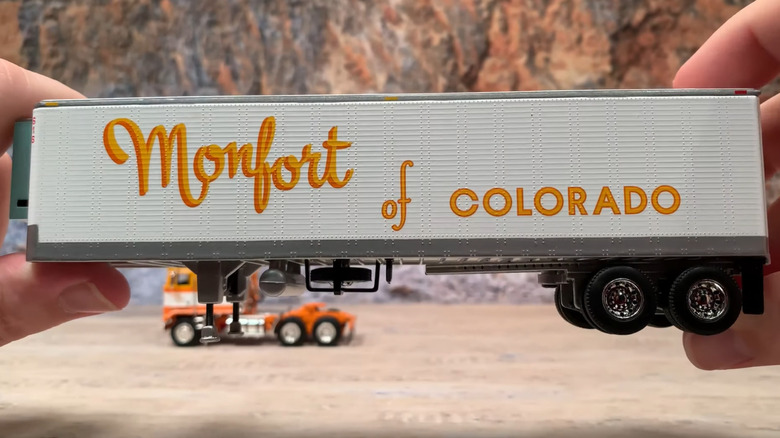
Today, you won't see a Monfort truck on the I-80, but its legacy is etched on the American highway and trucking industry. To the modern trucker governed at 65 mph and monitored by driver-facing cameras, the Monfort era sounds like a fever dream. It was a time when a man, his machine, and 1,700 miles of asphalt were all that mattered. The Monfort Lane is still a term used by old-school drivers to refer to the hammer lane, a nod to the ghosts of the orange-and-yellow K100s that dominated the hills of Pennsylvania.
The Monfort family moved on to other ventures, the most notable one being its ownership of the Colorado Rockies baseball team. The trucking world still remembers the name, though. Scale modelers still painstakingly recreate the Circus Wagon paint schemes, and die-cast Monfort rigs are prized collectibles that sell for hundreds of dollars. The Monfort legend survives because it represents a specific kind of American ambition: To do something better, faster, and louder than everyone else.
Today's world is one with optimized routes and safety sensors, which is better for the general public. But the American trucking industry's overlooked trucking crisis has made things difficult for the workers themselves. With that in mind, it's hard not to miss the idea that a load of beef was important enough to warrant such an intense chase across the plains. The Circus Wagons were glorious, diesel-smoke-filled legends that ran on the Monfort Lane reserved for the bravest amongst us.