

Why These Two States Still Don't Have Hold-Open Clips On Gas Pumps
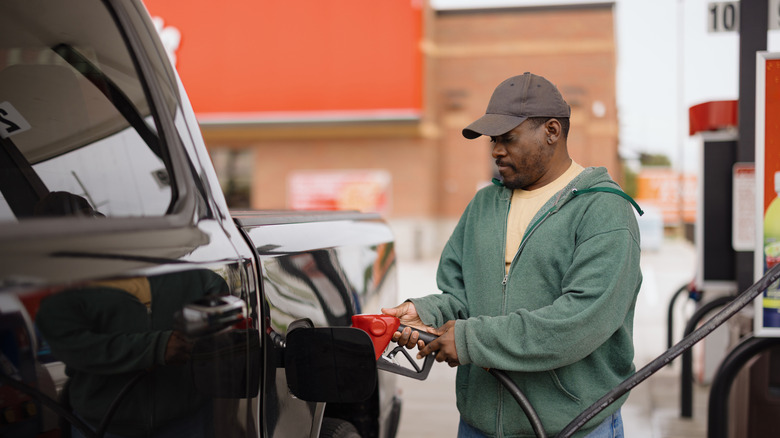
If you don't live in Rhode Island or New York, you've probably never experienced having your hand turn blue while gripping a gas pump in January. Lucky you! Unlucky, New Yorkers and Rhode Islanders, who live in the only two states in the nation that effectively ban hold-open clips.
Likely, if you live in the rest of the nation, you've never even thought about these mechanisms at gas stations that allow the pump to stay in "fill mode" without you having to keep fighting the spring. Just in case you want to suffer the pains of New Yorkers and Ocean State dwellers, go ahead and try to put gas in your car without using the clip — and feel the bureaucratic machine pushing back against your slowly weakening grip. (Although, to be fair, Jalopnik readers have shared far worse gas station stories.)
Bureaucracy, we say? Yes, because New York's fire-suppression laws are so confusing that gas station owners have avoided updating their pumps — which New York doesn't actually ban anymore, thanks to newer pumps and changes in car design that suppress possible fires caused by sparks or static electricity. Still, even updated guidance from 2018, which tried to prod station owners to add hold-open clips or use them at new gas stations, offered all the clarity of a parent trying to teach their child about the birds and the bees without actually using the word "sex." That's why a year ago, New York State Sen. Joseph Griffo, who represents a particularly frigid part of the Empire State outside Syracuse, put forth legislation to overtly push for hold-open clips.
Hold-open clips are ingenious!
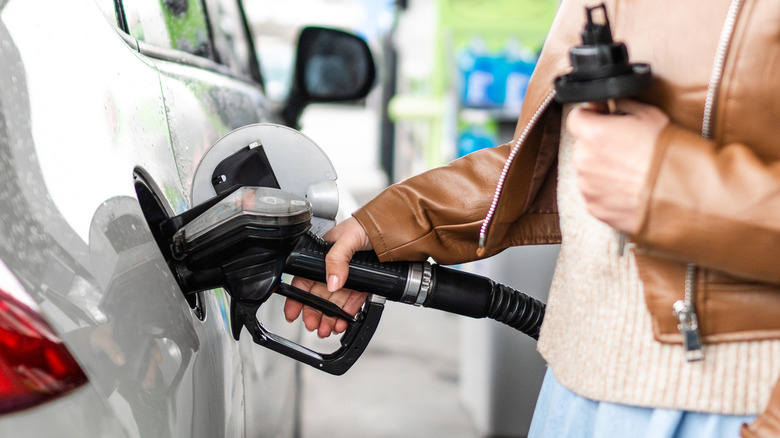
We know you're a nerd, because you're reading Jalopnik. Still, you probably haven't thought very deeply on the mechanics of how a gas pump knows when to stop. (Save that they don't in New York and Rhode Island.) The answer, courtesy of English science wiz Steve Mould, comes down to what's known as the Venturi effect, which has a bunch to do with how gases and fluids flow at different pressures. Essentially, a gas pump has a small tube at its tip that sucks air while the rest of that nozzle sprays out gas. Sucking that air creates a tiny bit of vacuum within a chamber in the handle.
When the pressure in the handle is constant (as fuel flows out of the pump and that nozzle still sucks air) a spring in the handle that's opened when you start pumping will remain open. But that chamber, which acts like a balloon from that small vacuum effect and sits above the spring, will change shape once that tube in the tip starts drawing fuel rather than air. In that instant the vacuum pressure switches in the handle, releasing the spring and shutting off the pump. It's an ingenious mechanical design with only a few moving parts, which is also why it's so widely used and very reliable.
The 10-foot rule

There's another part of this pending law that is head-scratching. The version that's passed only one chamber of the legislature, the New York State Assembly, reads in part that "any person, other than an attendant, who uses a hands-free gasoline or diesel fuel dispensing nozzle shall remain within ten feet and within plain sight of the refueling point during any refueling operation."
Hold the phone (or the nozzle) for a beat here. Consider why constituents in New York want automatic fuel pumps. We've just learned, above, that the mechanisms are pretty foolproof. Now say it's January, and what you want to do while pumping gas is buy yourself a cup of hot coffee. This is, after all, is what we do: We go to gas stations and buy a bunch of other products besides fuel. But New York State legislators want you to let that spring clip do its thing — but still have you hover in a minus-20-degree crosswind and monitor the device.
Never fear; this bill is still languishing in the State Senate and may never pass. And it could be worse. You could live in Rhode Island. There, during a brief era of statewide wisdom, a special style pump once ran wild and free across Little Rhody. These sucked vapors while they poured forth the fruit of the earth, and they were also permitted to sustain delivery sans human babysitting. But bureaucrats, ever-vigilant, banned those convenient fillers in 2017, and there isn't even a whiff that legislators want to revert to the national mean.
There could be hope, however. A decade ago, neighboring Massachusetts changed its laws to allow hold-open clips. Never say never, Rhode Island!