

The Hot Vee Engine Layout Revolutionized Turbocharging, And This Was The First Carmaker To Use One
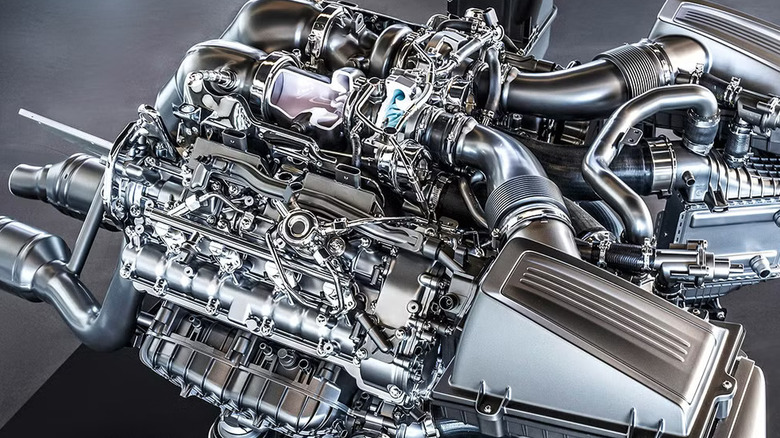
While Mercedes may have been the best at marketing the idea of "hot vee" turbo engines with the AMG GT, it wasn't the first production car to feature the concept — that honor belongs to the 2008 BMW X6. Now, however, with Ferrari's 296 lineup nestling two turbos within the V of the engine and Lamborghini employing the same idea in its V8 Temerario, the revolutionary tech has seemingly become a staple of the high-performance automotive landscape, particularly in the upper echelons. It's worth pointing out that while the X6's N63 V8 was the first production engine with a hot vee configuration, Ferrari pioneered the idea in the early 1980s in F1 land, when the marque switched from its 180-degree V12 to a twin-turbo V6.
In contrast to a traditional twin-turbo V6 or V8, where you'd find the intake manifold between the vee and the exhaust pipework outside the vee, engines with the hot vee configuration flip the layout — so now you have the turbos sitting inside the vee and the intake manifold routed around the outside of the engine. This arrangement presents several advantages, including better packaging efficiency, reduced lag, and improved throttle response.
Exhaust gases have a shorter travel path, resulting in turbos that spool quicker. Having the turbos in the "hot" side of the V enables the intake manifold to be positioned in a way that it supplies a much cooler intake charge, resulting in better engine performance and reduced chances of damage from detonation and pre-ignition. Since the engine takes up less space than a traditional twin-turbo layout, engineers can package it more efficiently in locations that optimize weight distribution and handling — critical factors when it comes to high-performance cars.
Understanding the BMW N63 V8
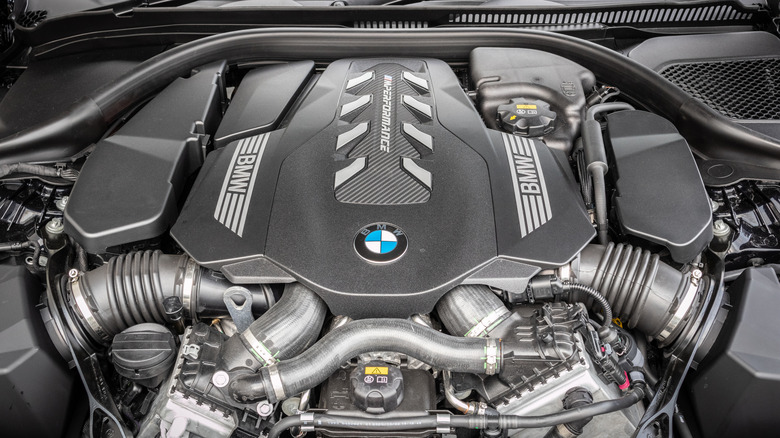
Although the N63 has its fair share of reliability concerns, the engine is quite a smooth and stout performer. Since debuting in the E71 X6 in 2008, the 4.4-liter twin-turbo V8 has found its way into many past and present BMWs with the 50i suffix, powering cars like the 5, 6, 7, and 8 Series to utility vehicles like the X5, X6, and X7. Depending on the variant, power and torque figures range from 402 to 523 horsepower and 443 to 553 pound-feet.
Even though the hot vee was a revolutionary step, it introduced complexity that marred the engine's reputation quite a bit, especially when it comes to service and repair. Discussions on enthusiast forums suggest the general consensus is to stay away from early N63 BMWs.
The original N63 was notorious for its valve stem issues, turbocharger failures, and high oil consumption. Although BMW improved later versions of the engine, the N63 was never a benchmark for reliability compared with its competitors, according to BMWBlog. Speaking of variants, the original N63 (N63B44O0) was followed by the N63TU (N63B44O1), which debuted around 2014. Then came the N63TU2 (N63B44O2) in 2016, with the latest N63TU3 (split into N63B44M3 and N63B44T3) rounding out the lineup. In BMW lingo, TU stands for "Technical Update." These later N63s are also found in newer Range Rovers.