

What's The Difference Between Unibody And Monocoque Construction In Cars And Trucks?
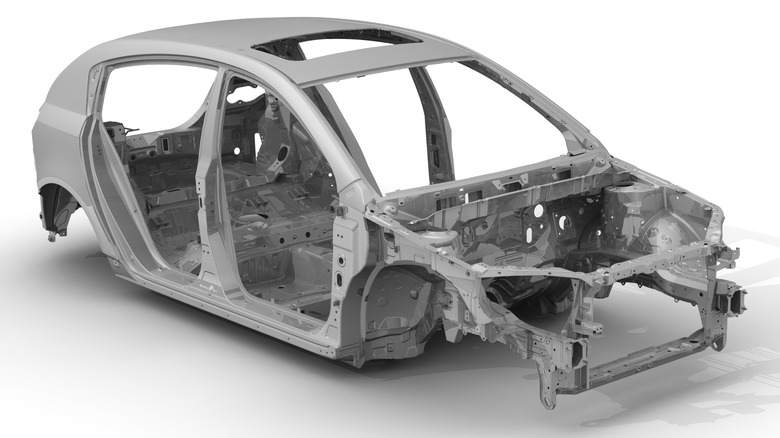
For decades, car enthusiasts, marketing brochures, and even some engineers have often used the terms unibody and monocoque interchangeably, even though it is a bit like calling a grilled cheese sandwich a quesadilla. Sure, there's bread/tortilla and cheese involved, but both are fundamentally different. Let's set the record straight. Unibody and monocoque are not the same. The term monocoque comes from the French mono (single) and coque (shell). In a true monocoque, the outer skin is the load-bearing structure. Some good non-automotive examples include eggs and soda cans. If you dent the skin of a soda can, the whole structure loses its integrity, because the skin supports the can's structure. You'll find monocoque body construction in the carbon fiber tub of an F1 car or in high-end supercars such as the McLaren 720S.
The term Unibody (short for unitized body), on the other hand, is what's under the skin of your Honda Civic or Ford Focus (pictured above). It's the best of both worlds. A unibody uses a series of stamped steel panels, box sections, and bulkheads welded together to form a single rigid structure. While the body panels contribute some structural strength, the unibody car relies on integrated frame-like sections or internal box structures to do the heavy lifting. A unibody is a single unit, but it's not a single shell in the way a monocoque is.
While we're at it, let's talk about space frames. While a unibody and space frame both look like a birdcage during assembly, a space frame is a skeleton of tubes that carries all the mechanical loads. Peel off the body panels of a space frame car, like a Caterham, and it remains structurally sound. Remove the structural body panels of a unibody, and it folds into itself.
The unibody revolution: why your SUV drives like a car
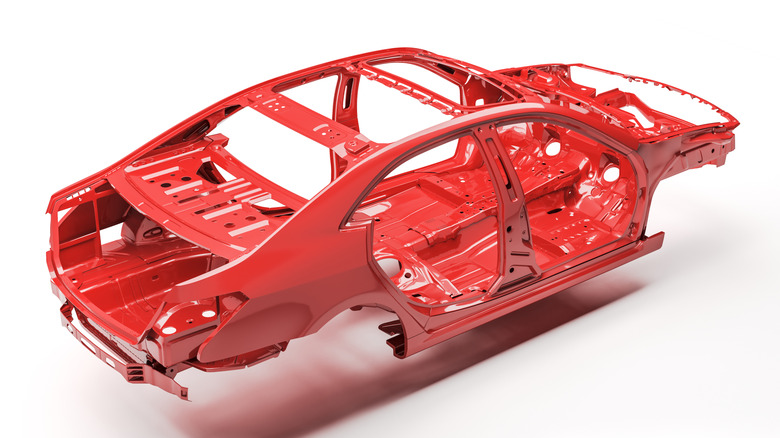
For a long time, cars were body-on-frame. You had a heavy steel ladder frame, and you bolted a metal box (body) on top of it. It was easy to build and tough as nails, but it handled poorly and weighed as much as a modern SUV. The shift to unibody construction changed everything. By welding the body, floorboard, and structural supports into one cohesive unit, engineers could make cars significantly lighter and stiffer at the same time. A modern unibody crossover handles well, whereas an old body-on-frame SUV feels like a boat in comparison. That's one reason to choose the unibody over a full-frame truck.
There are quite a few other benefits to unibody cars, too. For example, they were safer; Because the entire structure is integrated, engineers can design specific areas to collapse and absorb energy during a crash while keeping the passenger cell intact. Less overlapping metal also means less weight, leading to better fuel efficiency and improved performance.
However, unibody vehicles cannot match the ruggedness of traditional ladder frame trucks when it comes to heavy work. While your modern unibody is stiff, it can rarely handle the stress of heavy-duty towing as well as an old-school ladder frame pickup or SUV. It's one reason you wish some crossovers were a legit body-on-frame SUV. Also, when a unibody vehicle incurs structural damage, it's much harder and more expensive to fix, unlike the ladder frame truck, where you can simply swap the frame. These sturdy frames mean vintage cars can be great EV swap contenders.
The monocoque elitism: why you don't see them often
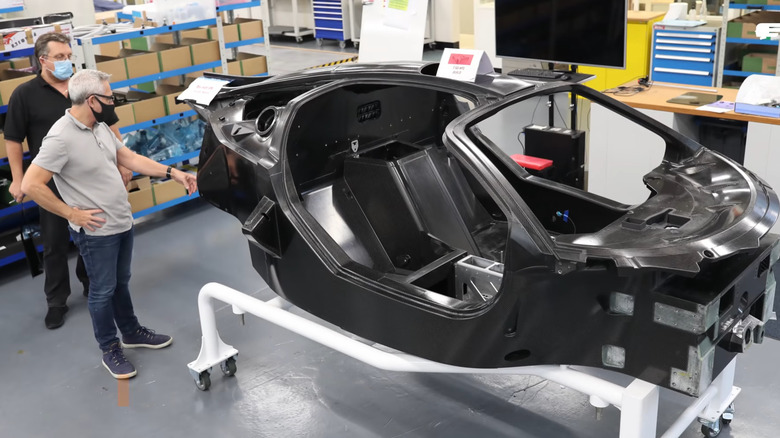
Simply put, a unibody is a complex assembly of parts acting as one, while a monocoque is a singular structural shell. However, if the unibody is an everyday solution, a true monocoque is reserved for that special occasion — such as aerospace, Formula One, and supercars. In a true monocoque, like the carbon fiber tubs used by Ferrari, Lamborghini, or McLaren, the body cage is a single continuous piece. There are no box sections welded together for the cabin; the shape itself provides the strength. This allows for unprecedented levels of lightness and rigidity. So why doesn't everyone use it?
A simple answer is cost. Manufacturing a carbon fiber monocoque is a slow, artisanal process involving hand-laid layers and massive curing ovens called autoclaves. You can't just stamp out a monocoque in a high-speed press like a unibody panel. This also means that if you crack a monocoque, you can't simply bondo it. A cracked monocoque could be a total loss, or at the very least, a prohibitively expensive specialist repair.