

This Is The Massive Barge NASA Uses To Transport Space Rockets
On April 1, 2026, over 18 million people tuned in to watch Reid Wiseman, Victor Glover, Christina Koch, and Jeremy Hansen blast off from Launch Complex 39B at Kennedy Space Center, on a historic journey around the Moon. But Artemis II's 30-story Space Launch System (SLS) rocket didn't just appear on the launch pad, did it? Not by a long shot. The National Aeronautics and Space Administration assembled the SLS from huge components like four RS-25 engines, a set of solid rocket boosters, and a massive core stage. Here's the thing, though: That core stage had to journey hundreds of miles from NASA's Michoud Assembly Facility in New Orleans to various testing centers and, ultimately, the Floridian launch pad.
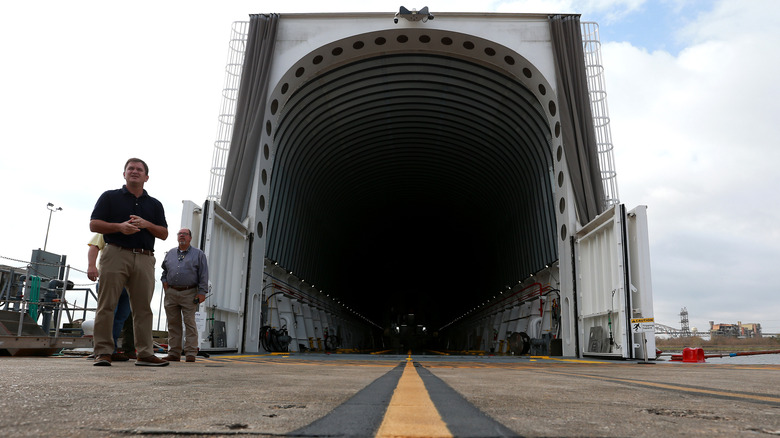
Now, the core stage (just the core stage, mind you) is 212 feet tall and 27.6 feet in diameter. You're not getting that chunky core stage across expanses of the United States on trucks. That's where NASA's Pegasus Barge comes in. To make multi-stage rocket systems like the SLS mission ready, the space agency uses the barge to transport gigantic components across inland and oceanic waterways. And just to get Pegasus up to the task of transporting the SLS core stage and other huge pieces, NASA had to give the already lengthy barge the stretched limo treatment.
Meet Pegasus, the enormous NASA barge built to transport rocket parts
If you've watched any documentaries about space flight, you've likely seen images of NASA's 6.6-million-pound Crawler-Transporter. The tortoise-like tracked behemoth CT2 transports assembled rocket systems from the Vehicle Assembly Building to the launch pad at a painstaking loaded top speed of 1 mph. That's how NASA moves the SLS around on land. Pegasus, on the other hand, allows the space agency to transport huge SLS components, like the almost prohibitively massive core stage, over great distances by water.
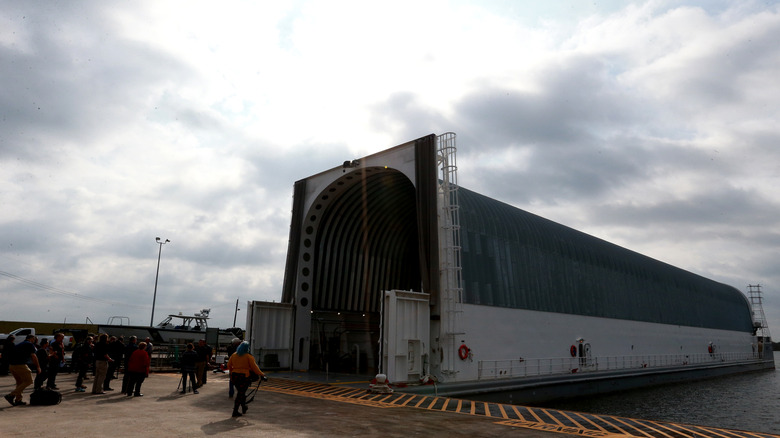
At a glance, Pegasus sort of looks like the love child of a giant hangar and a boat. Frankly, there's some truth to that. For instance, Pegasus isn't self propelled. That is to say, you won't find huge engines on board. Instead, towing vessels and tug boats are responsible for moving Pegasus around with and without a payload. Despite its 310-foot length from bow-to-stern, NASA says the usable cargo deck length is 240 feet, making the SLS core stage a relatively tight fit for Pegasus.
But Pegasus rose to the occasion. On July 16, 2024, Pegasus started its 900-mile journey with the vital core stage for the Artemis II mission that took astronauts around the moon and back to safely splash down off the coast of San Diego. In fact, Pegasus is already hard at work supporting the next SLS missions. On April 28, 2026, Pegasus delivered the core stage for the Artemis III mission, which will test the SLS' ability to dock with other spacecraft in orbit as NASA plans for a 2028 moon landing with Artemis IV.
Redesigned to carry the SLS core stage
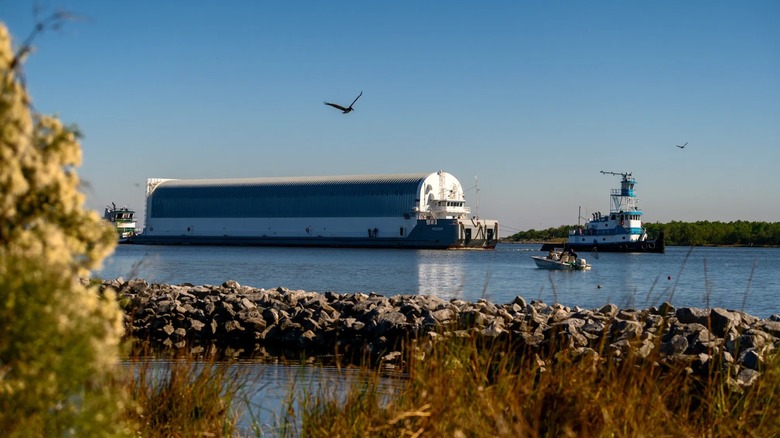
NASA's giant workhorse barge didn't start life as an SLS core stage-transporting monster. Pegasus' original mission was to help transport components for NASA's now-discontinued Space Shuttle Program. Remember those massive external tanks that helped the space shuttle to reach orbit? Well, if you're old enough, you just might. To move those massive tanks from Louisiana to Florida, the space agency commissioned the barge in 1999.
But, as it turns out, the space shuttle tanks were smaller than the SLS core stage — considerably smaller. Specifically, the "backbone" of the new SLS is more than 50 feet taller and 600,000 pounds heavier than the external fuel tanks. So, marine engineers and crews in Louisiana set to work cutting up the barge to make it larger. They removed a 115-foot section of Pegasus and replaced it with a 165-foot one, lengthening the barge from 260 feet to 310 feet and increasing its cargo capacity.
It's far from the first time NASA has used barges to transport sizable rocket components, too. Pegasus replaced Poseidon and Orion, the barges NASA used to transport the stages of the very Saturn rocket system used in the Apollo lunar program. And with future Artemis missions on the horizon, NASA barges' contributions likely aren't over yet.