

Why Cab-Over Semi-Trucks Have Nearly Disappeared In America
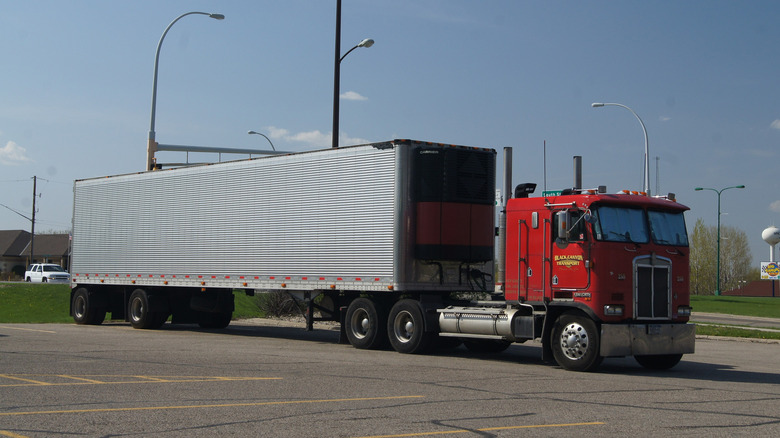
If you've ever watched an Australian or European trucking video and wondered why their big rigs distinctly look like someone's pushed the traditional snout all the way back to the bumper, you're not imagining things. Cab-over-engine (COE) semi-trucks were once common in the U.S., too — until their biggest advantage stopped mattering.
A COE's defining feature is a simple arrangement where the cab sits directly over the engine and front axle, thus saving the space of a long hood. The shorter cab is not only really cool to look at, it allows for a tighter turning radius and easier maneuvering, especially dense city streets. Yet there were still a few critical downsides. Sitting over the axle meant bumps and vibrations hit the driver more directly, while engine heat and noise had a shorter path into the cabin.
So why did America embrace cab-overs in the first place? U.S. freight rules limited the net length of tractors and trailers until the 1980s, meaning every inch of hood was an inch you couldn't devote to cargo. So fleets ran cab-overs to maximize trailer length and in turn, revenue.
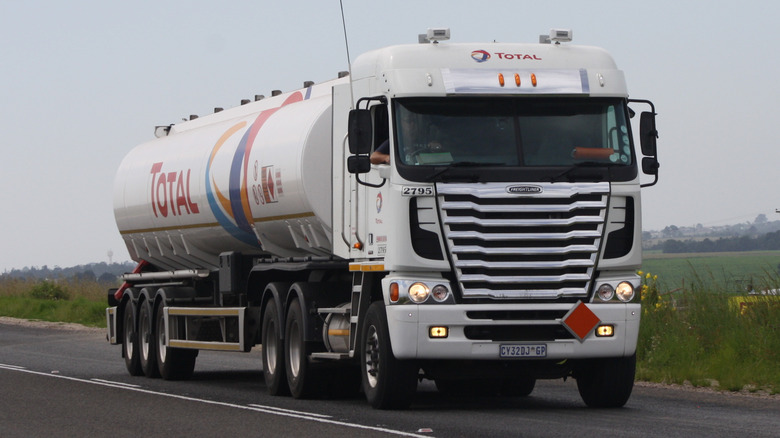
Cabovers still reign supreme across the globe
The turning point for the COE segment in the U.S. came in 1982 with the passage of the Surface Transportation Assistance Act. The legislation standardized trailer lengths and allowed conventional trucks to run 53-foot trailers — a significant jump from the previous 48-foot limit. Suddenly, the cabover's greatest advantage evaporated as operators no longer had to choose between a longer cab and a longer trailer. Conventional trucks could now carry maximum freight while also offering more spacious cabs, better sleepers, and overall a more comfortable ride for drivers grinding out long-haul miles.
It's worth noting that the cabover's story isn't necessarily one of failure — it's one of a tool that outlived its original purpose in one specific market. Cabovers are still commonplace in Europe, Asia and Australia, where road length restrictions remain strict and urban density demands tight-turning vehicles. Take for example the Kenworth K200 — and the updated K220. It's a popular cabover model widely used in Australia but not sold in the U.S. market. Cabovers have become legendary in Australian vehicular lore for many reasons — even for racing.
The cabover semi-truck truly didn't disappear because of a bad design. Rather, it disappeared because the rules changed, and when they did, drivers and fleet operators chose comfort and capacity for streamlined productivity — all things that the conventional semi-truck delivered better. With semi-truck manufacturers moving toward more aerodynamic and fuel efficient designs in the U.S. and beyond, it's important to recall the iconic cabover look that defined a generation of long-haul trucking.