

You Probably Don't Want The 2026 BYD Seagull Even If You Ignore The Chinese EV Stigma
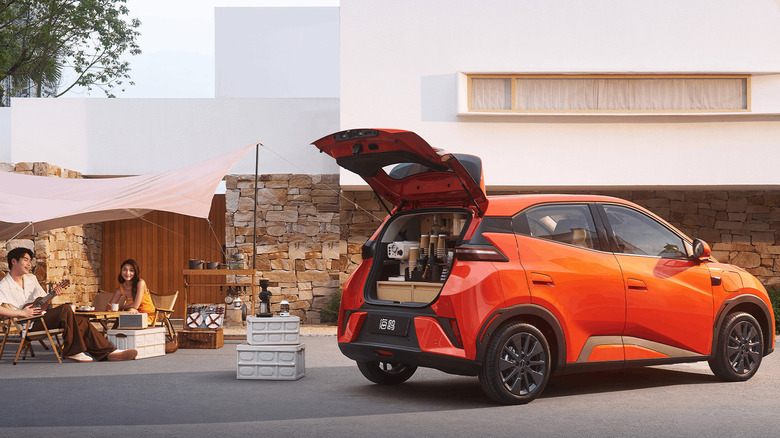
So we've just learned that without tariffs, the BYD Seagull with its lidar-enhanced driver assistance software would probably undercut the price of a new Hyundai Venue by several thousand dollars, even if you allow for the possibility that regulatory requirements would increase the overall cost. Plus, the base model has enough range to serve as your daily driver and add ~50% to the battery if you charge off a wall outlet overnight. Oh, and let's not forget that even some luxury automakers such as Volvo/Polestar have had to drop their lidar offerings over issues with their supplier.
Obviously, the new Seagull would destroy the U.S. market if we ever allowed BYD to sell it here, right? Not necessarily. Even ignoring unknowns we can't account for such as tariffs, conditions limiting BYD's entry into the U.S., etc., the Seagull doesn't appear to offer the kind of quick-charging capability that would make road trips possible in the U.S. I wasn't able to find official figures, but it doesn't look like anyone's reported a charging speed higher than 40 kW yet, which is fine for daily driving but absolutely not quick-charge-capable. For comparison, my little Fiat's max charging speed is 85 kW and also about the minimum I'd consider acceptable in the U.S.
The refreshed Seagull also reportedly makes 74 horsepower and 100 pound-feet of torque, which is probably more than enough for city driving, but on American highways, good luck. Also, good luck convincing Americans to buy any vehicle with less than 100 hp unless it's an ancient work truck.
She's tiny
Oh, and then there's the size. Despite including rear doors, the Seagull officially measures in at 3,780 mm long and has a 2,500 mm wheelbase. Convert that to inches, and we're talking about a car that's 148.8" long and has a 98.4" wheelbase. That's pretty darn close to my Fiat, which measures in at 143.0" and offers a 91.4" wheelbase. The Seagull's rear doors would add practicality to the equation, especially if you're a parent who needs to stash your kid in the second row, but it's still a tiny car by American standards.
This thing is Mini Hardtop-size, and no matter how much I personally love the size of the Mini and the Fiat, I can admit most Americans would probably hate it. Even when we look at inexpensive subcompact crossovers, vehicles that are typically a good bit larger than the Seagull, owner satisfaction scores tend to be pretty low because buyers get tempted by the low price and only realize later that they wish they'd spent a little extra money to get more room. Don't get me wrong, I'm not saying you, a Jalopnik-reading car enthusiast, would think the Mazda CX-30 was too small, but you know you normie friends and family would be much happier in a CX-5 or CX-50.
Those of us who would appreciate a small, cheap, electric city car would probably love the 2026 BYD Seagull, but are there enough of us to matter? Based on the number of people who don't understand why I drive such a tiny car, probably not. And if you're one of those perfectly normal U.S. Americans reading this, there's a good chance you'd hate the Seagull. Even if the overall cost to own it ended up being ridiculously cheap.