

Here's How Much A 2021 BMW M4 Has Depreciated In 5 Years
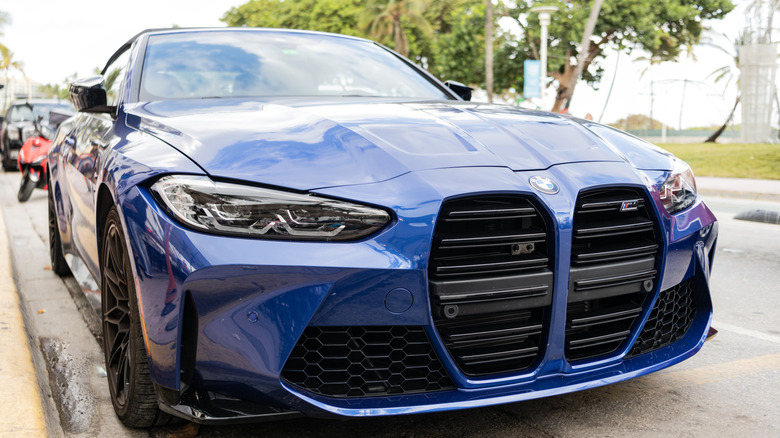
Since the first F82 BMW M4 arrived as a spiritual successor to the E92 M3 coupe in 2014, the car has carried a reputation that largely sells itself. It's part track weapon and part luxury grand tourer, defined by its twin-turbocharged inline-six and rear-wheel-drive formula that has characterized BMW's performance cars for over a decade. For 2021, BMW pulled the covers off a fully redesigned 4 Series, internally known as the G82/G83.
The G82 was complete with a polarizing kidney grille that generated headlines before anyone had driven a single mile. Under all that controversy sat a reengineered 3.0-liter S58 twin-turbo inline-six producing 473 horsepower in standard trim and 503 hp in Competition form. Standard G82 M4s come paired with the choice of a six-speed manual and an 8-speed ZF automatic , while the M4 Competition only comes with the ZF 8-speed.
That power, however, came at a price. The base 2021 M4 launched with an MSRP of $72,795, while fully loaded examples touched close to $100,000. Meanwhile, the lighter, more powerful BMW M4 CS that arrived in 2025 pushed that figure above $120,000 for base examples. Considering that price, a used 2021 M4 should, in theory, be a much better bargain. According to Kelley Blue Book's estimate, the 2021 M4 has shed roughly 24% of its value in just the last three years alone, with current private party values landing at around $57,100. The full five-year picture and what the real-world marketplace looks like today is what this article sets out to answer.
Depreciation for the 2021 BMW M4
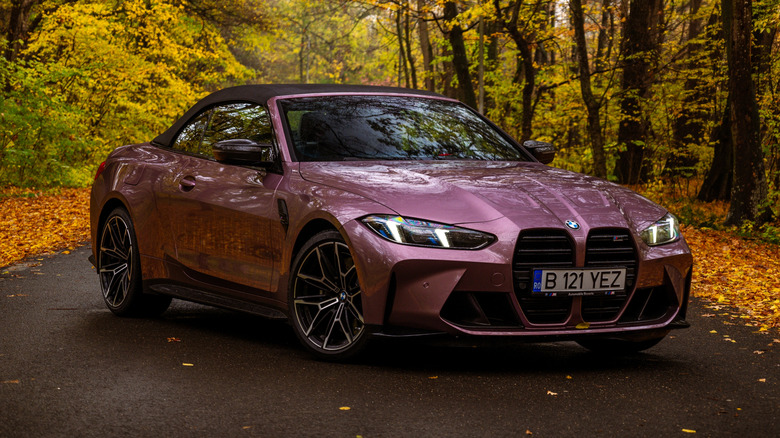
Since used values are never clear-cut, estimates for the 2021 BMW M4 vary depending on the source. Still, the overall picture is fairly consistent. iSeeCars puts the M4 Coupe's five-year depreciation at 35.5%, resulting in a projected resale value of around $52,471. For context, the site pegs the average depreciation for the luxury sports car segment at a much lower 24% over the same window.
The BMW M4 Convertible depreciates even more rapidly. According to iSeeCars, it lost 44.8% over five years, which tracks with the broader pattern of open-top variants retaining less value overall. KBB approaches the data a bit differently, focusing on a three-year window rather than five. By that measure, the 2021 M4 has shed 24% of its value over the last three years, with current (five-year) private party values sitting at $53,700 for the base Coupe and $57,200 for the Competition.
Meanwhile, CarEdge — working from a baseline new-car price of $105,288 (a high-spec example) — projects a five-year depreciation curve of 39% and the current used value for 2021 models of $63,868. When accounting for all of these five-year projections, the cross-source average lands at roughly 40% — meaning an average base 2021 M4 buyer who paid MSRP five years ago has seen their car lose close to $30,000 in value by now.
What the used prices say about the 2021 BMW M4's depreciation
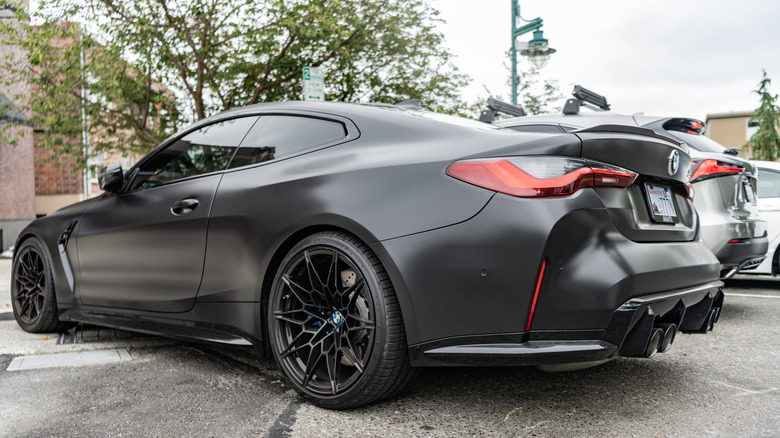
Although depreciation projections are useful benchmarks, the used marketplace is where purchase decisions are made and the real price is uncovered. A review of recent listings shows the 2021 BMW M4 currently listed at between $55,499 and $79,995 on Autotrader, and $49,999 to $74,977 on Cars.com — with the bulk of clean, average-mileage examples on both platforms clustering in the $57,000–$70,000 range.
At first glance, those figures appear to run slightly ahead of the projections laid out by iSeeCars ($52,471), KBB ($53,700–$57,200 private party), and CarEdge ($63,868). Still, there's an important distinction worth making: marketplace listings reflect asking prices, which often carry a markup above what a car ultimately sells for after negotiation. Once that gap is accounted for, the projections and the real-world market are more aligned than they initially appear.
A buyer negotiating from a $62,000 asking price down to $55,000–$57,000 on a clean, average-mileage example would land almost exactly where the valuation sources predict. When we investigated how much a 2020 BMW M4 had depreciated in five years, the G82 actually came out ahead, losing roughly nine percentage points less in value compared to its F82 predecessor over the same five-year window.