

The Difference Between H-Beam And I-Beam Connecting Rods
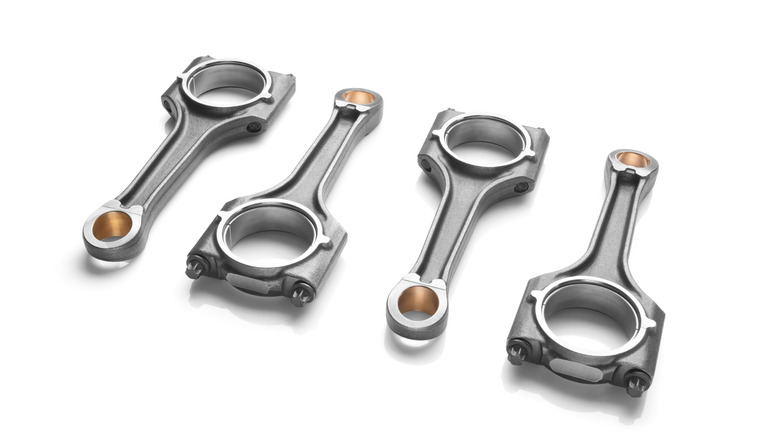
The idea behind an internal combustion engine with pistons is simple. The combustion of air and fuel pushes down on a piston, which then spins the crankshaft and turns it into forward or backward vehicle motion by way of the drivetrain (transmission, driveshaft, differential, etc.). The key component that lives between the piston and the crankshaft is the connecting rod.
The two most common types of rods are I-beam and H-beam. They can be made from a variety of metals in a variety of production methods, but these two styles are quite universal. What's the difference between H-beam and I-beam rods, then? It comes down to not only their shape and appearance, but also to what each is best-suited for in the internal combustion environment. One is typically better suited for high horsepower and torque, whereas the other is designed for fast revs where every ounce counts. However, the roles can certainly switch depending on their material and production process.
The main difference is quite literal
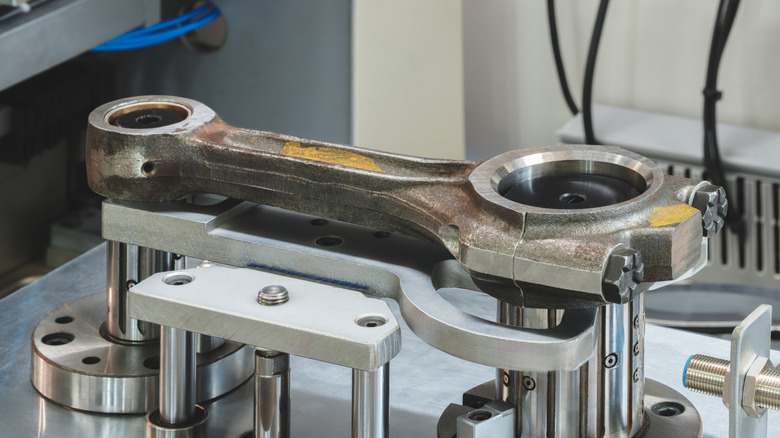
Put an H-beam and an I-beam rod next to each other, and their physical differences are quite apparent. If you have a gander at a cross section, looking at the beams top-to-bottom, the former is in the shape of an "H," whereas the latter is shaped like an "I."
I-beam rods are the most common in the sense that they're often original equipment from the manufacturer. They're cheaper to produce, get the job done, and aside from the materials they're made of, haven't changed much in their basic design since the internal combustion engine became a thing.
The H-beam is more common in the aftermarket. These are often thrown into an engine because they handle increased power better, particularly when forced induction — meaning, supercharging and turbocharging — is either added or cranked up from stock levels. They're more resistant to bending at the face from high power output.
I-beams are stronger at the crank, and thus well-suited for stroked engines and those with high-compression builds. H-beams are stronger at the piston, so they handle increased power at high rpms from forced induction and even nitrous.
But what about weight and revs?
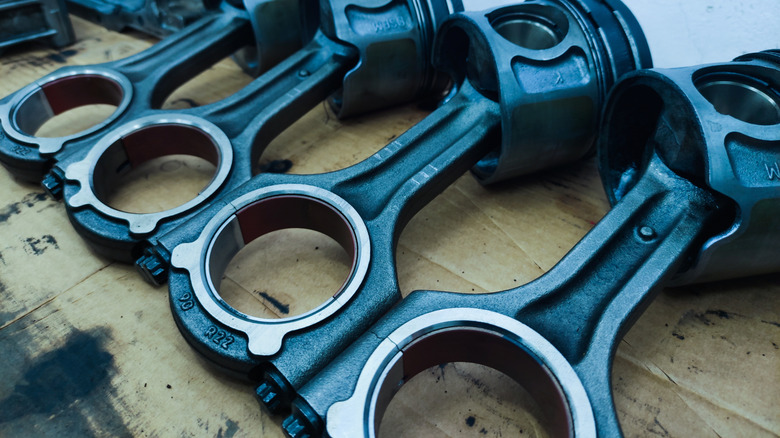
One might assume that because H-beam rods handle increased high-rpm power better, they must be an obvious upgrade. But it all depends on the application.
H-beam rods are often heavier than their I-beam counterparts. The more rotational weight present, from piston to crankshaft, the slower the engine will rev. If there's enough aftermarket-sourced power to push 'em down, no big deal, the benefits of sturdiness outweigh this downside. Therefore, I-beam rods are better suited for fast-revving naturally aspirated applications. Two standout examples come to mind: the Honda K engine and the heart of the Porsche 718 Cayman GTS 4.0.
No matter the application, going with as light a rod as possible is something to consider because a freely revving rotating assembly maximizes efficiency, and thus power output. However, it must be said that I-beam rods can be plenty strong for forced-induction applications and H-beams can be quite light; modern material science and design have enabled their roles to reverse, so to speak.
A cursory search of aftermarket rod companies reveals I-beams that can handle a lot of power. Some brands claim their solutions can handle as much as 500 hp naturally aspirated, or 700 hp with forced induction. On the flip side, those same brands offer lightweight H-beams that handle up to 600 hp. It's also important to point out that upgrading to a different rod material, such as going from cast to forged, may require re-balancing the rotating assembly.
The difference between H-beam and I-beam connecting rods comes down to design and application. However, thanks to modern technology, their roles can certainly be reversed.