

How The Rokon Two-Wheel Drive Motorcycle Works
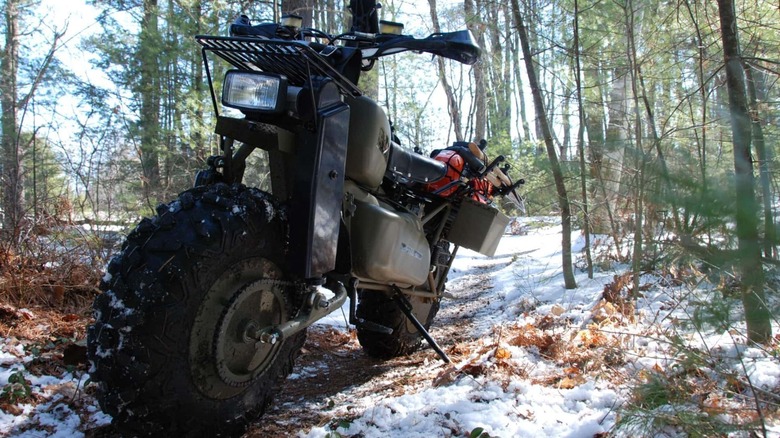
We live in an era where you see all-wheel-drive vehicles almost everywhere, from soccer-mom crossovers to 700-horsepower sport sedans. Yet, in the world of two-wheelers, AWD remains a bizarre niche – a mechanical unicorn seen mostly on experimental prototypes. And the Rokon.
While the rest of the two-wheeled world spent the last 60 years perfecting weight reduction and lean angles, a quiet factory in New Hampshire was diligently working on the "mototractor". Born of an idea that popped into Charlie Fehn's mind in 1958, the Rokon is a tool designed to survive the wild outdoors. It uses a patented mechanical AWD system that's gloriously analog.
Unlike your typical chain and sprocket drive setup, the Rokon sends power from its centrally mounted engine, usually a 208cc Kohler single-cylinder motor, through a torque converter and into a three-speed gear selector. From there on, it gets weirder. Power travels rearward via a standard chain, but a separate shaft extends forward towards the headstock. This shaft meets a universal joint and a miter box, which redirects the torque down to the front wheel via another chain drive. It's a crude piece of engineering, but effective enough to have the Rokon crawl up a 60-degree gradient.
The genius of Fehn's design is how it handles steering. On a conventional motorcycle, the front wheel travels a longer path than the rear during a turn. If they were getting the same amount of engine drive, the motorcycle would slip and stall. Rokon solves this with an over-riding clutch. This allows the front wheel to spin faster than the rear when turning, effectively "freewheeling" its way through the arc while the rear pushes forward.
Hollow wheels and hardtail suspension
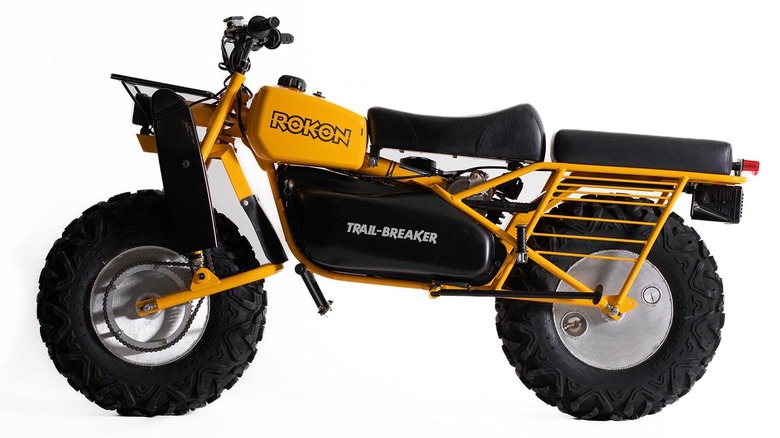
If the drivetrain is a cool lesson in engineering, the wheels are the Rokon's party trick. These massive balloon-like tires aren't just for show. They are mounted on 12-inch hollow drum-like aluminum wheels that serve a dual purpose. If you leave them empty, they provide enough buoyancy to let the 218-pound Rokon float, and you can literally pull it across a river like a piece of driftwood. Conversely, you can fill those drums with up to 2.5 gallons of extra fuel or water per wheel. That's extra 5 gallons of fuel, which gives you quite the extended range. While you don't need an adventure motorcycle to go motocamping, a Rokon could be the perfect candidate.
Because the Rokon is designed to operate at crawling speeds (top speed is 37 mph), suspension is an afterthought. Older models feature a rigid rear, relying simply on the spring seat and massive 3 psi tires to maximize contact patch over rocks and soft mud, as well as soak up the small bumps that come in the form of boulders and fallen logs. The front now uses an "Auto-Grab" suspension with about eight inches of travel, but the real comfort comes from the single sprung saddle. Braking is equally unconventional. It uses disk brakes mounted high on the miter boxes rather than the wheels, keeping the sensitive hardware away from the abrasive silt, mud, and slush.
The frame is a rugged tubular steel setup that doubles up as an oil reservoir on older models. With a ground clearance of 14 inches and a narrow 30 inches width, the Rokon can go places where an all-wheel-drive ATV can't.
The Rokon is now street-legal!
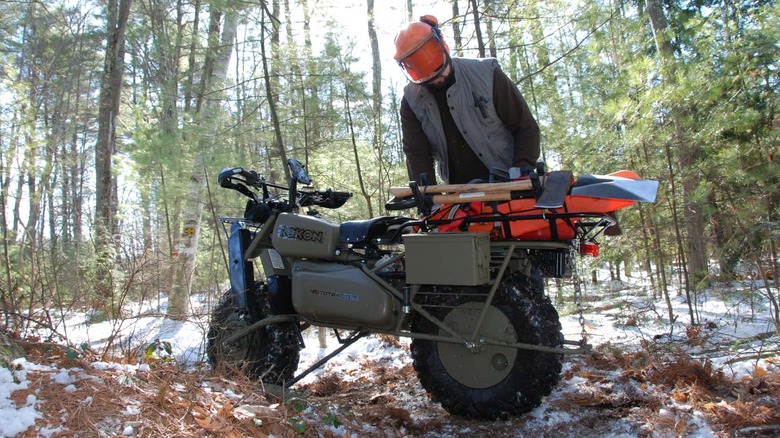
For decades, the Rokon was a tool for hunters, forest rangers, and people who lived in the wilderness. The recent introduction of the Rokon Ranger Dual Sport Edition now brings this mechanical anomaly to the streets. To make it street-legal, Rokon added the bare essentials – A DOT-approved upgraded headlight, a digital speedometer, mirrors, turn signals, and a horn. It is now compliant in all US states.
The Rokon's street-legal status isn't about being an A-to-B commute. It allows you to ride it straight from your garage to the trail, without needing a trailer. Once you hit the dirt, the Rokon retains the same 2,000-pound towing capacity and rugged reliability that made the original Trail-Breaker famous. Compared to dirt bikes, the Rokon's low seat height makes it quite accessible as well, while the oversized metal luggage racks on the front and back makes a lot of space for carrying equipment. It could be the perfect motorcycle for you if you are done with adventure motorcycling. In fact, if there was a two-wheeled list for best off-roaders of all time, the Rockon would probably top it. In a world of 200-horsepower superbikes with more sensors than a NASA rover, the Rokon remains a refreshingly honest, mechanical reminder that sometimes, the best way to get across is slowly, with both wheels pulling.