

Lingenfelter Once Transformed A Suburban Into A 9.9-Liter V8 Super SUV At GMC's Behest
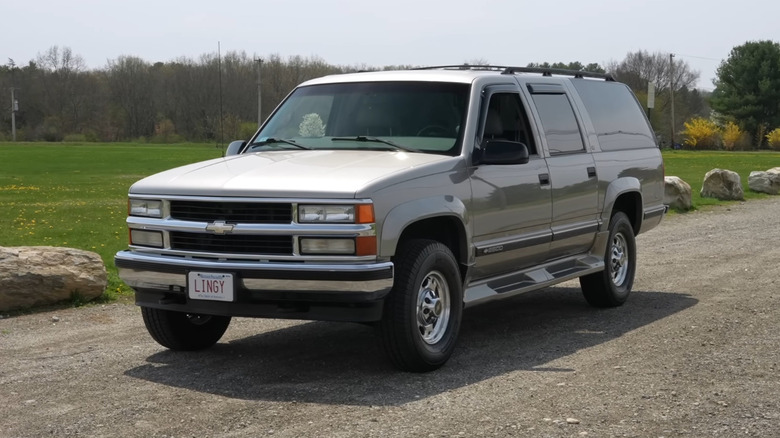
Founded in the 1970s, Lingenfelter Performance Engineering (LPE) is a turner shop known for a wide range of performance applications, from pioneering cylinder deactivation tech for Chevrolet's small block V8, to building 1,400-horsepower Corvettes. Interestingly, the current owner of Lingenfelter Performance has a car collection large enough to be counted among the 10 largest private car collections in the world. And in the mid-90s, GMC approached LPE with a request to transform the family-hauling Suburban into a genuine performance machine with massive sheer cubic displacement.
GMC officially commissioned the Suburban prototype as a feasibility study for a potential high-performance powertrain, but some stories tell of a deeper motivation — that float that GMC planned to make this prototype for Saudi officials, who wanted armored Suburbans that could move at high speeds across the desert in spite of the added weight of ballistic armor plating. The project began with a 2500-series GMC Suburban, originally equipped to handle the already-large 7.4-liter (454 cubic-inch) Vortec V8. For most enthusiasts, a 454 is all the engine they would ever need. For Lingenfelter, it was merely a starting point.
The birth of a 600 cubic-inch behemoth
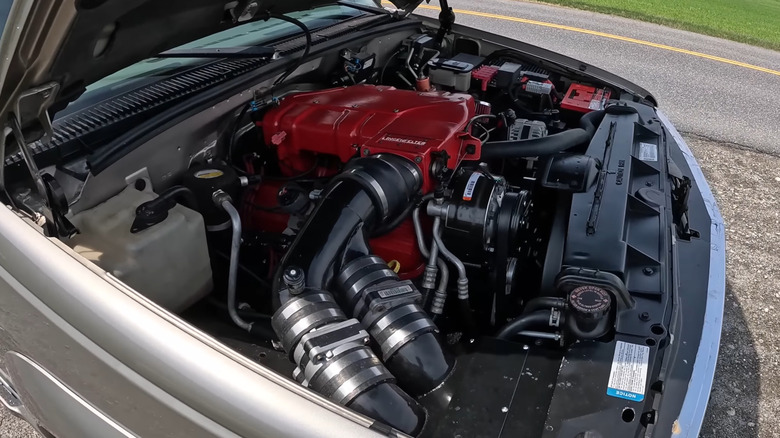
Lingenfelter decided to ditch the standard block in favor of a heavy-duty engine block usually reserved for marine applications. By the time they were done with it, via boring and stroking the block, the V8 displaced a staggering 602 cubic inches, or 9.9 liters. To feed this massive engine, Lingenfelter used a custom intake manifold also developed by Mercury Marine. The result was 550 horsepower and a monumental 705 lb-ft of torque sent to all four wheels via a 4-speed automatic transmission. In an era where the Ferrari F355 made 375 horsepower, this Suburban was a horsepower beast.
With the astonishing power figures, the Suburban was naturally capable of pretty impressive acceleration, too. From a dead stop, the Lingenfelter was likely to embarrass a Porsche 911 Carrera from the same era. At that time, Car & Driver's performance tests had the Lingenfelter Suburban hit 60 mph from a standstill in just 4.6 seconds compared to the Porsche's 6.0-second sprint time. For a bit more comparison, a C5 Corvette of the time took 4.9 seconds to do the same acceleration run. Heck, the big family SUV was quick enough that it would've earned a place in the fastest 90s cars drag race. It even dispatched the quarter-mile in 13.3 seconds at 103 mph. Don't forget, we are talking about a close to 6,300-pound SUV with no turbochargers, no supercharger, and 1990s technology.
Physics-defying performance with 90s era comfort
According to Tedward, who drove a Chevy version of the Lingenfelter Suburban last year, "This genuinely feels like it was built by Chevrolet in the factory." From behind the wheel, the Lingenfelter Suburban must be a surreal experience. Sitting high up, like you would in any big 2500-series SUV, you don't expect such raw and impressive acceleration to be paired with such functionality. Yet, for all its modifications, it remains a Suburban through and through. You could still fit seven people in it, you could still go to Home Depot and fill the back with plywood. It was the ultimate sleeper SUV when it was built, and could probably be among your list of favorite sleeper cars today.
So why don't we see many of these today? Probably because the cost for this transformation was very high. The conversion alone cost around $38,000 back in the 1990s (that's about $85,000 in 2026 money), and that's significantly higher than the price of a new Suburban 2500 back then, without including the price of the SUV itself. For a high-performance SUV like that today, you'll pay top dollar. The Cadillac Escalade V, for example, starts at over $170,000 — and it only shaves 0.2 seconds off the Lingenfelter's zero-to-60 time.