

This Striped Road Design Helps India Slow Traffic And Protect Wildlife
Infrastructure is quite possibly one of the least attractive words in the English language. And yet, drivers are obsessed with thinking about it. We just call it by other names: pot holes, construction, and frost heaves. Traffic jams star on news reports and earn more sympathy than the flu, as it's hard not to hate being slowed down. Our economy and livelihoods depend on safe, healthy roads, but our outdated infrastructure is garbage.
Know who else isn't too jazzed about it? Wildlife. Pew Charitable Trust research estimated that there are between 1,000,000 and 2,000,000 motor vehicle crashes involving large animals like deer on over 4,000,000 miles of U.S. roads each year. And that's not to mention other creatures and all the other different ways American highways kill animals. Naturally, this is a global issue, and one solution that's being tested on India's National Highway 45 in Madhya Pradesh could prove to be worth emulating.
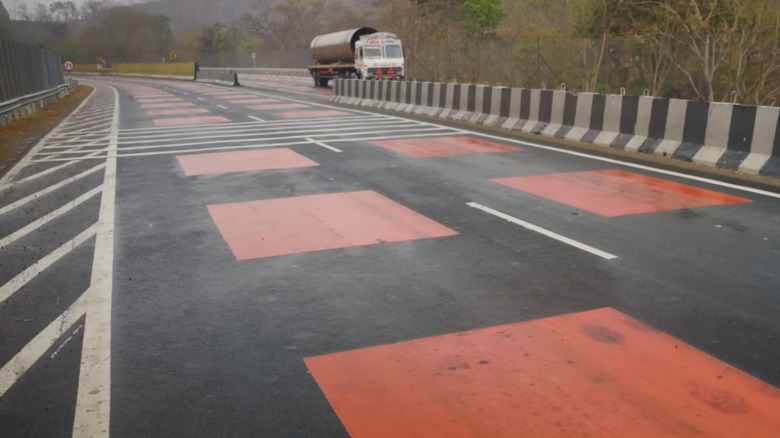
The wildlife protection features of the project include fencing and underpasses, which work together to guide animals toward safe passage. That's not so revolutionary; a massive California wildlife crossing is in the same ballpark. What's unique is the vibrant red pattern — inspired by red-painted speed zones on Sheikh Zayed Road in Dubai — being applied to the road surface. That pattern is meant to help motorists be mindful of the natural habitat they're driving through, and to make sure they slow down for safety.
Stripes that make it safer to be a tiger
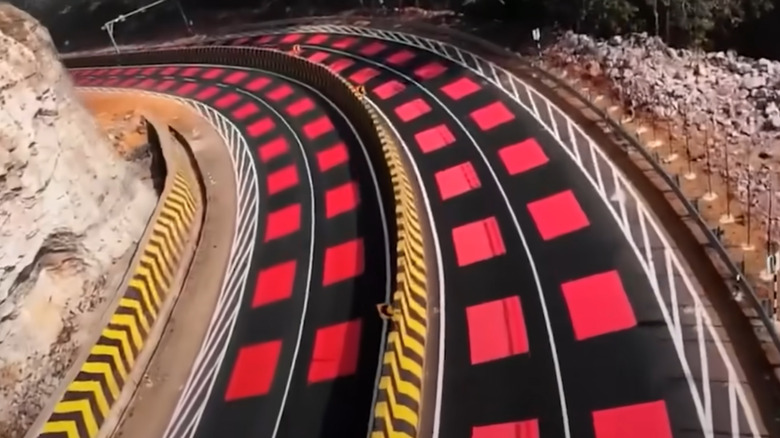
Every region of the planet has its own distinct wildlife with which people must find ways to coexist, and which can pose unique dangers for motorists. Maine has moose and Australia has kangaroos that move erratically. In India, tigers, monkeys, and cheetahs aren't uncommon sights. India's national roadway infrastructure has nearly as many miles of road as the U.S., and has grown exponentially over the past ten years. National Highway 45 is a major road that connects several key areas, and it winds through a little over seven miles of the Veerangana Durgavati Tiger Reserve. The red stripes cover 1.2 miles of designated danger zone territory where animal life is particularly dense.
The red segments are each five millimeters high, so on top of being highly visible to signal a behavior change, drivers are able to hear and feel them, too. They also have embedded speed sensors, and vehicles won't ride smoothly if they're traveling too fast. It's sophisticated, yet it's also an incredibly simple idea that's part of the government's overall initiative for ecological responsible engineering. As India's Ministry of Road Transport & Highways explains: "A pioneering safety initiative implemented on a National Highway stretch passing through a sensitive forest and ghat section demonstrates how road engineering can balance human safety, wildlife protection, and ecological preservation, without compromising on any of the three."
Time will tell if this approach works to the desired effect. What seems clear is that there's no single safety divider or mechanism that works on its own. Rather, it's a combination of tactics that help both drivers and animals stay safe throughout the stretch.
Stripes, fences, and underpasses working together
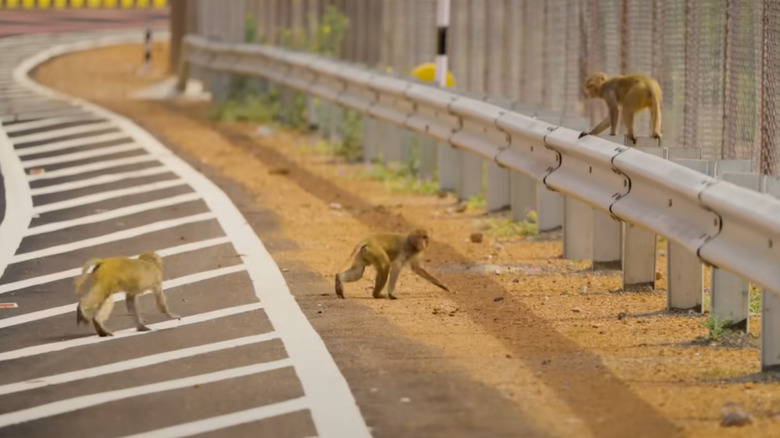
There's no escaping the fact that the safest road for wildlife is no road at all. But in the context of balancing human activity with the animals living in the forests, trees, deserts and mountains that roads, the red striped roadway is rather innovative. Given the climbing skills of monkeys and leaping abilities of a tiger, it has to be.
Fences are an effective deterrent to crossing, but they're not impenetrable. From a monkey's perspective, they could be seen as a playground. And forget about tigers; they can jump 16 feet into the air. Clearing an eight foot fence is nothing. This is why, as noted earlier, the fences are intended to more than deter. They help guide animals toward the 25 underpasses that dot the entire stretch of the 7.4 mile road segment, in and beyond the 1.2 mile red stripe zone. The project also includes solar-powered lighting at busy areas, which eliminates the need for extensive power lines that could put those animals' lives at risks.
If this proves successful, could we see something like red stripes on U.S. roads? The good news is that there are roughly 1,500 wildlife crossings already in place in America across 43 states, including Washington, Montana, Florida, Utah, and Wyoming. So, it's not a stretch, but blizzards and plows could pose problems for red stripes like these in places that get pelted with snow. In milder climates, the red squares seem like a no-brainer. To see the system in action in India, check out the video below.