

Why Replacing The Air Filter In Modern Cars Improves Performance But Not Fuel Economy
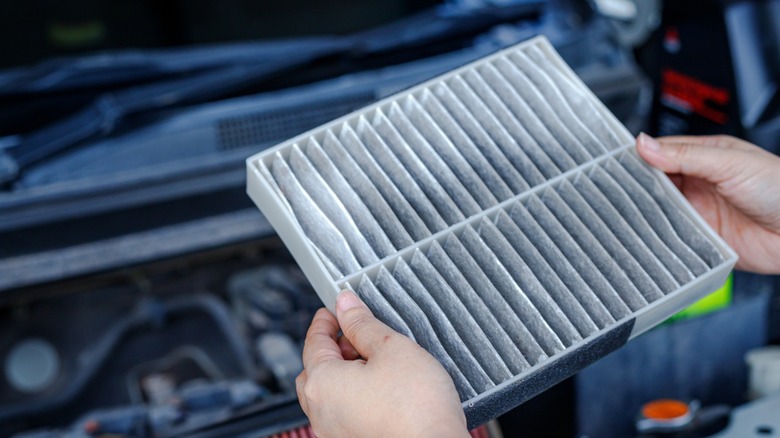
One of the go-to upsells at a lot of quick-lube places seems to be changing the air filter. The internet is awash with stories of managers shaking dirty filters at customers and describing how much it needs to be changed, or claiming that driving with a dirty filter will hurt gas mileage. While you should change a dirty filter, that last claim isn't true. If you're driving a modern car with a fuel-injected engine, changing the filter will not make any difference to your gas mileage.
You don't have to take our word for it. None other than the United States Department of Energy, based on a study done by Oak Ridge National Laboratory, states that, "...for modern computer-controlled, fuel-injected engines, changing a clogged air filter has no measurable effect on fuel economy..." That makes sense, because in a fuel-injected engine, less air flowing into the engine means that less fuel will do so, as well.
So, why does everyone say that a dirty air filter will hurt your gas mileage? It might be a holdover from when most cars had a carburetor, which was a while ago, as the 1994 Isuzu Pickup had the last carbureted engine sold in the U.S. So while the DOE makes it clear that changing the air filter in the carbureted car in the study improved fuel economy, it won't help a fuel-injected engine cut consumption. But that doesn't mean you shouldn't still change a clogged filter, as the study points out it will still hurt other performance metrics, such as acceleration.
Why changing an air filter improves gas mileage in older cars, but not newer ones
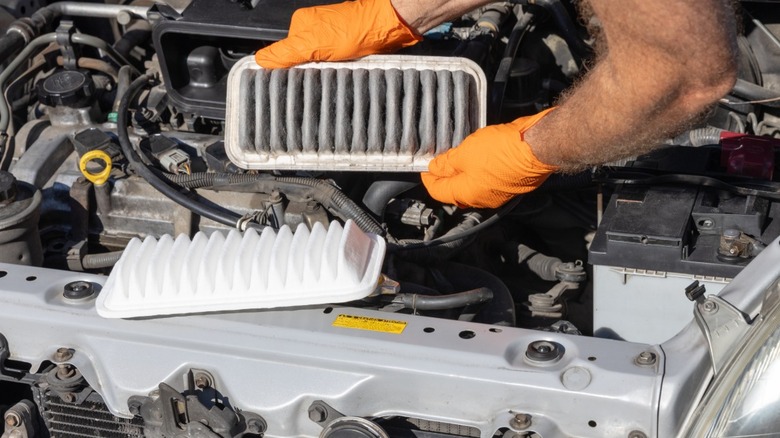
The reason why changing an air filter improves gas mileage in a carbureted engine, but not a fuel-injected one, is down to the way air and fuel are mixed. When air flows into a carburetor, it is forced to mix with a jet of fuel in the throat of the carburetor. This mixture is then sent to the engine. If too little air makes it to the carburetor because of a clogged filter, there is nothing that can dynamically change the amount of gas that flows through, which means the air/fuel ratio will be low on air, high on fuel.
But when air flows into a fuel injected system, it has to pass the Mass Airflow (MAF) sensor and the oxygen (O2) sensor, after going through the air filter. These sensors tell the ECU how much air is passing into the engine. If too little air is passing through, the ECU will reduce the amount of fuel that's injected, to keep the ratio right. It's one of the advantages of fuel injectors over carburetors.
But that also means that less air and gas are getting to the engine, resulting in less power, and affecting other performance. The DOE states that, while changing the air filters didn't improve the gas mileage of the vehicles in the study, "Average acceleration times for the vehicles in the study improved by 6-11% when running on a clean filter."
You should still change a dirty air filter
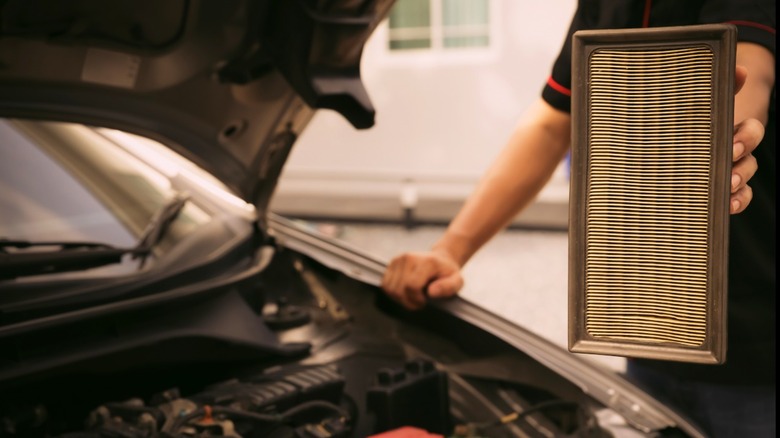
While the fact that a clogged air filter can hurt your car's acceleration should be a good enough reason to change it, it goes far beyond that. The main purpose of the air filter has nothing to do with acceleration, but is to safeguard your engine by keeping it clean from dust, dirt, pollution, pollen, and any other contaminants that can get into it. This helps to protect the pistons, cylinder walls, and the MAF sensor from damage.
It can be costly or even catastrophic if those components get damaged, and illustrates why it makes sense to change a clogged filter. A new air filter may cost under $20 and is typically easy to swap out yourself, which is why we always pass on that upsell at the quick-lube shop. On the other hand, changing an MAF sensor can cost upwards of $500, although you may be able to clean it instead, and save a few bucks. Additionally, if debris gets between the pistons and the cylinder walls, it can wear down the seals, allowing gas to leak into the crankcase. That, in turn, can cause your car to blow smoke out of the exhaust, accelerate slowly, and burn oil. Ultimately, it could ruin your engine. Either way, you're out thousands of dollars.
There are other reasons to change your filter. A clogged filter could cause you to fail your emissions test. And running with blocked airflow causes unnecessary wear and tear on your engine.