

Why Consumer Reports Called The Acura SLX 'Not Acceptable'
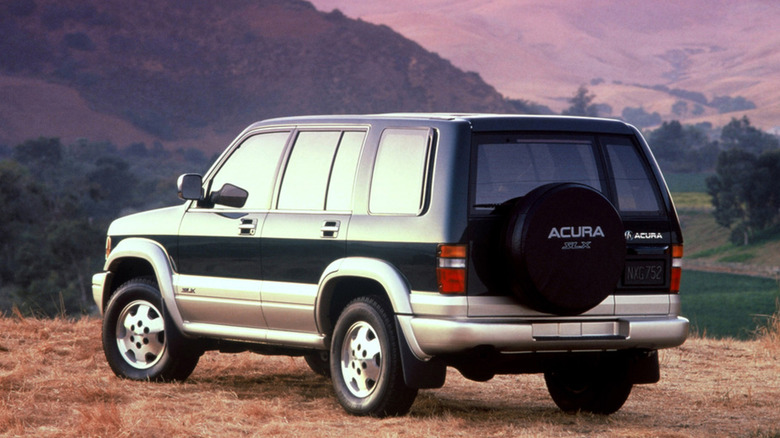
Honda's premium division first dipped its corporate toes into the SUV pond in 1996, when Acura introduced the SLX as "the latest chapter in the company's mission to build the most comprehensive luxury import line in the United States." Unfortunately, that chapter was copied directly from the Isuzu playbook, since the SLX was essentially an upgraded Isuzu Trooper (which was also the source for a rebadge job you might not have known existed, the Honda Horizon). As reported by the New York Times back then, when Consumer Reports put the Trooper and SLX through its routine avoidance-maneuvering test back in the day, they both flunked.
In each case, CR said that the vehicle's outside wheels would leave the ground during situations like making a sudden turn to miss an obstacle on the road. This put both SUVs at a high risk for rolling over. In fact, CR rated them both as flat-out "not acceptable."
It wasn't the first (or the last) time that a vehicle has earned such a poor ranking. The 1988 Suzuki Samurai and 2001 Mitsubishi Montero Limited, for instance, got the same marks for the same reasons. (That's why Suzuki took Consumer Reports to court for a legal battle that lasted until 2010.) Regardless, with that kind of press, folks didn't exactly flock to the SLX after the report came out. Acura sold only about 6,590 units during the model's four years of production. The MDX, designed in-house by the brand, came online as a replacement for 2001.
Was the Acura SLX really less stable than other SUVs?
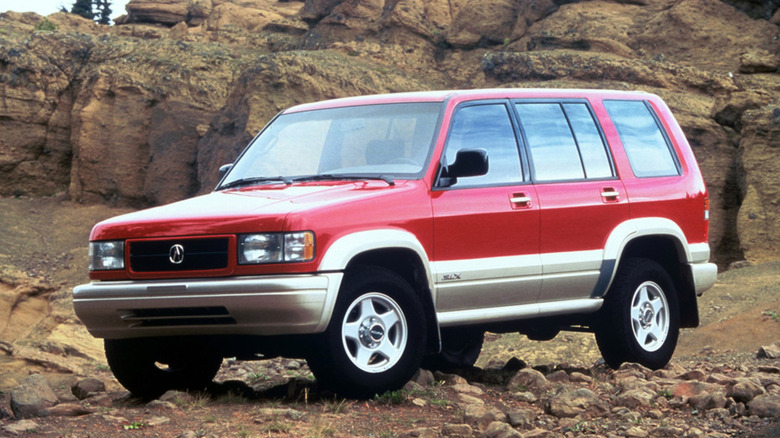
The typical SUV is taller than a typical car, which increases its weight and throws off its center of gravity. That combination of characteristics that makes most SUVs more likely to roll over than a comparable car; it's not a specific issue with the SLX or Trooper. It's still a concern today, too, as evidenced by recent efforts to ensure the Jeep Wrangler doesn't roll over as easily. Indeed, it's notable that when NHTSA took a look at the SLX/Trooper situation at CR's request, it declined to press forward with a further investigation. A spokesperson even told the L.A. Times, "no, we can't see that there is a defect here."
It's also worth pointing out that CR singled out Trooper/SLX models from 1995 and 1996, with suspensions modified from previous years, as the problematic vehicles. But statements from the Orlando Sentinel indicated that Isuzu engineers accounted for this, and that the center of gravity wasn't affected by any suspension upgrades. Additionally, while the Trooper/SLX suspension was changed again after the CR testing, Acura itself did not tie the upgrades to the rollover issue.
The few customers who actually purchased an SLX seemed pretty happy, as well, based on reviews. And Acura itself was able to put a positive spin on the vehicle in 2019. That year brought about a restomod of an SLX that packed some very modern upgrades.