

With How Gas Prices Are Going, Bet You Wish Thorium-Powered Cars Had Become Real
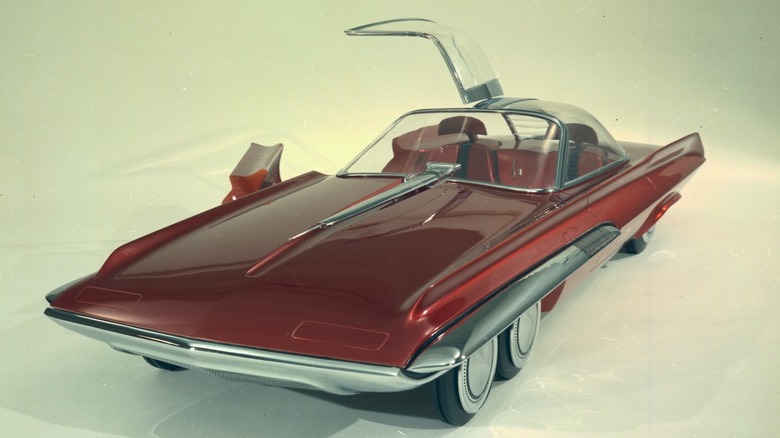
The pain of shelling out over $100 to fill up your large SUV or truck is all too common. These prices can make swapping your gas-guzzling V8 for an EV quite compelling. However, range anxiety exists, and where would you plug it to charge at night — especially if you live in an apartment? But what if there was a third option? A glowing, slightly radioactive third option that would let you drive for one million miles without the need for refueling? That's what the thorium-powered car promised as one of the greatest "what if" scenarios in the history of automotive propulsion. Why thorium, though?
Unlike the uranium used in traditional nuclear reactors, thorium is abundant, relatively stable, and much harder to turn into a civilization-ending nuclear bomb. It is a naturally-occurring radioactive element, a waste product of rare earth mining. In theory, the concept behind a thorium-powered car is quite simple. You take thorium, hit it with a laser to initiate a nuclear reaction that emits heat, use the heat to flash-boil water into steam, and run a turbine that powers an electric generator.
In 2011, a company known as Laser Power Systems was proposing such a thorium reactor — one that weighed around 500 pounds and was compact enough to fit under the hood of a sedan, MotorAuthority reports. According to the company, a single gram of thorium packs the energy equivalent of 7,400 gallons of gasoline. But let's be clear: this thorium car never actually had a working model. At best, it was a study of what could be possible.
Not the first nuclear automotive propulsion concept, but maybe the most promising?
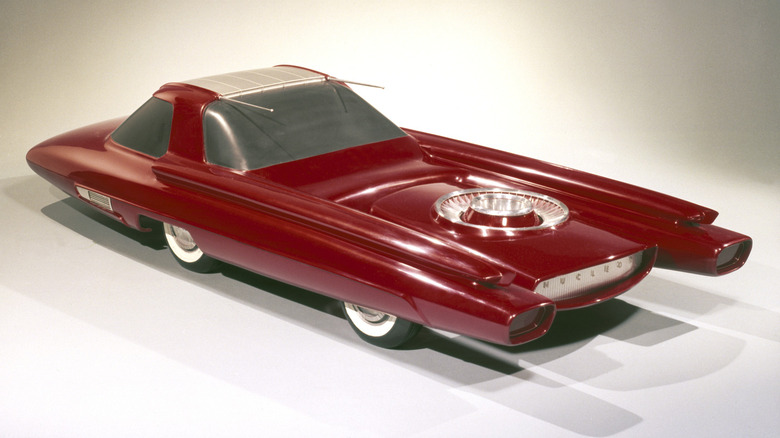
The idea of a nuclear-powered car isn't new. In fact, In 1958, Ford revealed the Nucleon Concept. It didn't use thorium for propulsion; instead, it used a scaled-down uranium fission reactor. The car had a modular system where the reactor core was located behind the passenger cabin for maximum shielding distance, and could be swapped at "recharging stations". Ford's atomic-age fantasy would never be built due to obvious safety concerns, incredibly high costs, and design problems (a car powered by a 1950s nuclear reactor would be incredibly heavy) made the Nucleon ultimately unfeasible.
Nearly 50 years later, in 2009, Cadillac introduced the World Thorium Fuel concept. It was not Cadillac's idea, though — rather, it was an independent design study by renown New York designer Loren Kulesus. Kulesus proposed a thorium reactor built inside of a vehicle designed to run for 100 years without refueling. Two years later, news outlets reported on how Laser Power Systems sought to utilize a high-intensity thorium laser to flash-boil water and create pressurized steam, powering turbines inside of the car. Unlike uranium, thorium requires an external source of neutrons (introduced by the laser) to maintain a nuclear reaction. If the neutron source shuts off, the reaction stops, making it safe for mobile applications.
These design studies never really rose past the drawing board. We heard about Laser Power System's idea back in 2013, and we still don't have a working experimental car to show for it. Some might even argue that the whole thorium-powered car business is nothing more than snake oil.
Why are we not driving thorium-powered cars by now?
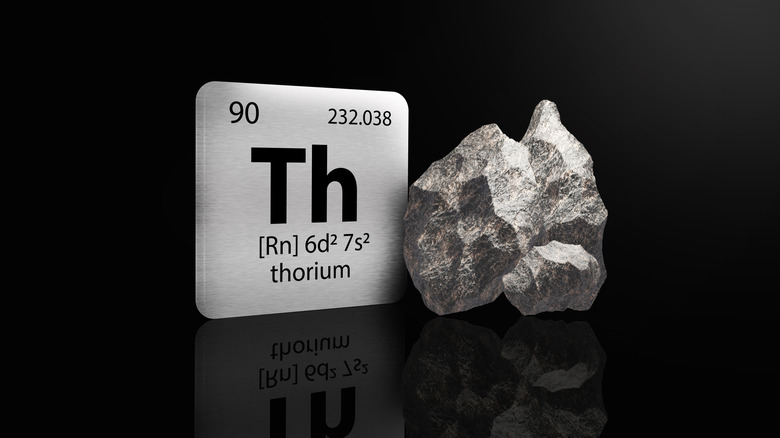
If thorium is so magical, safe and dense with energy, why are we not driving cars powered by it? Well, even ignoring how the minds behind such concepts might've never intended to build them, it's because they would still be pretty radioactive. A significant technical hurdle with thorium propulsion is radiation shielding. Thorium is a safer metal because it emits weak alpha particles, but the fission products generated inside a working thorium reactor include highly dangerous gamma particles. To effectively block the radiation emitted during the thorium decay chain reaction, you would need heavy-density materials like lead, tungsten, or specialized boron-infused polymers. For a thorium reactor, the shielding alone would need to be quite heavy to ensure the driver does not suffer the effects of prolonged radiation exposure. And if you add more weight in the form of shielding, you need more power to move the car, which requires a larger reactor and larger shielding.
Beyond that, there's the issue of thermal management. A thorium reactor generates massive amounts of heat. To dissipate that kind of heat from a closed-loop nuclear system and prevent the steam turbine from melting, you'd need massive heat exchangers the size of the car itself. The final deterrent is the nuclear regulatory body. Imagine the Nuclear Regulatory Commission having to oversee the licensing of millions of mini-reactors hitting the road every year. If a thorium-powered car were to be involved in a collision serious enough to breach its reactor, the cleanup would require more than a tow truck — it would need robots and men in lead hazmat suits. For now, thorium propulsion simply remains a brilliant (and dangerous) theoretical solution.