

Yes, There Are Different Grades Of Diesel Fuel, Too

Go to most fuel pumps in the U.S., and you'll find three or four grades of gasoline, but just one lonely nozzle for diesel. Did you know there are multiple grades of diesel and a few different blends on top of that? It's true – making diesel fuel involves a complex refinement process, and, depending on the exact steps, you can create different grades and blends. Although, it's likely that you'll only ever use one grade if you generally get your diesel at a gas station.
The first grade is #1 diesel, which has a lower pour point than the other grades, as it is made to withstand extremely cold temperatures, typically down to -40 degrees Fahrenheit. It also has a higher volatility and lower viscosity than the other grades. The most commonly sold grade of diesel is #2. It's great for a variety of uses and is more efficient than #1. However, it does not handle the cold as well as #1, gelling even when ambient temperatures are around 10 degrees Fahrenheit. There is no #3 grade in the U.S., but there is a #4 grade. This grade is mostly used for marine vehicles and non-vehicle applications, like boilers.
There are also biodiesels and various specialty blends. Ultra-low sulfur diesel is made to produce fewer emissions, specifically emissions from nitrogen oxide and particulate matter, both of which can contribute to major health issues. Winterized diesel is #2 mixed with #1 so it can handle the cold, and red diesel is for off-road vehicles like tractors and bulldozers.
Diesel grades and what makes them different
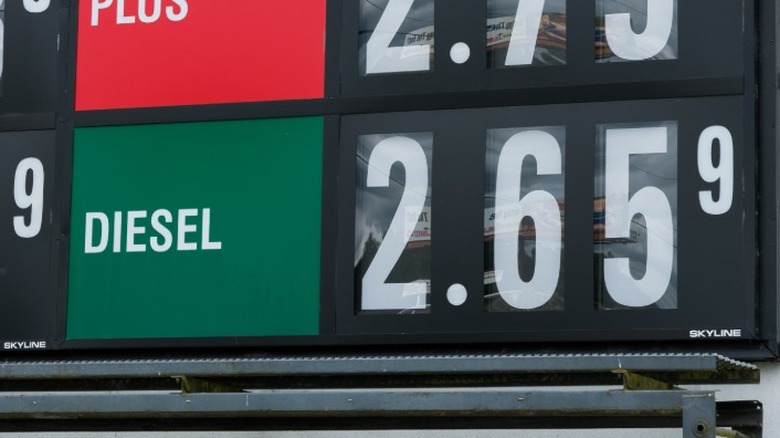
What differentiates the different grades of diesel fuel from each other? To start with, #1 diesel, or 1-D, is especially made for cold weather. It doesn't contain paraffin wax, which can cause fuel to gel in cold temperatures. But this lack of wax means #1 diesel is not as good at lubricating as the other grades. It is also less efficient and has a lower viscosity than the other grades. It's best used in commercial trucks when it is very cold.
The grade of diesel you'll find sold most often is #2 diesel or 2-D. It's more efficient than #1, meaning you'll get better mileage out of it. It's also better at lubricating, since it contains paraffin wax. However, that paraffin wax is also why diesel gels in the cold but gas doesn't, so there is a tradeoff. That said, #2 diesel is versatile and has a wide number of applications. It's best used in warm weather, and the diesel you get at the pump is most likely this grade.
The third grade is #4 diesel, or 4-D. Wait, did we skip #3? No, there isn't a #3 diesel grade in the U.S. Grade #4 is used mostly for non-automotive applications. So, you'll find it in boats, furnaces, and boilers. It doesn't do well in cold temperatures, but it is good at lubricating, thanks to its lower volatility. It's ideal for high-load, low-speed engines.
Other specialized blends of diesel
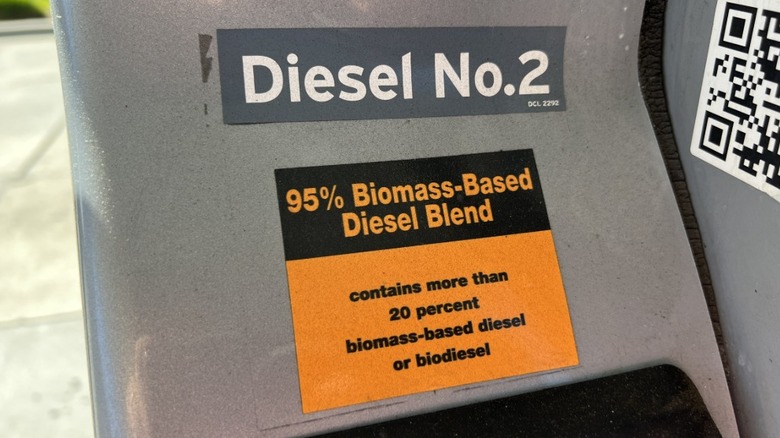
Besides the different grades, there are other specialized blends of diesel you should know about. For example, winterized diesel is a blend of the #1 and #2 grades. That means it still retains a lot of energy components and lubricating ability, but it is far less likely to gel during the winter. Efficiency should dip only slightly compared to #2 diesel.
Then there is diesel designed for off-road uses, like in farming machinery or construction equipment, and this type of fuel is not legal for use on the road. It is much cheaper than other types of diesel, which is its main advantage. It is dyed red, so it's often known as red diesel, red dye, or dyed diesel.
Other diesel blends designed to be better for the environment, like biodiesel and ultra-low sulfur diesel (ULSD). Biodiesels can be made from animal fats, vegetable oils, and recycled grease, while ULSD has enabled new technology that helps to reduce nitrogen oxide emissions by 90% and particulate matter emissions by 95%. These are particularly nasty types of emissions, causing respiratory health problems, and they're even suspected of contributing to cancer. One downside of ULSD is that it is less efficient than other types of diesel. Additionally, it costs more to produce and does not lubricate as well. That's why it's important to know when to use ULSD vs. regular diesel.