

How Well Does The Tire Sealant Kit That Replaced Your Spare Tire Actually Work? Here's What Experts Say
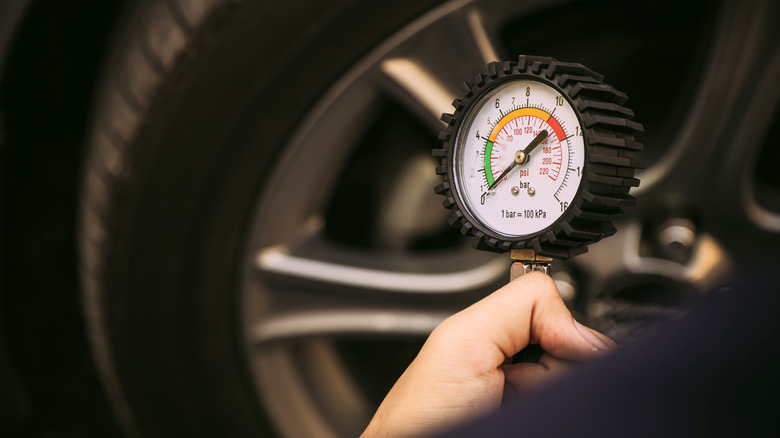
Around 45% of all new vehicles in the U.S. arrive missing something. No, we're not talking about bench seats, although we do miss some of the features you don't find in new cars anymore. Pop your trunk or swing that rear hatch open, and you might not find what once drivers once took for granted: that helpful spare tire. Is this some sort of practical joke? As hilarious as that would be, automakers started phasing out spare tires in favor of space-saving, fuel-sparing, lighter weight alternatives.
So, now you've got a flat on the side of a busy road, but no spare tire. In place of the space saver you expected to find, you find a 12-volt air compressor and some sealant. In some cases, that convenient little tire sealant kit can get you back on the road, if only for a bit. But some experts say your tire-sealing kit isn't quite up to the task in the same way that a full-size or temporary spare tire can. Especially when it comes to a couple of specific situations.
Experts say spare the sealant, buy some rubber
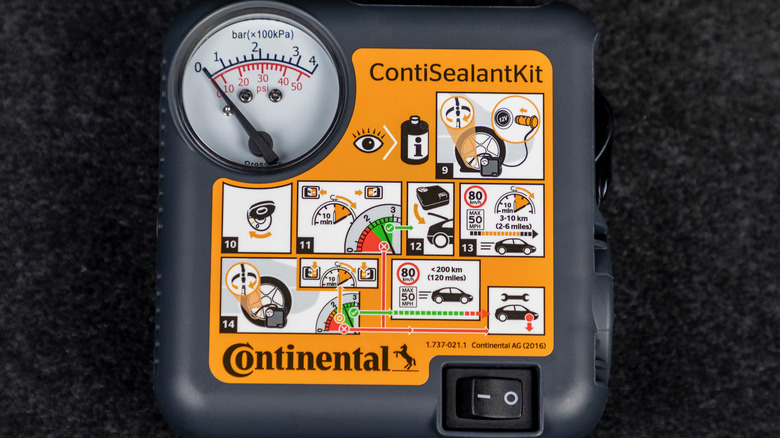
Let's start with how tire sealant gets you off the shoulder and on your way. Your emergency sealant kit may contain a compact air compressor and a sprayable container full of sealant. That, or you might just have an aerosol can or liquid sealant. Whatever the flavor of flat-fixer, the function is essentially the same: inject a sealant through a tire's valve stem into the wounded tire to cover the path of escaping air. The pressure forces the sealant to the leak's source, and forms a barrier. The air compressor can then raise your tire pressure. Presto: You're back on the road.
Well, many experts recommend carrying extra rubber instead. In a pinch, the sealant may do the trick. However, uneven sealant distribution can leave a big, nasty mess and obscure tire pressure sensors. Ryan Pszczolkowski, a tire technician with Consumer Reports, says that a sealant kit with a compressor will work to get you moving, but adds, "you can't beat a true spare tire as a solution to any tire problem." Ronald Montoya of Edmunds agrees that temporary spares offer the best balance of size and utility. A heavier full-size spare, on the other hand, will drive like any of your other tires, with little to no performance loss.
Then there's the question of repeat use. Kurt Berger, manager of consumer products engineering for Bridgestone, tells Edmunds that most automakers send sealant-fixed tires straight to the scrap heap. However, Dave Cowger, global tire subsystem leader at General Motors, says the temporary sealant can be removed, and after a cleaning, a professional can repair the tire. The spare tire that once lived in your trunk, on the other hand, was a reusable tool to get you out of trouble.
Not for every flat
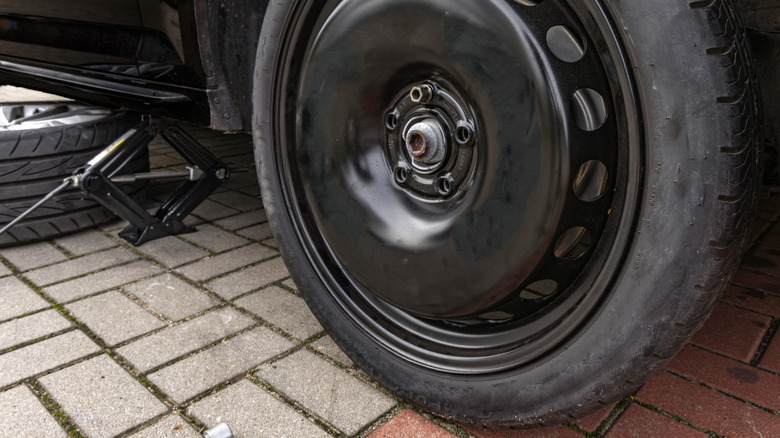
Your tire sealant kit, especially the type that includes a compressor, can save your bacon in the event of flat. But, unlike a spare, sealant isn't a solution for every kind of flat. Is the hole bigger than 0.24 inches? Gene Petersen and Chris Jones of Consumer Reports say don't even bother. The same goes for a gouge in the sidewall of your tire. The American Automobile Association reminds drivers that a tire's sidewall flexes too much to support a fix like a patch or sealant injection. As for the large hole, your sealant simply isn't up to the task of repairing a breach large enough to weaken the structure of the tire. In that case, it's best to replace a severely damaged tire.
While 34% of new vehicles between 2020 and 2025 came with a tire sealant kit from the factory, buying a spare is still worth consideration instead of relying on the gooey stuff. Especially given the mere 9% of cars to arrive from the factory with a full-size spare during that time.
After all, a temporary spare, often referred to as a "space saver" or "doughnut," is far from a permanent solution. Sure, you can reuse your doughnut spare tire, but most manufacturers don't recommend driving faster than 50 mph or farther than 50 to 70 miles before replacing it. That tire sealant kit in your trunk might do the trick, save space, and keep things light, but it's no practical match for a spare tire.