

Does Towing Impact How Often You Have To Change Your Oil?
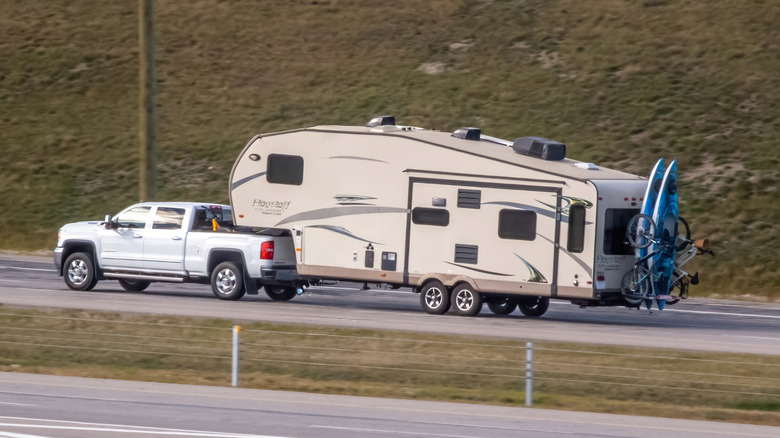
Skipping oil changes is just one of several mistakes that can ruin a diesel engine faster than you can say "holy smokes!" Even though the rising cost of oil products has made changing the oil of a diesel vehicle costlier than ever, adhering to more frequent oil changes might be worth the extra cost in the long run. And this is especially the case if you do a lot of heavy-duty work like frequent towing or hauling.
You see, there is such a thing as "normal" and "special" operating conditions in the maintenance section of the owner's manual (like the manual of a Ford F-150). Other brands may refer to it as "duty" instead of "operating conditions," but the idea is the same. Typically, it means that the servicing requirements of a vehicle operating under severe conditions would require more frequent maintenance, inspections, and fluid changes. It's why engine hours and idling hours matter in commercial trucks and heavy-duty equipment, and it all boils down to prevention and protecting your investment from premature wear and costly repairs.
Ford constitutes severe duty (or special operating conditions, to be more precise) for vehicles that tow a trailer or use a car-top carrier, do extensive idling or low-speed driving over long distances, make frequent short trips, operate in dusty or sandy conditions, and drive off-road. So yes, towing will definitely affect how often you need to change the oil. But it also involves more than just a basic oil change.
Towing & heavy-duty work leads to premature oil degradation
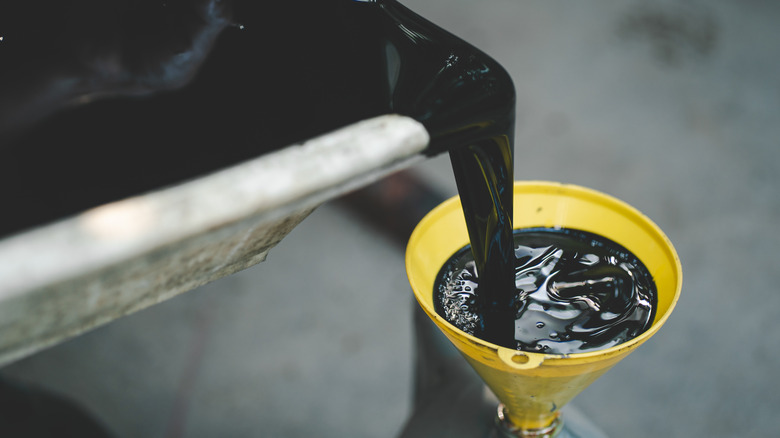
Oil for diesel vehicles is quite different from gasoline engine oil, but both types can still go bad for a multitude of reasons. No matter the case, oil will quickly break down due to higher-than-normal temperatures and stress. When towing or hauling, you're almost certainly putting your engine through such stress. Moreover, more oil will be consumed when your daily routine includes other high-load activities, so you'll have to be wary of excessive off-roading or track driving in addition to towing.
To put things in perspective, the aforementioned Ford manual claims extreme driving or heavy-duty work could increase oil consumption to a quart per 500 miles, or roughly a liter of oil for every 800 kilometers of hard driving. The automaker adds that oil dilution is also possible for vehicles that do a lot of idling, low-speed driving, and frequent short trips. This actually increases the oil level in the crankcase, but it's increased in a way that has caused the oil to also degrade significantly. So, regardless, it will probably need to be changed out.
Other things to check besides changing the oil
Vehicles that frequently tow trailers, campers, or gear would most likely need oil changes and servicing every 3,000-7,000 miles, although the actual mileage may vary. For trucks or SUVs with oil life monitoring systems, the reminder message could pop up within those intervals. Ford advises that drivers never exceed a year or 10,000 miles between oil changes. Ram has similar recommendations for oil changes, but it adds that 350 hours of run time is the maximum before servicing. It's a good example of how idling hours matter when maintaining hardworking vehicles.
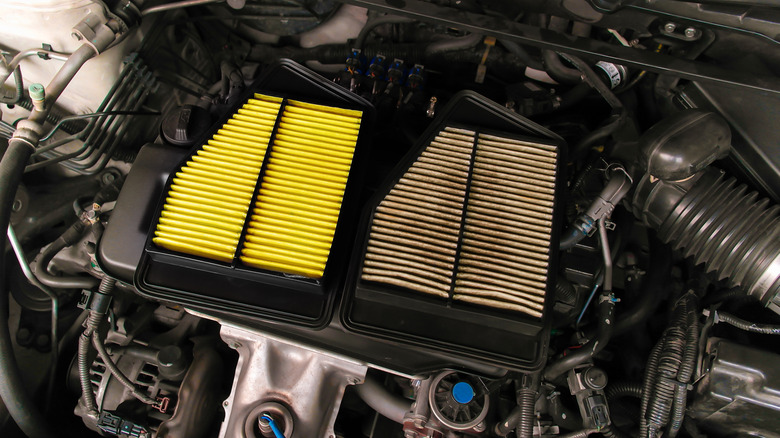
Beyond changing the oil, Ford also recommends replacing the spark plugs every 60,000 miles, as well as inspecting and lubricating the U-joints and axles when servicing vehicles that frequently tow. On the other hand, Ram insists on rotating the tires and replacing the evaporative system's fresh air filter when applicable, along with inspecting other components like the brake pads, cooling system hoses, and exhaust system. Replacing air filters more frequently is a must for vehicles that undergo heavy commercial use, prolonged idling, or low-speed driving.
Vehicles like the 2021 Honda Civic have displays for the oil life percentage and other maintenance-reliant items. The items are displayed as codes and may include tire rotations, spark plug replacements, and brake fluid changes, among others. The point is, alongside oil changes, you'll have to perform more extra maintenance more often if you do a lot of towing, hauling, or hard driving. Of course, your car or truck's servicing requirements will vary, so it's better to refer to the owner's manual.