

How To Tell When Your Harmonic Balancer's Gone Bad
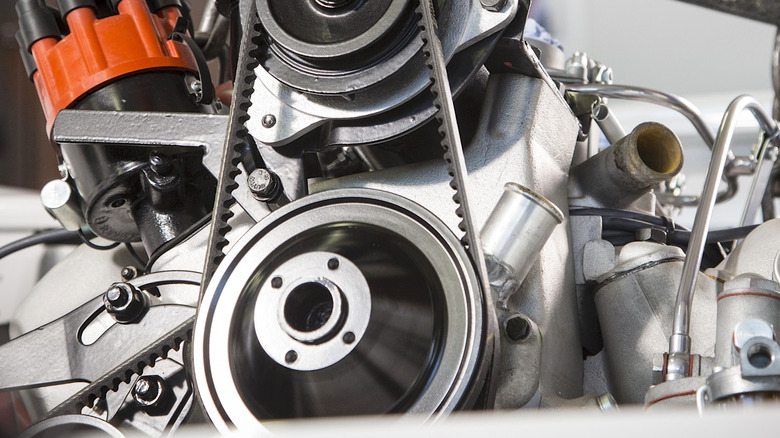
There's an awful lot of spinning and vibration going on when a car's engine is running. Not only is it due to the crankshaft being spun by the pistons as they travel up and down during their strokes, but there are lots of other various parts moving as they do their duties. One of the pieces in the engine that does the most moving is the timing belt or chain, which spins the camshaft(s) in perfect time with the crankshaft to ensure proper intake and exhaust valve timing. But then, there's also the accessories attached to the front of the engine, including the idler and tensioner pulleys that ensure they're spinning in the right direction, and at peak efficiency.
The harmonic balancer soaks up these vibrations and ensures the engine runs as smoothly and efficiently as possible. It's an essential part of the engine, and in some cases, requires replacement after a certain amount of miles, so be sure to read up on your manufacturer's recommended service schedule. Not replacing it when it's due can cause a myriad of issues, but how can you tell when your harmonic balancer's gone bad? It all comes down to examining its appearance, determining whether it's spinning true, and if it's making any funny noises or vibrations — all key signs telling you when your harmonic balancer's gone bad.
The harmonic balancer's construction and role
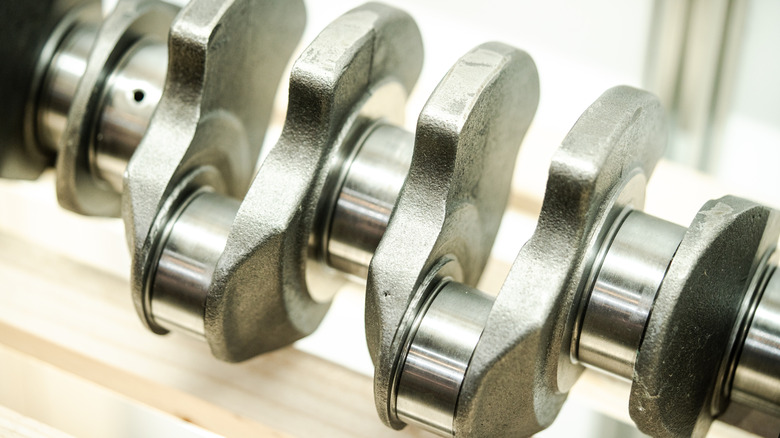
With such tremendous spinning and force on the crankshaft comes tremendous vibration. No matter how balanced the engine is — whether straight-six, V8, or V12 — the crankshaft experiences an immense amount of force being applied to it at thousands of revolutions per minute. All this movement must be dampened to prevent it from being brutalized, which is where the harmonic balancer comes into play.
The harmonic balancer — also known as a vibration dampener or crankshaft damper — is commonly made of thick steel and rubber. Where it bolts up to the crankshaft is metal, as is its outer construction, and somewhere in the middle is often rubber. Additionally, some types are filled with silicone fluid, such as in a fluid damper, to turn the crankshaft's torsional vibrations into heat.
If you've ever replaced a harmonic balancer, you may notice that it's very heavy for its size. That's so that it absorbs and neutralizes harmful vibrations,and its weight, size, and design are specified by the automaker for the particular engine it's bolted up to. The harmonic balancer goes several steps further, too. It's used for engine timing by having a mark to show where top dead center is, which is crucial information when replacing a timing belt or chain. Then, it's often what spins the accessory drive belts to spin the water pump, alternator, power steering pump, and more.
When is it time to replace the harmonic balancer?
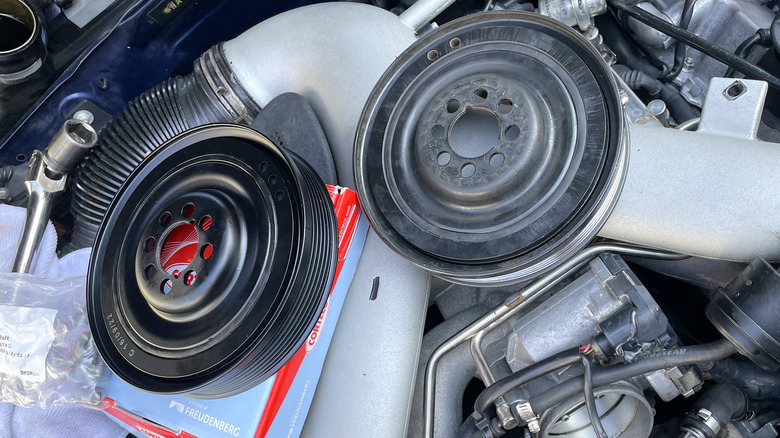
Harmonic balancers often last the life of the engine, but there's always a chance that they'll wear out earlier. It's especially possible if an oil leak on the front of the engine goes unchecked — oil and rubber don't go well together, as oil can deteriorate the latter over time. Balancers can also crack, rust, and even break apart. This can result in a balancer that no longer spins truly, or one that disintegrates. Deterioration will result in excessive vibration being left unchecked, which can cause long-term damage to the crankshaft and other internal engine components.
A quick look at the belt system can clue one in on the harmonic balancer's health. Is it (or, are they) running straight and true? Any excessive vibration or movement could mean it's on its way out. Then, there might be a noise present, such as a rattling, knocking, or squealing. The balancer itself may exhibit cracks, major rust patches, and even separation between its rubber and metal layers, or even leaking silicone fluid if it's a fluid damper.
In my experience with a personal car, the serpentine belt wasn't running as true as it could, and upon removing the balancer, it indeed looked worse for wear. Shout-out to the previous owner(s) who kept the front of the engine caked in engine oil for seemingly most of its life. By the way, it's worth mentioning that harmonic balancers can be on the pricier side for such a seemingly simple part.