

Do Classic Cars Need Specific Kinds Of Oil?

The answer to whether classic cars need special lubricants is a resounding yes — and no. For starters, modern lubricants have undergone standardized changes over the years and have almost zero similarities to engine oil from the 1930s or 1960s. Vintage-blend motor oil typically contains higher levels of zinc additives (zinc dialkyldithiophosphate or ZDDP, to be exact) to combat wear and tear. Zinc is a necessary ingredient that coats metal parts with a protective lubricant to prevent or reduce friction in moving parts. The engines of classic cars have high-friction parts like flat tappet camshafts and lifters that rely on heavy lubrication to minimize wear, thus making zinc a necessary ingredient of motor oils back then.
However, higher zinc content in motor oil has drawbacks, too. When it heats and forms a shield of lubricant inside the engine, it produces phosphorus, which could damage the catalytic converter. This has led to zinc taking a back seat through succeeding generations of engine oil, even though it's still quite common today. So, yes, the oil needed by classic cars is different from modern-day oil — but you can get away with using something that wasn't specifically designed for those models.
On an additional note, the oil change schedules are quite different, too. Vintage classics that rarely get driven should have mandatory oil changes every 3,000 miles or each year (modern oils enable newer cars to go longer than that) with oil that conforms to the manufacturer's recommended viscosity. Don't forget that oil can go bad even when just sitting in the oil pan for weeks or months on end, so annual oil changes at a minimum are the prerequisite for classic cars.
An oil expert offers a different perspective
You might not have heard of Lake Speed, Jr., an industry-renowned lubricants expert with a NASCAR background (also the son of former NASCAR driver Lake Speed). He's also the founder of the SPEEDiagnostix testing laboratory and one of the brains behind Driven Racing Oils. Apart from having one of the coolest names in the industry, Speed has a genuine passion for motor oils and lubricants that he shares with more than 300,000 subscribers on his YouTube channel, in which he mentions that classic cars do not need special oil. In the video above, Speed explains that oils had zinc levels of around 1,000 parts per million (ppm) in 1996, but the API SM specification introduced in 2004 limited ZDDP levels to 800 ppm, wreaking havoc on flat tappet camshafts.
To compensate, API SM and SN grade oils were infused with higher levels of calcium additives to improve the detergency and acid-neutralizing properties of the oil. Then again, it was later discovered that calcium can break down the protective ZDDP shield in an engine's moving parts. That's why the later API SP category has lower doses of calcium. In addition, API SP motor oil has brought back more ZDDP and some molybdenum-based additives for better wear protection, while higher infusions of magnesium keep the oil fresh to deliver longer drain intervals.
By taking all of this into account, your classic car probably won't actually need a "special" type of oil. It just needs to conform to the latest API specifications — either that, or you should avoid moving too far away from the specifications of its time. Of course, adhering to the recommended viscosity is equally important, so keep all of these in mind when servicing your timeless vintage car.
Conventional or synthetic oil: Which is best for my classic car?
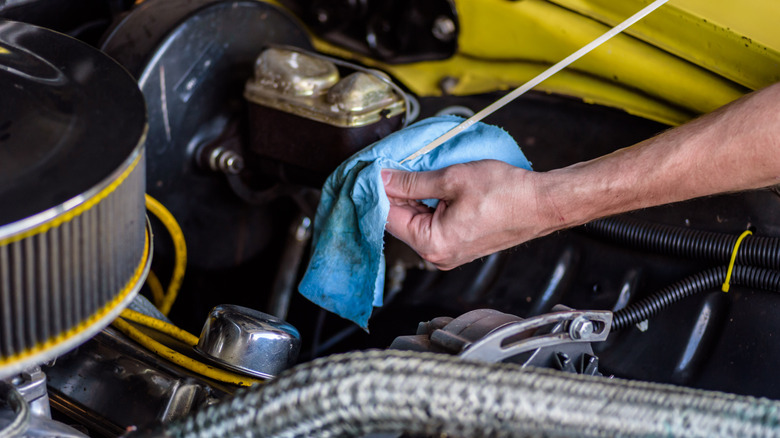
Classic cars can survive on a diet of synthetic oils and take advantage of the longer service life and advanced detergency they bring. Issues with leaks occurring after using synthetic oil in older engines mostly have to do with worn-out seals and gaskets rather than the thin viscosity and lubricity of synthetic oils. Their potent detergency can dissolve thick sludge wedged between worn seals, causing leaks and making it seem like the oils aren't compatible with the vehicle.
If the engine is already leaking and is not yet scheduled for a costly rebuild, it's best that you stick to conventional oil. On the other hand, freshly-rebuilt vintage car engines can safely use synthetic oil. The gist is to stick with conventional oil if that's what the engine has been using over the years. Otherwise, switching to synthetic oil will surely benefit your classic motor and keep it humming reliably for longer.