

Why Are Desmodromic Valvetrains So Rare In Engines?
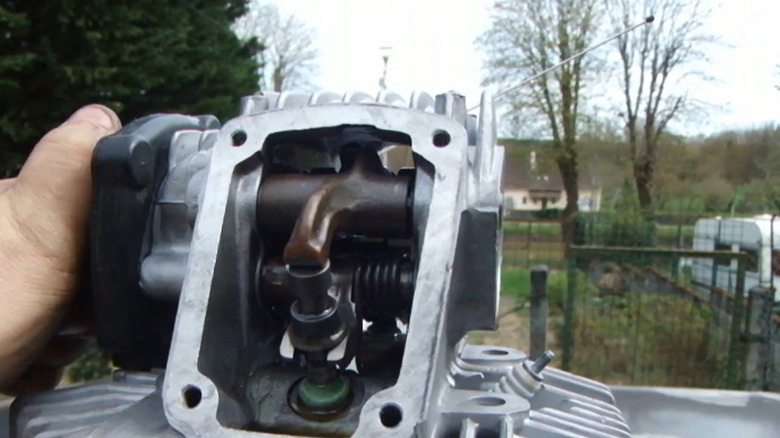
An internal combustion engine, at its core, is similar to a giant air pump. To produce power, it sucks in fresh air and fuel, compresses that mixture, and then explodes it, before expelling the burnt mixture out of the exhaust. Standard internal combustion engines use a camshaft overhead to push the valve open against a heavy metal spring. Once the cam lobe rotates upward, this compressed spring slams the valve shut. It's a simple, effective system that has powered everything from a lawnmower to a hypercar.
However, back in the 20th century, engineers had to figure out a peculiar problem known as valve float. As engine rpm climbed higher to liberate more power, metal springs simply could not rebound fast enough. The camshaft would try to open the valve again before the spring had even finished closing it. This phenomenon could cause power loss and catastrophic engine failure in some cases. To fix this, engineers looked at the concept of Desmodromic valve control. They found success with this method, but it isn't as widespread today due to being loud and more complicated, making development and maintenance very expensive.
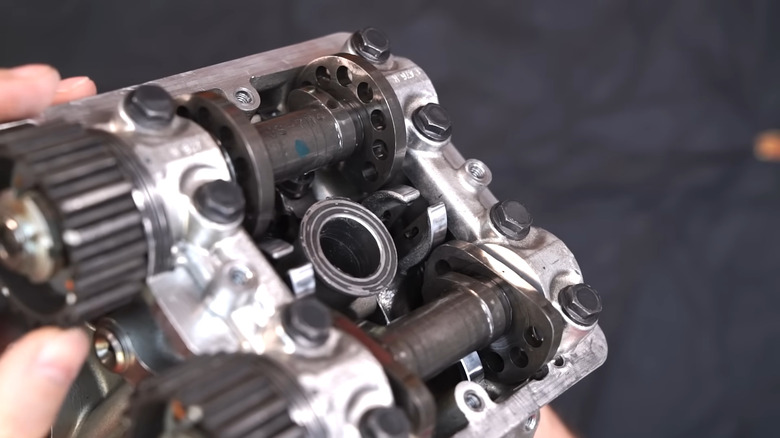
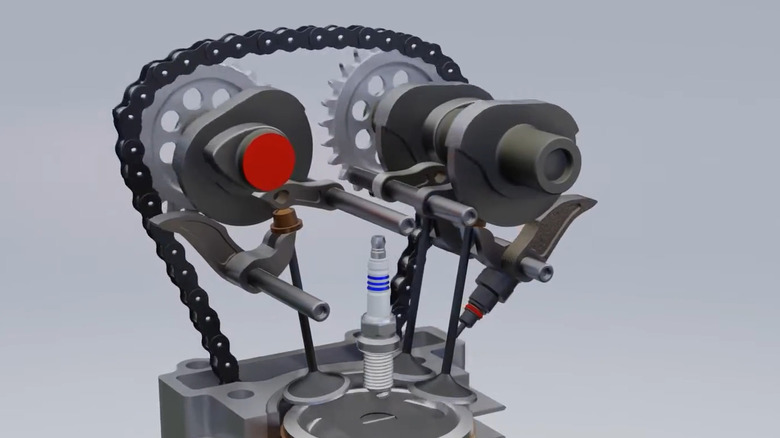
Desmodromic comes from the Greek words "Desmos" (bond) and "Dromos" (track). The idea behind the desmodromic valve system was to eliminate the unpredictable nature of springs by utilizing a mechanical track. A desmodromic valvetrain does not use springs; instead, it uses a camshaft with two distinct lobes per valve. One lobe forces the valve to open while a second lobe pushes on a dedicated rocker arm that mechanically pulls the valve back up to close it. This means the movement of the valve is controlled in both directions, tracking the rotational position of the camshaft with absolute mechanical precision.
From Grand Prix to motorcycle royalty
While the desmodromic valvetrain is mostly just found in Ducati motorcycles today, the Italian bikemaker did not invent the technology. The concept of positive valve actuation was conceived as early as 1896 by Gustav Mees. Back then, the desmodromic valvetrain could be found in early four-wheeled race cars. The most legendary four-wheeled application belongs to the 1954 Mercedes-Benz Silver Arrow, which absolutely crushed Formula 1 in the mid-1950s with a 2.5-liter eight-cylinder engine boasting desmodromic valves. Mercedes-Benz followed it up with the breathtaking 1955 300 SLR sports racer, which revved to limits that were unachievable by a standard spring-valved motor of the times.
Seeing the sheer race-winning potential of eliminating valve float, an ambitious engineer at Ducati named Fabio Taglioni decided to move from the terrible valve spring setup of the era. In 1956, he developed a brilliant desmodromic valvetrain for the Ducati 125 Grand Prix motorcycle. The bike was an absolute rocket for its size, safely revving up to 13,000 rpm by forcing the valves to work as they should while hardly losing any energy. This marked the definitive moment when desmodromic valvetrain technology fused itself into Ducati's DNA.
While racecars of that era briefly flirted with desmodromic technology, Ducati wholly embraced it and made it synonymous with the brand. Its modern lineup is moving away from desmodromic valve technology, but there are still motorcycles like the Panigale V4 (with 210 horsepower), the Desmo450 MX, and the Hypermotard, which employ the famed tech. (You can also check out a breakdown of what makes Ducati's V4 engine so good.) But you won't find this valvetrain in more types of vehicles in the modern era, as the performance boosts didn't outweigh the downsides for auto manufacturers.
The cost of perfection: how the desmodromic valvetrain's genius holds it back
If desmodromic valves offer high-rpm dependability and prevent valve float, why didn't more manufacturers adopt this tech? The answer boils down to basic manufacturing economics, engineering priorities, and the evolution of metallurgy. For a mass-produced car, a desmodromic valvetrain is a massive engineering headache. Every single valve requires an opening lobe, a closing lobe, and multiple rocker arms. This high number of parts makes cylinder heads incredibly complex, heavy, and expensive to manufacture. Also, cars generally operate at much lower rpm ranges than high-performance motorcycles; the expensive remedy to high-rpm float is a cure that a typical commuter car never needed.
Traditional desmodromic valve setups also require plenty of service. They have double the amount of shims as a standard engine, which means high maintenance costs. Also, without the dampening elasticity of a valve spring, the mechanical contact of forcing a valve to close (and open) creates intense noise and vibrations. This raw, aggressive clatter might sound like mechanical music on a Ducati, but in any other commuter-focused vehicle, the same noise would be shunned by people looking for a refined and comfortable daily drive.
In modern times, advanced pneumatic valve springs are used in Formula 1, and high-quality steel alloy valve springs are used in production sports cars. These allow standard high-performance engines to rev comfortably past 10,000 rpm without breaking a sweat. The problem that desmodromic valves set out to solve isn't a problem anymore (like this weird Ducati from the 1990s), yet Ducati still sticks with it as a tradition — and a badge of honor.