

The Difference Between Efficiency And Miles Per Gallon
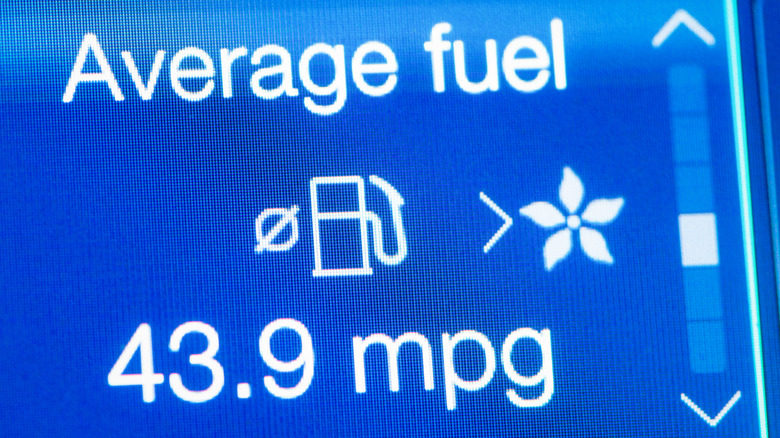
Gas prices are soaring, and saving money on fuel is increasingly important to many drivers. Given a choice between the most fuel-efficient car, or the car with the best gas mileage, many car shoppers might simply shrug "yes," figuring they're the same thing. That's because we're accustomed to thinking of fuel economy — miles per gallon — as totally synonymous with fuel efficiency. You can search for either term and end up with basically the same answers.
From an engineering standpoint, they're related, but they're different concepts. Fuel economy is a number on a window sticker that tells us how far a gallon of gas should take us, at least according to Environmental Protection Agency (EPA) tests that simulate city and highway conditions, speeds, temperatures, and air conditioning use. If you want to spend less on gas, economy figures loom large.
Fuel efficiency, on the other hand, is another way of saying what percentage of the fuel burned is powering the wheels. Very efficient road cars might only harness around 30% of the energy in the fuel they consume to move you down the highway, according to the U.S. Department of Energy (DOE). The rest of it is drained by things like thermal loss as exhaust heat, and powering accessories. Put another way, 70% of the gas you buy could be getting you nowhere.
The thing is, higher efficiency doesn't always mean higher fuel economy — and improving fuel economy across the automotive spectrum requires some counterintuitive dynamics.
Efficiency gains and fuel consumption
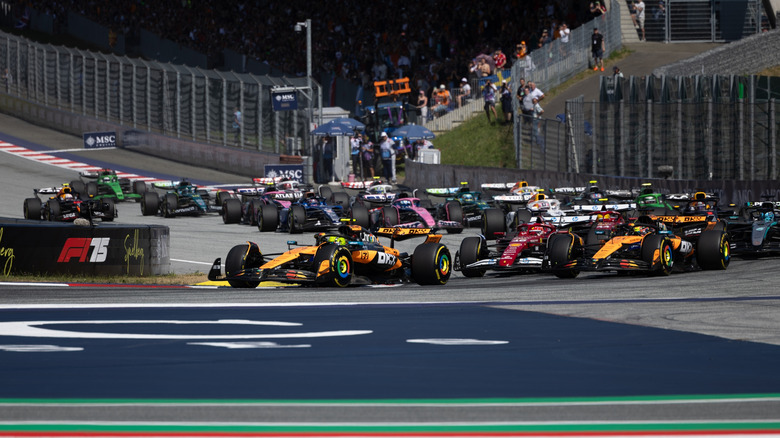
At the extreme end of the equation, a Formula 1 car can convert half its fuel energy into propulsion, making it very efficient at extracting energy from fuel, and minimizing thermal loss. But, being a race car, it may only achieve 7 mpg, and need to use every drop of its allowance during a race. It maximizes fuel usage, relative to a road car that can crank out 35 mpg all day long.
Large SUV engines can be just as efficient those in smaller cars, but their mass robs them of fuel economy, hence they consume more fuel. In the real world, from a fuel consumption perspective, a 5 mpg increase would seem to yield the same fuel savings, no matter which car you apply it to. But, that's not the case. Over the course of 1,000 miles, bumping a car from 20 to 25 mpg saves 10 gallons of fuel, while getting a car from 40 to 45 mpg saves roughly three gallons.
Gaudy mpg numbers can trick us into fixating upon further decreasing consumption at the higher end of the spectrum. A car that gets an astonishing 100 mpg over the course of 100,000 miles would use 1,500 fewer gallons of gas than a car that gets 40 mpg. But getting a 15 mpg car to hit 25 mpg would conserve over 2,600 gallons. This is why it's so important to boost the fuel economy of the vehicles at the lower end of the spectrum.
Gallons per mile versus miles per gallon
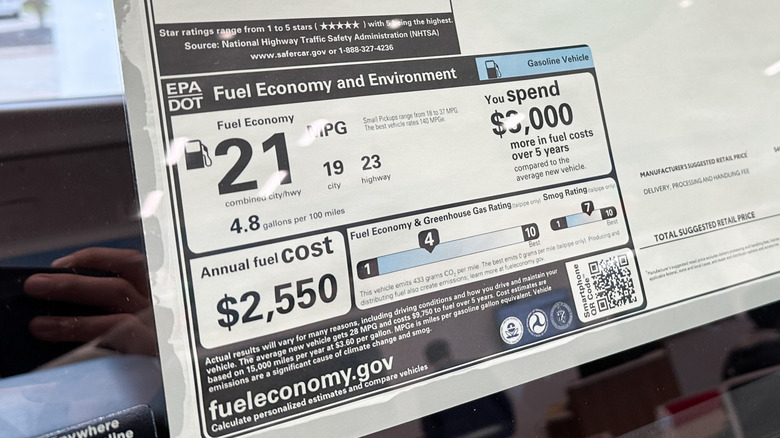
Does that mean we should all start driving cars that get lower gas mileage to conserve gas? Hell no! It's just another way to think about how economical your car is — and you'll find a shortcut on the window sticker.
Thinking in terms of consumption first, rather than mileage, flips the script. Though it seems like a subtle bit of wordplay, the emphasis on gallons per mile can help us better visualize how much fuel we're actually buying and using — which is really what we want to know when we ask about mpg. It reflects the actual energy used to move the vehicle. This is why window stickers feature estimated fuel costs, along with a consumption ratio that makes it easy to compare different vehicles, because it's rendered in gallons per 100 miles.
For example, say you're considering an SUV that gets 13 mpg and takes 7.7 gallons to travel 100 miles, or a minivan that gets 36 mpg and takes 2.5 gallons to go 100 miles. It's obvious which one will cost less at the pump, but you don't need a calculator to look at those figures and easily compute how much less the minivan will save you — roughly $20 for every 100 miles you drive, at today's prices. Of course, if you're just looking for the most efficient way to get around, we've done the math for you.