

Hypercars Are Boring, Why Not Drive A 1960s Race Car Remake Instead?
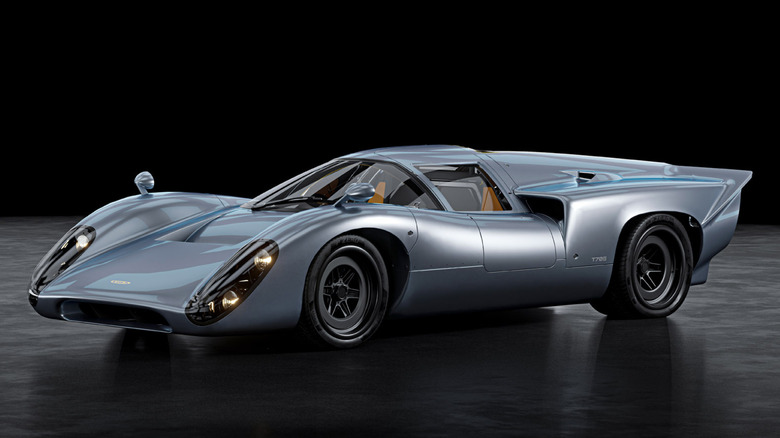
When you drive around in a modern hypercar, you look like a moneyed dork. You really can't help it. They're big and heavy and powerful, but their only party trick is going fast and maybe sounding cool. But if you drive a new Lola T70S instead, you can feel all the sensations that a racer in the heady days of 1960s American motorsport might have felt. You can pretend you're Mark Donohue crossing the finish line to win the 1969 24 Hours of Daytona, or that you're dominating the 1966 SCCA Canadian American Challenge Cup (Can-Am). This is bare-bones speed, not quiet luxury. You get an aluminum chassis and a big American V8. No frills, because you don't need them.
Lola, the company known for building race cars and winning races for decades, is building a run of street-legal race cars to celebrate the 60th anniversary of the T70's Can-Am success. Available in both a competition specification, created specifically for use in vintage racing programs, and a street-legal track-day spec, the new T70S is the driver-focused lightweight powermonster it always has been. With a car like this, you would stick out in traffic much more effectively than you would driving anything Ferrari or Lamborghini have built in the last twenty years. The gorgeous swooping 1960s design is incredibly anachronistic today, adding to the unexpectedness.
Just 16 examples of the new T70S will be built, each to the exacting specifications of its new owner. Whether you choose the race car version or the road car, both will be powered by a 530-horsepower small-block Chevrolet 5.0-liter V8 and backed by a Hewland 'dog-box' transaxle. Unlike the original's fiberglass bodywork, the new T70S will make use of a carbon-neutral composite called Lola Natural Composite System, which combines natural plant fibers with a new natural resin created from sugar cane byproduct. Sounds tasty.
The coolest part of this car, at least the street car, is that Lola developed a shift-by-wire system that allows the driver to use an H-pattern gearbox to tell the sequential gearbox where it should be. I am interested in seeing how that system works. There is still a conventional manually-operated clutch, but the actual shifting will be handled by computer to make sure inexperienced human drivers don't accidentally muck it up.
Just like the old days
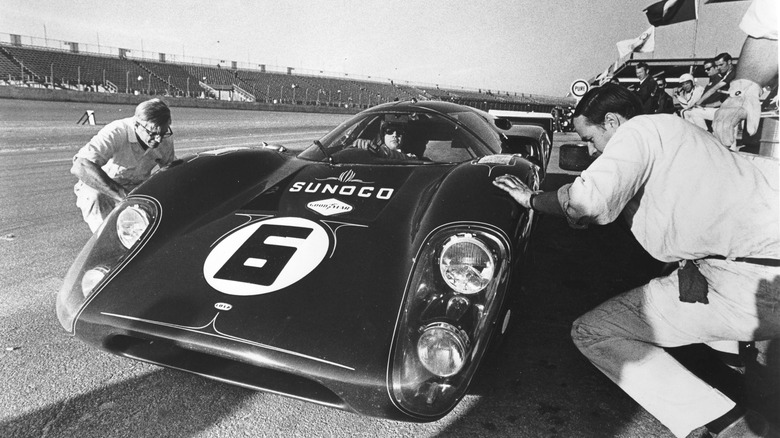
Driving the new T70S is a throwback to racing's golden era. You can hop inside this thing and immediately be transported back to Eric Broadley's original vision, sitting in one of the most iconic racing cars of all time. "The hairs on the back of my neck stood up, to hear that roar from the V8 sitting right behind you is something that always gets your emotions going," said veteran racer Johnny Herbert, after driving the original David Piper Mk3B.
Till Bechtolsheimer, Chairman of Lola Cars, had this to say about the company's return to its glory days: "The T70 is not only one of Lola's greatest designs, but one of the most iconic racing cars ever built. With the T70S, we are delivering a car identical to the original fire-spitting, Steve McQueen-era, V8 monster, but refined with advanced manufacturing processes, sustainable materials, and an unparalleled attention to detail."
According to Lola's website, the racing version of the new T70S will feature a 305-cubic inch version of Chevrolet's small block V8, though instead of the original's octet of carburetor throats, this 7,300 RPM small block will apparently feature direct fuel injection. If you order the street-legal T70S GT model, however, you're getting a 6.2-liter V8 making 500 horsepower. That street-focused car is fitted with a few creature comforts to make it livable in town, like air conditioning and a stereo, but it barely tips the scales with a dry weight of just 1,965 pounds, so it's going to be a handful in ways modern hypercars with three times as much power just aren't. Expect a top speed over 200 miles per hour and a run from zero to 60 mph in under 3 seconds.
There's no word yet on how much one of these new machines is going to cost (a 2006 Lola sold at auction late last year for $305,000 while a 1976 T70 had the hammer fall at $450,000), but you can bet that it won't be cheap. This style of nostalgia is valuable in 2026, as it reminds people of a time when racing was still viewed not just as a pastime, but as a source of street car innovation.
While Lola went bankrupt and disappeared for a while, the company was revived in 2022 as the new owners bought up not just the rights to the name, but the full archive of technical drawings. Lola hopes to return to its onetime seat as the leader in motorsport chassis design and engineering, which is a pretty long row to hoe. Lola, as it is, currently competes in Formula E alongside Yamaha.