

The Science Trick That Can Cool A Scorching Hot Car Interior In Seconds

We may receive a commission on purchases made from links.
It's never fun to enter a scorching car interior after parking in the sun. It doesn't take long for your car to turn into an oven after you get out and shut the door. Cabin temperatures could rise to 109 degrees Fahrenheit in just 20 minutes when it's only 80 degrees outside. After 40 minutes, it can hit 118, and after an hour an extremely hot 123 degrees.
For context, Ecostress maps from the NASA Jet Propulsion Laboratory show that asphalt and concrete pavements in Phoenix can register a similar 120 degrees during the hottest parts of the day. That's hot enough to give your skin second-degree burns.
Unless carmakers find ways to combat heat with thermal-reflective paint, there's almost no escaping the sun's rays when your car is parked outdoors. However, you can do something to minimize your discomfort upon getting in. And what better way to do it than by using some scientific wisdom from a social-media personality with a PhD in fluid dynamics who teaches math at the University of Cambridge.
Professor Hannah Fry suggests that instead of turning on the AC at full blast, you can cool down a hot interior more quickly by cranking down a passenger-side window, then rapidly closing and opening a driver's side door a couple of times. Doing so draws the hot air outward and creates a low-pressure or vacuum zone that draws in fresher air from the open window.
Science to the rescue
Professor Fry does warn that repeatedly opening and closing a car door on a hot summer day might draw some weird stares from passersby. Of course, that won't worry you, since you have fluid dynamics and the principle of bulk flow at your disposal.
Then again, whether this works will depend on the ambient temperature, since the cooling effect will be almost imperceptible if the outside air is just as hot as the air inside the cabin. Moreover, it's not just about the air, since the interior surfaces of your vehicle can get incredibly hot thanks to the greenhouse effect. The sun's rays strike your vehicle as shortwave radiation that has no problem penetrating through glass and metal. The resulting heat gets absorbed easily by the dashboard, steering wheel, and everything else inside the car. When those things get hot, they emit long-wave radiation that can't escape the cabin, superheating it.
Fry's scientific method is still worth a try. In some cases, though, it might take more than three or four pumps of the driver's door to cool the cabin.
How about cracking a window slightly open?
You may have heard the age-old advice that cracking a window open while parked is the simplest way to keep the cabin cool. It does make sense, since doing so lets the heat buildup escape. And a 1981 study of heat stress in cars published by the American Academy of Pediatrics said that reducing a parked car's interior temperature significantly is possible if the windows are half-open (at least 7.9 inches).
But anything less won't help much, the study said. On a 97-degree day, a gap of just under 2 inches led to cabin temperatures exceeding 122 degrees Fahrenheit, which is toasty enough for the situation to turn dire quickly if children or pets are left inside. And a separate 2005 study in the National Library of Medicine said cracking the windows by 1.5 inches did nothing to cool a hot interior.
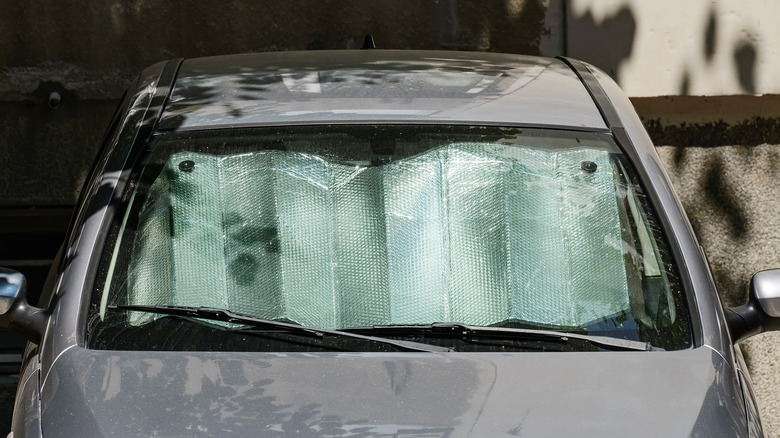
Instead of cracking windows, the Florida Solar Energy Center recommends using a radiant barrier system sunshade behind the front windshield. It said such shades can reduce the air temperature inside a car by 18 to 20 degrees and dashboard temperatures by 46 to 51 degrees.
Products like the EcoNour Windshield Sunshade or Big Ant Windshield Sun Shade are cheap, easy to use, and more practical (or safer) than leaving the windows open. Finally, these tips for keeping your car's A/C blowing cold will ensure you and your passengers won't have to deal with sweaty brows on those picturesque summer road trips.